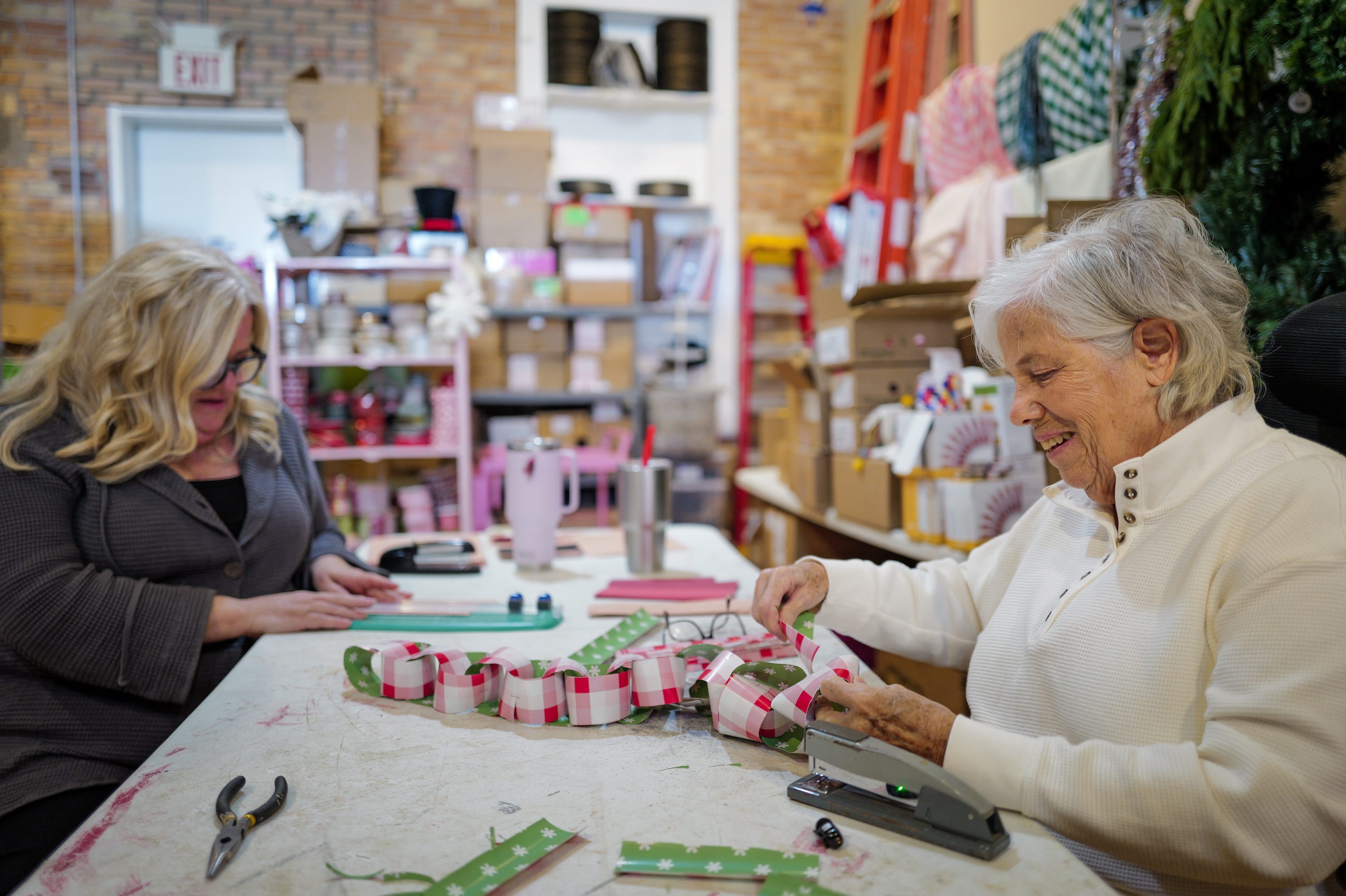
- Fran Herendeen, 84, was diagnosed with Alzheimer’s about three years ago after a spinal tap confirmed the disease.
- She has been treated with Leqembi at Memorial Healthcare Institute for Neuroscience in Owosso, one of 400 patients there.
- Her family credits “radical acceptance” and keeping her working at Twiggies boutique for mitigating her anxiety.
Warning signs appeared as Fran Herendeen slowed down and repeated stories in the wake of the COVID-19 pandemic. Her children initially attributed the changes to pandemic isolation rather than cognitive decline, Lansing State Journal reported.
“My mother was a very active person and still is to this day,” said Beth Herendeen, Fran’s daughter. “She’s always been a really quick critical thinker.”
Scott Herendeen, 57, Fran’s son, said his mother’s memory had always been the sharpest in the family, recalling names of his classmates from 30 years earlier. In 2023, he noticed she began telling him things more than once, unaware they had already spoken.
“She tried to overcompensate if she forgot something, saying, ‘Oh, I’m just so foggy today,’ or ‘I’m so stupid,’ and we were all like, ‘No, that’s not it, mom. That’s not it,’ and so then we pushed a little further,” Beth Herendeen said.
Further testing and a spinal tap confirmed Alzheimer’s disease. The diagnosis devastated Fran’s husband, DeWayne, who died at age 83 two years ago, and triggered depression and anxiety for Fran, according to Beth Herendeen.
Family builds routine around ‘radical acceptance’
The Herendeens adopted what Scott Herendeen calls “radical acceptance” — openly discussing the illness to erase stigma and keep Fran involved in decisions.

“The radical acceptance of this is where things are, and it makes it so that we can be more proactive and be involved,” Scott Herendeen said.
He began taking his mother to dinner every Saturday, a standing date he says reduces the unknowns that drive anxiety. “What’s most important to me is listening and being present with mom. And it doesn’t matter if I’ve heard a story multiple times before. I laugh as if it’s the first time I’ve heard it. Just to be present and enjoy each other’s company,” he said.
Beth Herendeen, who has lived with her mother since her father’s death, brings Fran to Twiggies, the boutique she owns in Old Town, whenever Fran wants to go. There is no fixed schedule. Fran staples decorative chains, interacts with staff, and travels with family in summer.
“There’s always something to do here,” Beth Herendeen said. “I think my big key takeaway is talking about it. Actually having those conversations. So many people shy away from that, and normalizing it in your conversations because it’s here, it’s real. Those are really important. It helps the patient to not feel so inadequate.”
Jennifer Reeder, senior director of education and social services at the Alzheimer’s Foundation of America, said involving patients in early-stage care decisions is important. Families should think of themselves as “care partners,” she said. “It looks different at every stage. It’s always about meeting the person where they’re at.” She called the Herendeens’ approach “certainly is a beautiful approach if it is working for the family.”
Leqembi treatment shows early stability
Fran Herendeen was treated with Leqembi (lecanemab) at Memorial Healthcare Institute for Neuroscience in Owosso. The clinic has treated 400 patients with the drug, Leahy said, against a backdrop of 200,000 people living with Alzheimer’s in Michigan. Not all mid-Michigan health systems offer the treatment.
McLaren Greater Lansing’s infusion center does not currently provide it, spokesperson David Jones said. University of Michigan Health-Sparrow has not dispensed it but would make it available if ordered by a neurologist for outpatient treatment only, spokesperson John Foren said.
The treatment requires infrastructure including scheduled MRI scans, which limits where it can be offered. Patients travel hours to Leahy’s clinic for infusions.
“It has not progressed,” Beth Herendeen said of her mother’s condition. “I know that our results are not what everybody experiences. My mother’s very lucky.”
“For our personal experience, it’s a Godsend,” Scott Herendeen said. “It’s a blessing.”
Fran Herendeen reported no side effects. “I feel like it’s going very well,” she said. “I don’t feel so sluggish. I feel better.” “She’s not isolated.”
Related reading
Thanksgiving Potato Guide: 10 Ways to Prepare Spuds in Idaho
Idaho cooks facing Thanksgiving dinner have ten potato preparations to choose from, the Idaho Statesman reported Wednesday. Mashed...

Columbia Banking System Raises Dividend 3%, Model Shows Undervaluation
Columbia Banking System raised its quarterly dividend 3% to $0.38 per share and maintains a $1.2 billion share-repurchase...

Indianapolis Startup Flexe Park Offers 48-Hour Grace Slips Instead of Tickets
The pale green slip Flexe Park monitors leave under windshield wipers instead of tickets says, "It looks like...

Kreiss-Tomkins, Johnson to Be Sworn In Dec. 7 in Sitka, Celebrate in Juneau
The JKT transition team announced Monday that Governor-elect Jonathan Kreiss-Tomkins and Lieutenant Governor-elect Zac Johnson will be sworn...