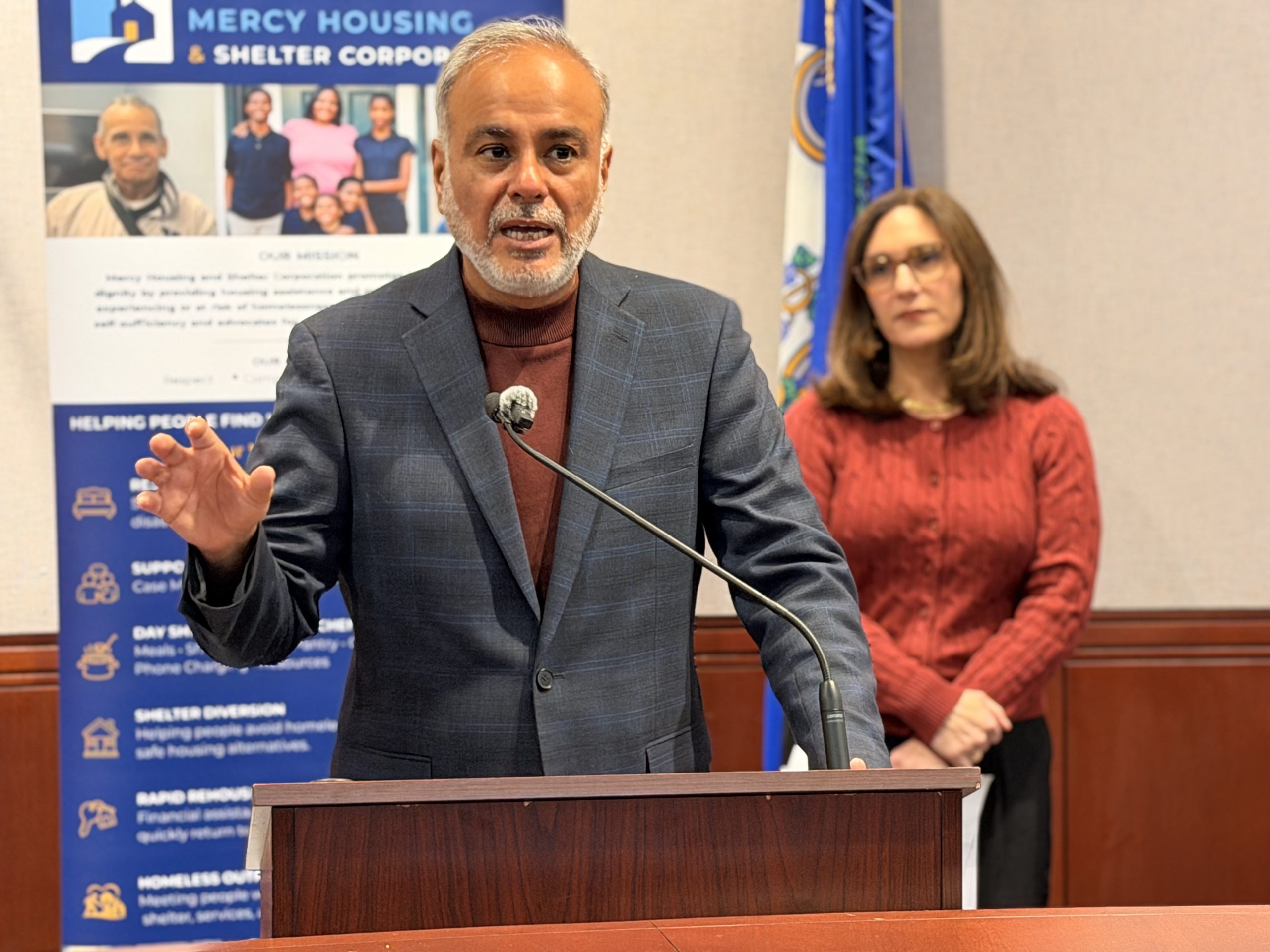
The numbers out of Hartford are staggering: 82 percent of unhoused people aged 53 and older screened in a new pilot study showed cognitive impairment, CT Mirror reported Thursday.
The study, conducted by Mercy Housing and Shelter Corporation at The Friendship Center in partnership with the University of Saint Joseph Nursing Practice Program, screened 72 people between 53 and 78 using the Montreal Cognitive Assessment. Twenty-six percent registered moderate to severe impairment; 56 percent showed mild impairment. Among those 62 and older, the rate climbed to 94 percent.
“This was flabbergasting for us, it was something that we knew but we certainly didn’t understand the full extent,” Kara Capone, CEO of Community Housing Advocates and Mercy Housing, said at a press conference Thursday.
The population is aging faster than the system
The findings land as Connecticut’s unhoused population grays rapidly. The state’s annual point-in-time count shows the number of people 65 or older experiencing homelessness jumped from 281 to 320 between 2025 and 2026. Since 2024, the elderly homeless population has increased by 51%.
Julian Pierce, deputy commissioner of the Connecticut Department of Housing, said cognitive impairment makes it much more difficult to navigate complex systems, manage healthcare needs, complete housing applications, keep appointments and ultimately achieve long-term housing stability.

Programs have historically been designed for younger working-age adults who probably don’t have these issues, Capone said. “We can’t expect that type of approach to work for everybody who is coming through our doors.”
Not just addiction — hypertension and diabetes drive decline
Sen. Saud Anwar, D-South Windsor, a physician, pushed back on the assumption that impairment among the unhoused stems primarily from substance use. The study only included people who were actively sober at the time of participation, Capone noted.
“Uncontrolled hypertension causes vascular impact on the blood flow to the brain. Diabetes uncontrolled can do the same thing,” Anwar said. “The sad part is, in ideal circumstances in a society, that individual would get the care and be able to be in a safe environment.”

Because so many participants showed mild impairment, Anwar warned those cases will likely progress to more severe decline over time. “Now we have numbers to show that this is a big deal, and we also have prediction models that tell us it’s going to be a far bigger deal,” he said.
“So today we are saying we are ready. Let’s start to work, ask more questions and work on the solutions.”
Screening, training and a legislative push
Capone said staff should be equipped to screen for cognitive impairments, especially for those 62 and older, and trained to respond once impairments are identified. Stronger partnerships are needed between homelessness service providers and healthcare agencies, along with supports to secure and maintain housing.
Rep. Laurie Sweet, D-Hamden, co-chair of the End Homelessness Caucus, said tenant protections must be passed to keep people housed and zoning changed to allow more housing to be built. “The End Homelessness Caucus is going to be putting forth a pretty big human rights bill,” during the 2027 legislative session, Sweet said.
Hartford, the state capital since 1875 and among the nation’s oldest cities, founded in 1635, now illustrates the crisis starkly: it has been one of the country’s poorest cities since 2015, with three out of ten families below the poverty threshold, even as the Greater Hartford metropolitan area ranks among the highest nationally in per capita income.
The study was conducted at The Friendship Center in this city of 121,054 residents as of the 2020 census.
Anwar said Connecticut’s relatively small population makes the challenge manageable if the state chooses to act.

Ravens Deactivate Marlon Humphrey for Week 11 After Podcast Comments
Baltimore Ravens cornerback Marlon Humphrey will sit out Sunday's game against the Carolina Panthers after the team sent...

Charleston’s First Four Seasons Hotel Breaks Ground, Projected 2030 Completion
Brad Cooke, an executive with Strategic Property Partners, stood on the vacant lot at 155 Meeting Street as...

Jeff Bzdawka Says Lifetime Award Represents Team Effort, Not Solo Work
Jeff Bzdawka accepted the Hotel Visionary Lifetime Achievement Award from Hospitality Technology on Thursday evening in Las Vegas,...

Atrium Health Rolls Out Visitor Restrictions, Mask Rule Starting Thursday
Atrium Health is rolling out temporary visitor restrictions across its hospitals starting Thursday, barring children ages 12 and...