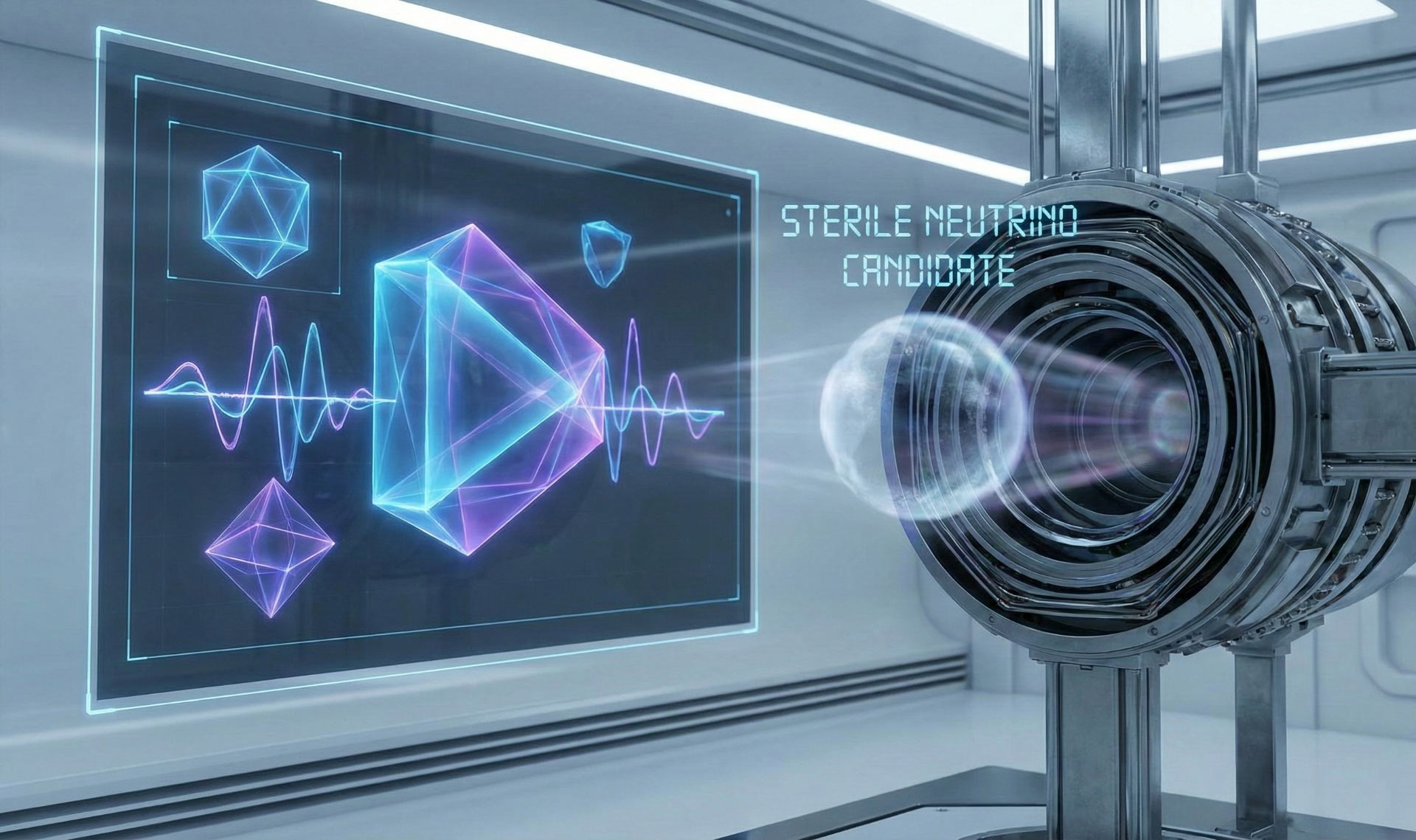
A single neutrino beam that knows its own flavor, energy, and travel distance for every particle could rewrite the search for sterile neutrinos, and a paper published Thursday in Physical Review Letters maps exactly how.
The study, led by Adrien Blanchet, César Jesús‑Valls and Animesh Chatterje, uses the proposed nuSCOPE facility at CERN as a benchmark to show that a tagged beamline can probe mass‑squared splittings across several orders of magnitude in one experiment — something conventional beams, limited by flux uncertainties, have never managed.
“Tagged neutrino beams, where the neutrino flavor, energy, and propagation distance are determined with exceptional event‑by‑event precision, provide a new experimental approach to search for non‑standard neutrino oscillations,” the authors write in the accepted letter. The technique simultaneously covers νμ disappearance, νμ→νe appearance and νe disappearance channels, turning a single run into a multi‑channel sterile‑neutrino hunt.
Why tagging changes the math
Conventional short‑baseline experiments — think LSND, MiniBooNE or the current SBN program at Fermilab — rely on predicting the unoscillated flux and comparing it to what arrives at the detector. A 10‑20 % flux uncertainty is typical, and it smears out the telltale L/E (distance over energy) wiggle that signals oscillations.
nuSCOPE sidesteps that by tagging each neutrino at birth. The concept builds on the ENUBET monitoring technique and the momentum‑tagging demonstrated by the NA62 experiment at CERN, where a positron from a kaon decay pins down the parent meson’s kinematics.
If you know the parent, you know the neutrino’s energy and flavor before it leaves the decay tunnel. The simulation pipeline described in the paper assumes a 400 GeV proton beam on target over roughly five years, with a static quadrupole‑dipole system focusing the secondary beam.
The payoff: sensitivity contours that barely flinch when flux normalization is floated, because the tag provides an internal calibration. The paper shows that nuSCOPE could exclude regions of the sterile parameter space motivated by the LSND and MiniBooNE anomalies while pushing into mass‑splitting territory — up to ~10 eV2 — that no current beam can reach.
The anomaly context
Sterile neutrinos have haunted particle physics for decades. The LSND experiment at Los Alamos saw a 3.8σ excess in νμ→νe appearance back in 2001; MiniBooNE later confirmed a low‑energy excess but with different systematics. Reactor experiments, meanwhile, reported a νe disappearance deficit. No single conventional beam can test appearance and disappearance simultaneously with the same flux, so the global fit has remained contradictory.
By delivering all three channels — νμ disappearance, νμ→νe appearance and νe disappearance — from one tagged source, nuSCOPE offers a “powerful internal consistency test that is difficult to achieve in conventional beam experiments,” the authors note. If a sterile signal appears in appearance but not in the matched disappearance channel, the tag tells you it’s not a flux artifact.
Caveats the authors flag
The study is a sensitivity projection, not a design report. No detector reconstruction or selection efficiency is folded in yet; the contours assume 90 % νe selection efficiency in the fiducial volume and zero background. Nuclear effects in neutrino‑nucleus interactions — modeled with GENIE and tuned to NA61/SHINE data — could still shift the predicted spectra. The authors explicitly leave full detector simulation and systematic error budgets to future work.
Even so, the conceptual leap is clear: tagging turns the beam itself into a precision instrument rather than a statistical source. If CERN approves nuSCOPE — currently a proposal, not a funded project — the first physics runs would not start before the mid‑2030s.
“The strong potential of tagged neutrino beams for precision oscillation physics is demonstrated,” the collaboration concludes, leaving the ball in the court of the European Strategy for Particle Physics update due in 2026.
Related reading
No. 1 Auburn Equestrian Visits No. 2 Georgia for Final Fall Meet
No. 1 Auburn equestrian travels to Bishop, Georgia on Friday for a 1 p.m. CT showdown with No....

Boston Children’s Museum Hiring Full-Time Exhibition Designer at $70,000 Salary
Boston Children's Museum is hiring a full-time Exhibition Designer at a salary of $70,000 to develop hands-on experiences...

Concord Academy Students Building Squash-Playing Robot to Expand Training Access
Concord Academy students are building a squash-playing robot named Squat that they hope will eventually give players real-time...

Booneville Man Pleads Guilty to Fentanyl Trafficking During Trial
John Dylan Bates, 30, of Booneville, pleaded guilty to drug trafficking charges Thursday after two days of trial...