
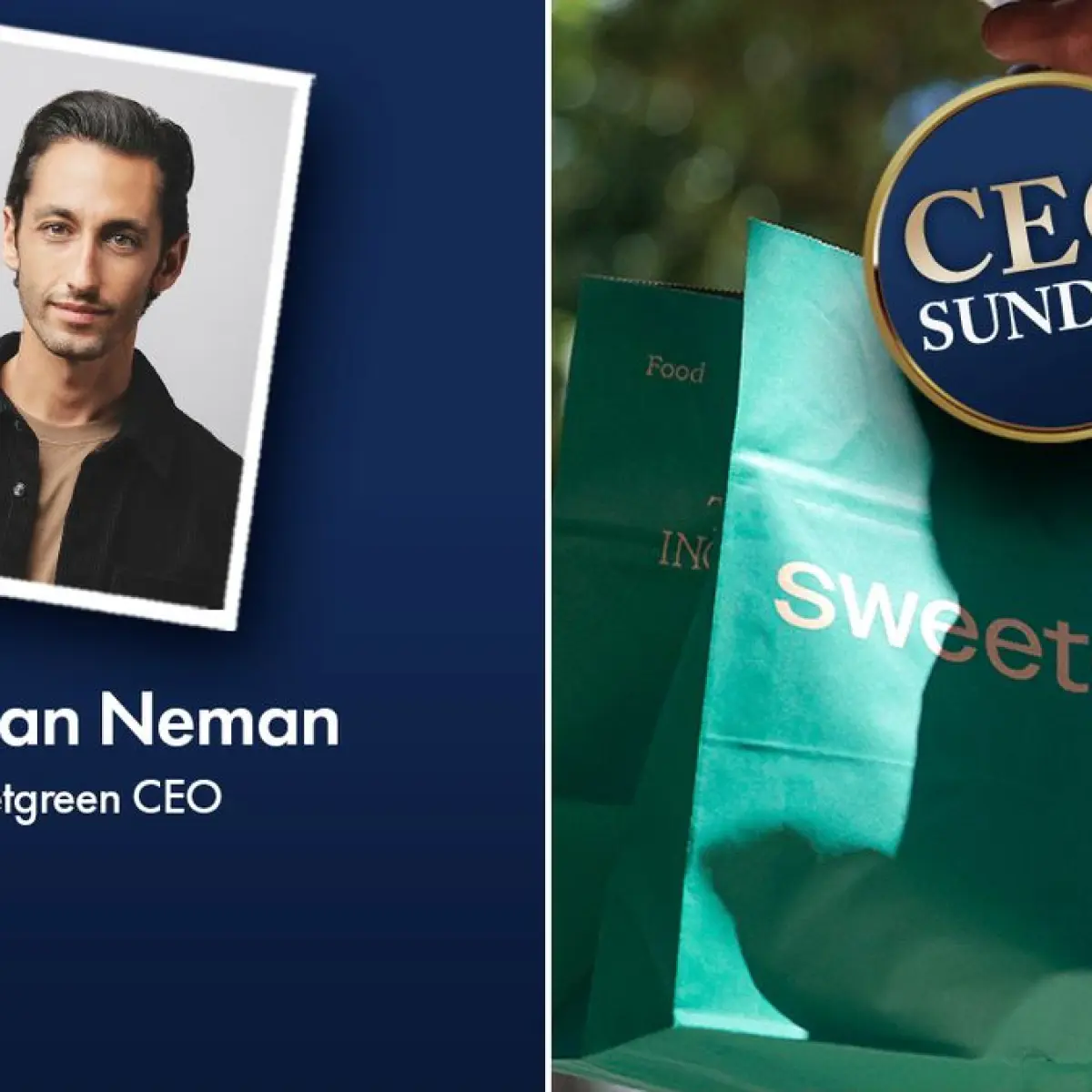
Sweetgreen CEO Jonathan Neman is pushing a pay structure that can lift top restaurant managers past $200,000 a year while adding wraps to a menu built on salads and bowls, moves he frames as proof that the American dream remains intact, Fox Business reported.
- Sweetgreen operates 290 locations with 6,486 employees, according to company figures cited by Fox Business.
- Top restaurant managers can now earn more than $200,000 annually under a new compensation plan.
- Neman’s Persian Jewish family fled Iran during the 1979 Islamic Revolution and rebuilt their lives in the U.S.
- The chain began in 2007 with a 500-square-foot former burger joint in Georgetown leased for under $3,000 a month.
Compensation push targets hospitality careers
The Los Angeles-based chain recently rolled out a compensation plan designed to create six-figure career tracks for store managers, a step Neman ties directly to his family’s immigrant experience. “Restaurants are one of the true engines of opportunity and growth in this country,” Neman told Fox Business. “I wanted to create that opportunity where we could incentivize and empower people to create great lives for themselves and truly be a win-win-win situation where they do great, they do great for their customers, they do great for themselves.”
Menu expansion adds wraps
Alongside the pay changes, Sweetgreen has introduced wraps to sit beside its established salads and bowls. The menu expansion and the compensation overhaul arrive together as the company courts both budget-conscious diners and workers seeking advancement.
Founding story rooted in youthful naivete
Neman and co-founders Nathaniel Ru and Nicolas Jammet launched Sweetgreen in 2007, months after graduating from college. Before signing a lease on a 500-square-foot former burger restaurant in Washington, D.C.’s Georgetown neighborhood for less than $3,000 a month, the trio counted foot traffic outside competitors including Chipotle and Subway, calculating they needed roughly 100 customers a day to make the model work.
“I think there’s something about when you start a business when you’re so young, there’s this naivete where, if I knew what I knew today about restaurants… I would have definitely never done this,” Neman told Fox Business.
“But the naivete of not knowing what I didn’t know, and that bright-eyed optimism around it… it allowed us to think differently.”
Starting with three roommates and almost no money removed the fear of financial ruin. “There’s this quote, ‘You can’t fall off the floor.’ … There’s no better time to start a business,” Neman said.
Leadership as service
Neman describes the CEO role as constant service to customers, employees and shareholders. “If I walk into a restaurant and I see a napkin on the floor, I’m picking it up, I’m wiping things down,” he told Fox Business. “Yes, in one way, you’re the boss, but I think great leaders are really in service to their customers, their team members and their investors.”
Immigrant roots shape CEO outlook on opportunity
Neman told Fox Business his Persian Jewish family fled Iran during the 1979 Islamic Revolution and rebuilt their lives in the United States, an experience he said strengthened his confidence in the country’s economic opportunities. “I think so many people don’t believe in the American dream today, and I think that’s misguided,” he said. “I think the American dream is alive and well.”
He described the hospitality industry as “one of the true engines of opportunity and growth in this country” and said the company’s compensation strategy reflects that philosophy by creating six-figure career paths for restaurant managers.
Founders counted on naivete and low overhead to launch
“There’s this quote, ‘You can’t fall off the floor.’ … There’s no better time to start a business,” Neman said, noting they already had three roommates and almost no money to lose.
He added that youthful naivete let them think differently: “If I knew what I knew today about restaurants… I would have definitely never done this,” but the optimism allowed them to pursue the idea anyway.
The chain launched its mobile app in 2015, adding real‑time order tracking and push notifications in May 2020 and its own in‑app delivery service in January 2020, which built a direct digital relationship with customers and supported pandemic‑era growth.
In May 2023, Sweetgreen opened its first robot‑driven Infinite Kitchen location in Naperville, Illinois, where automation handles bowl assembly; those pilot stores reported a 28% profit margin versus 18.1% for traditional units, validating a technology‑first operations strategy that enables scalable, consistent execution.
Simplicity as a scaling principle
Pointing to chains such as In-N-Out and Chick-fil-A, Neman argues that operational simplicity drives consistent execution at scale. “I think there’s a lot of value in simplicity,” he said. “Because execution is so important, if you look at so many of the great restaurant brands like the In-N-Outs and the Chick-fil-As, there’s that level of simplicity there that allows them to really focus on driving a consistent execution.”

American Eagle Jet Slides Off Wet Taxiway at Provo Airport; No Injuries
An American Eagle jet bound for Dallas‑Fort Worth was scheduled to leave Provo at 7:05 a.m. Saturday; instead...

Oregon Loses to Washington in Double OT on Missed PAT, Blocked FG
Instead, Gage Hurych missed his first career try off the left upright and then had his field goal...

Columbus to Honor 2026 Everyday Kindness Heroes at Dec. 2 Awards Ceremony
Five central Ohio residents will be honored as Everyday Kindness Heroes at a Dec. 2 ceremony in Columbus,...

Penn State Professor Proposes State Agency to Oversee Data Centers
"We are overbuilding these data centers, because this is not the next generation technology. This is just the...