
A major storm system is moving into the Canadian Maritimes after leaving more than 100,000 homes and businesses without power across the Northeast, NPR reported Saturday.
Nationwide, thousands of flights have already been delayed or canceled. Some regions face more snow, freezing rain and high winds.
The system produced a six-foot storm surge at Wachapreague, Virginia, and winds of 60 to 70 miles per hour from the Delmarva Peninsula to New York and New Jersey, according to meteorologist Matthew Cappucci. Nearly a foot of snow fell in southeast Missouri, giving St. Louis a white Thanksgiving. On the West Coast, they got the king tides and serious flooding.
El Niño link detailed
Cappucci, a senior meteorologist at MyRadar and The Washington Post, tied the coast-to-coast chaos to El Niño. The pattern has sent the subtropical jet stream “screaming west to east across the Gulf,” dumping 35 to 40 inches of rain this month along Florida’s Space and Treasure coasts, he said.
It picks up moisture and dumps it on Florida and the Southeast. Recently, there has been a ton of flooding in Florida. That is very El Niño-connected.
“That same moisture sometimes pinches off into low-pressure systems that ride up the East Coast,” Cappucci told Delaware Public Media.
West Coast king tides
In Pacifica, California, king tides damaged a pier and threatened homes, footage from ABC7 showed. “The El Niño-driven event is taking out part of the pier, with floodwaters threatening homes,” an unidentified reporter said in the broadcast aired by NPR. King tides forced evacuation.
Travel outlook for Sunday
A new system developing across the Southern Plains will bring high winds to Oklahoma, Kansas and North Texas Saturday night into Sunday, then push through the Mississippi Valley on the year’s busiest travel day. Crosswinds could affect airports in Chicago, Memphis, Nashville and New Orleans, though Cappucci said the system is “not nearly as intense as its predecessor.”
“Anyone flying through Chicago should keep an eye out,” Cappucci told Delaware Public Media.
Storm system pulls into Canadian Maritimes
The low-pressure center is “filling in” as it lifts into the Canadian Maritimes, Cappucci told Delaware Public Media, comparing the process to a swirling cup of coffee returning to equilibrium once stirring stops. He said the Northeast still faces lingering gusty winds that are starting to ease and snow beginning to melt across the central United States.
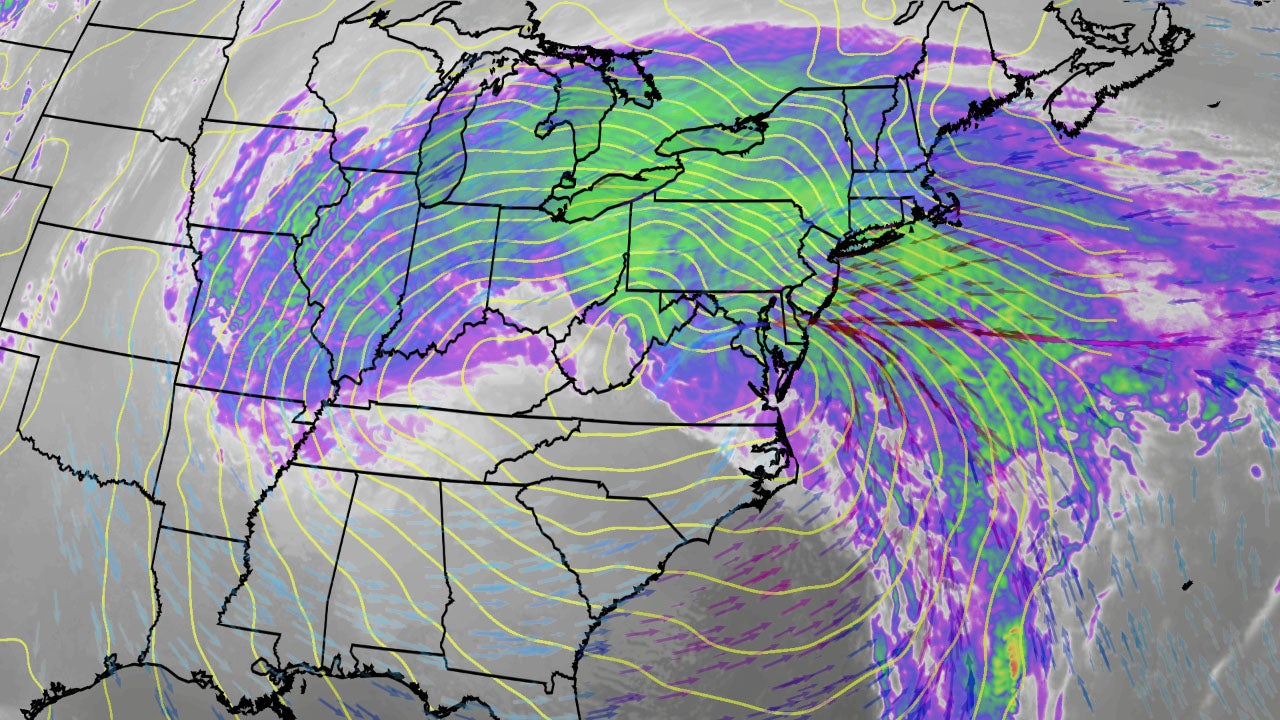
Ordinarily, wintertime storms pull in markedly colder air that increases vulnerability during outages, but this system drew in so much warm air that it is “really not that cold,” he told Delaware Public Media.
Next storm targets Southern Plains travel
By Monday into Tuesday, that storm reaches the East Coast, shifting the focus to the Deep South where strong winds and “maybe even a few tornadoes” are possible along the Gulf Coast next week, Cappucci told Delaware Public Media.
Next threat: Gulf Coast tornadoes
By Monday into Tuesday, the next storm reaches the East Coast. Cappucci said the focus then shifts to the Deep South, where strong winds and “maybe even a few tornadoes” are possible along the Gulf Coast next week.
As a senior meteorologist at MyRadar and a member of The Washington Post’s Capital Weather Gang, Matthew Cappucci provides expert analysis on major storms, such as linking this coast-to-coast chaos to El Niño. His career began in 2019 when he joined The Washington Post, where he had already written over 200 stories as a full-time meteorologist.
In 2021, he became a weekend meteorologist at WTTG-TV in Washington, D.C., and later that year started his current role as senior meteorologist at MyRadar, where he continues to break down complex weather patterns for national audiences.
Temperatures behind the departing Northeast storm remain unusually mild, reducing the danger for those still without power, he said. Ordinarily, when big storm systems like this occur in wintertime, temperatures drop markedly behind the system, increasing vulnerability for those with power outages. This time around, it is really not that cold because the system pulled in so much warm air.
Keep reading
- US Economic Data Week: Inflation Ticks Up, Jobs and Sentiment in Focus
- Magnitude 4.7 Quake Offshore Manhattan Beach; LAFD Surveys Infrastructure
- Virginia Beach Closes Boardwalk, Beaches After Storm Destroys Fishing Pier (world-today-news.com)
- Hall and Woodford's Nobel Rewards the Fed Talk That Moves Mortgages (daybreakwire.com)
US Economic Data Week: Inflation Ticks Up, Jobs and Sentiment in Focus
Stubbornly high inflation still shadows the U.S. economy as the year’s final major data drops arrive this week,...

Magnitude 4.7 Quake Offshore Manhattan Beach; LAFD Surveys Infrastructure
The temblor hit at 9:30 a.m. local time about three miles west-southwest of Manhattan Beach at a depth...

Marquez Beats San Fernando 21-20 for City Division II Title; Roosevelt Rallies for Division III Crown
Marquez High captured the City Section Division II football championship with a 21-20 victory over defending champion San...

Madison Keys Identifies Technical Changes in Coco Gauff’s Serve and Forehand for 2026
Madison Keys identified technical changes in Coco Gauff's serve and forehand during Sky Sports' review of the 2026...