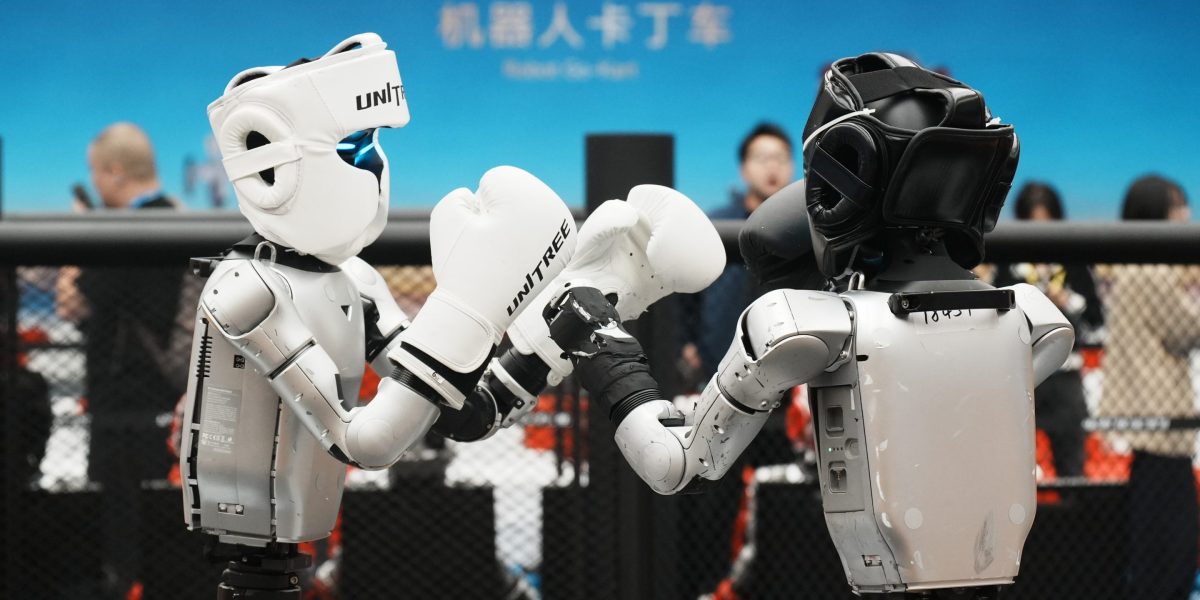
A robot called Tiangong Ultra ran 100 meters in 8.64 seconds at Beijing’s World Humanoid Robot Games in August, nearly a second faster than Usain Bolt’s world record, Fortune reported.
The same machine crashed into a padded barrier beyond the finish line, along with several rivals, illustrating what researchers call a jagged frontier: breathtaking progress on some physical skills, persistent failure on others. A year earlier, the winning time at the inaugural games was 21.5 seconds.
Four rooms, one moving frontier
The authors map robot adoption across four environments. Factories come first, with fixed layouts and repeatable motions. Warehouses are structured but busier. Commercial spaces such as supermarkets or hospitals are open to the public yet bounded and mapped. Homes come last — no two are alike, and objects are never where they should be.
From legs to hands
Figure, a California start-up, describes robot intelligence in four layers through its Helix 02 system. System 0 controls balance and stability; a single learned model of 10 million parameters replaced 109,504 lines of hand-written code. System 1 turns perception into action such as grasping an object. System 2 reasons and plans when the situation is unfamiliar.
System 0 has raced ahead, which is why robots can sprint. Better AI models, real-world training data and increasingly affordable computing power are pushing the frontier forward.
Early deployments, real data
Amazon deployed its one millionth robot in July 2025.
These are early milestones, not yet proof of industrial-scale economics. The challenge is moving from successful trials to reliable, large-scale deployment, particularly when handling unfamiliar objects and changing conditions.
The third room is opening now
Pudu says it has shipped more than 130,000 robots worldwide.
Figure chooses integration over outsourced intelligence
Figure has chosen integration.
China’s manufacturing ecosystem is driving hardware costs down at remarkable speed. Europe’s opening may lie in integration and fleet operations — the Novares pilot used Chinese hardware running French intelligence in a European factory. Who will own the data, and ultimately the customer, is wide open.
Rules are not ready
China published its first national standard framework for humanoid robots in February.
“When our consultants stepped outside the frontier, the cost was a flawed memo. When a robot does, it is a damaged shelf or an injured worker,” the authors wrote.
Worth a look

Lions’ Run Game Adjusts as Gibbs Reaches 1,000 Yards, 15 TDs in 10 Games
The Detroit Lions have won six straight games entering a Thanksgiving Day matchup with the Chicago Bears, fueled...

Ferrari’s Vasseur Warns Hamilton and Leclerc Clashes ‘Cannot Continue’ After Las Vegas Collision
"This cannot continue," Ferrari team principal Frederic Vasseur said after the Las Vegas Grand Prix on Sunday, delivering...
Baltic Kiss to Reopen as Baltic Lounge; Betty Reid Soskin Bound for California Hall of Fame; San Pablo Sets Measure R Priorities, Comments Extended on San Pablo Avenue Project; US Loses Measles Elimination Status
The former Baltic Kiss restaurant and music venue in Point Richmond will reopen as Baltic Lounge under new...

Shirley Ann Pagluica, Child Pianist and Court Conservator, Dies at 91
Shirley Ann Pagluica, a pianist who performed with the Boston Symphony Orchestra at age 12 and later served...