
The Trump administration is giving states until June 30, 2027, to fully enforce new Medicaid work requirements, pushing back a January 1 deadline that many states said they could not meet.
- CMS announced an optional six-month “hold harmless” period on Nov. 13, Politico reported.
- States must tell CMS by Dec. 11 whether they will participate.
- At least 10 states and Washington, D.C., have said they will opt in, according to Becker’s Hospital Review.
- Arizona has not decided; about 417,000 AHCCCS enrollees could be affected.
CMS offers grace period
The Centers for Medicare and Medicaid Services acknowledged “impediments to successful launches at scale, policy updates, operations, and overall readiness” in a Nov. 13 letter to state Medicaid directors. The optional hold harmless period lets states verify whether enrollees meet the work rules but suspend denials and disenrollments for those who cannot prove compliance until July 1, 2027, KFF reported. States must still work toward full compliance during the six months.
“The optional hold harmless transition period gives states the ability to improve and refine their systems and processes before enforcement begins, supporting long-term success of the work requirement,” a CMS news release said, according to The Gleaner.
Arizona weighs options
Arizona’s Medicaid agency, the Arizona Health Care Cost Containment System, has not decided whether to accept the reprieve. In a statement Monday, an AHCCCS spokesperson said the agency “is reviewing every option to prevent confusion and keep eligible Arizonans covered,” KJZZ reported. The agency is also considering a statutory provision that could automatically exempt residents of counties with high unemployment rates, The Gleaner reported.
About 1.7 million Arizonans are covered by AHCCCS. The work requirements would apply to roughly 417,000 adults in the ACA expansion population with incomes up to 138% of the federal poverty level, KJZZ reported. As of November 1, that expansion group totaled nearly 400,000 people, The Gleaner reported.
CMS details hold harmless terms and medical frailty rule
CMS also confirmed that the obligation to work toward full compliance does not require states to make individuals prove a health condition limits their ability to work, aligning with a court ruling that tossed out a key medical frailty provision in the interim final rule, KFF reported.
Instead, states need only verify that a person has a condition falling into one of five statutory medical frailty categories to qualify for that exclusion, KFF said.
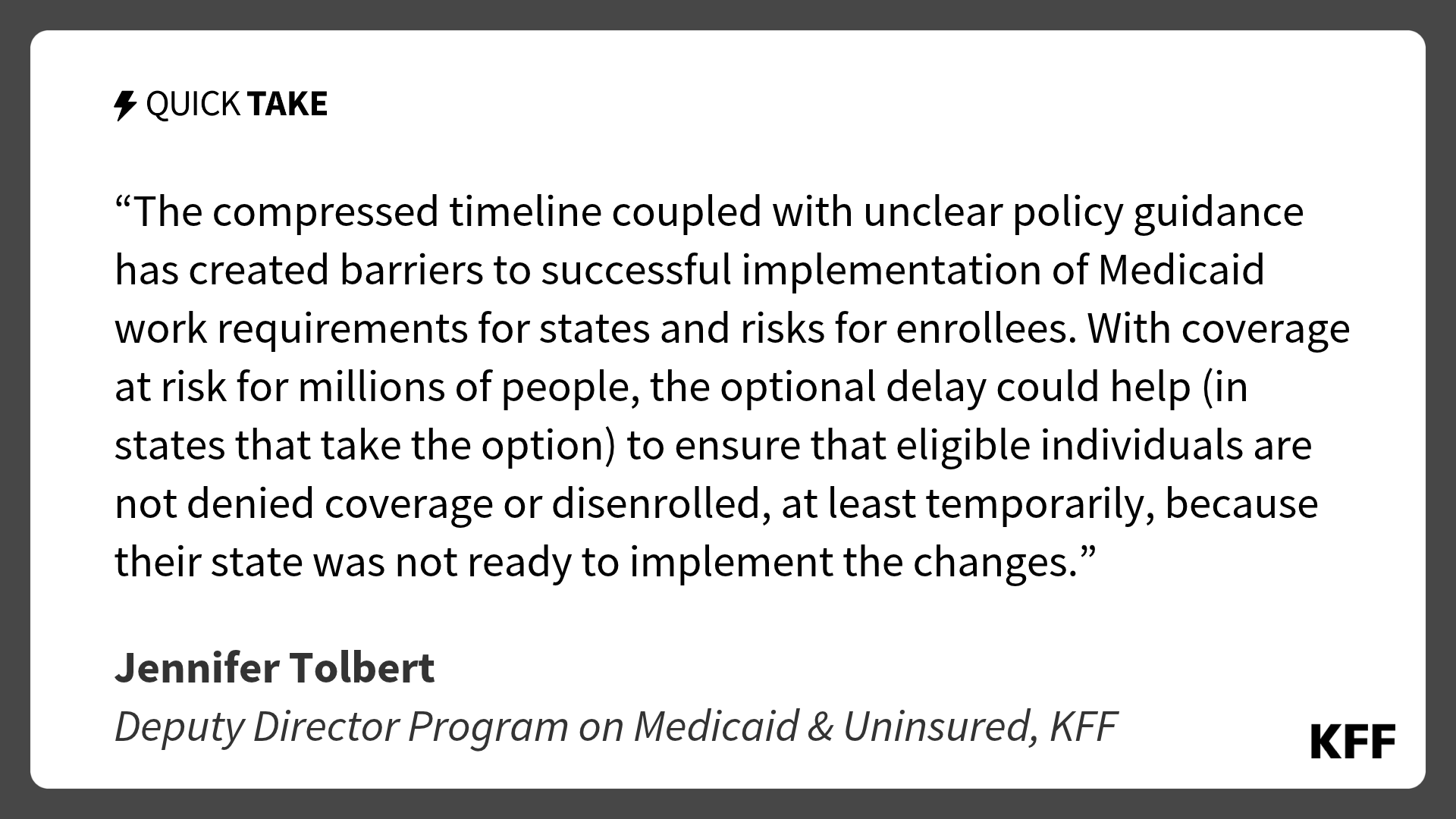
Before the delay, CMS had told states to adopt mitigation plans for identified implementation deficiencies, KFF reported.
Outdated computer system challenges work requirements implementation
The agency also faces the challenge of implementing work requirements on an outdated computer system, The Gleaner said.
Will Humble, executive director of the Arizona Public Health Association, said the September awareness campaign and website keepmyahcccs.com show state officials are likely trying to avoid public confusion, The Gleaner reported. He added that both the agency and the people need to prepare and take the changes seriously, The Gleaner said.
Advocates warn of coverage losses
Nationwide, more than 5 million Medicaid enrollees are expected to lose coverage under the changes enacted in the 2025 “One Big Beautiful Bill,” according to KFF. The federal government projects savings of more than $326 billion over 10 years.
Even people who meet requirements or qualify for exemptions could lose coverage because of administrative hurdles, advocates say.
“When you do not have an address to receive mail or do not have a phone to receive text alerts, then how are you going to find out that you are up for renewal, or that you have paperwork that is missing?” Stephanie Martinez, chief community outreach and engagement officer with Circle the City, said.
Joseph Palomino, director of the Arizona Center for Economic Progress, warned of broader economic ripple effects: “You can see higher uncompensated care hospitals, which means that those hospitals already operating on thin margins may start to operate in the red, may be forced to close. There’ll be less people employed, meaning less people spending at the grocery store, less people being able to pay their rent. It will reverberate in pretty damaging ways.”
AHCCCS launched a website in September to help members understand the changes. The agency must inform CMS of its decision by Dec. 11.
Keep reading
- MiLaysia Fulwiley Returns for LSU After Charges Dropped, Helps Pace Win Over Belmont
- University of Utah Details Parking Rate Hikes, New $130M Garage at ASUU Town Hall
- Trump's Beef Quota Filled About 37% in Month One; Ground Beef Fell 13 Cents (daybreakwire.com)
- Trump says Army will not detonate bomb-making chemicals in Iowa without court approval (newsarchyuk.com)

MiLaysia Fulwiley Returns for LSU After Charges Dropped, Helps Pace Win Over Belmont
East Baton Rouge District Attorney Hillar Moore dropped the two most serious charges — aggravated battery and aggravated...

University of Utah Details Parking Rate Hikes, New $130M Garage at ASUU Town Hall
University of Utah officials announced a new $130 million parking structure adding nearly 1,500 spaces at an ASUU...

PG County Animal Shelter Seeks Adopters, Fosters for Up to 13 Dogs at Risk of Euthanasia Wednesday
Prince George's County Animal Shelter in Upper Marlboro, Md., is seeking adopters and fosters today until 7 p.m....

Giants 6.5-Point Road Favorites Over Colts in Week 12
The New York Giants enter Sunday's Week 12 matchup at Indianapolis as 6.5-point road favorites over the Colts,...