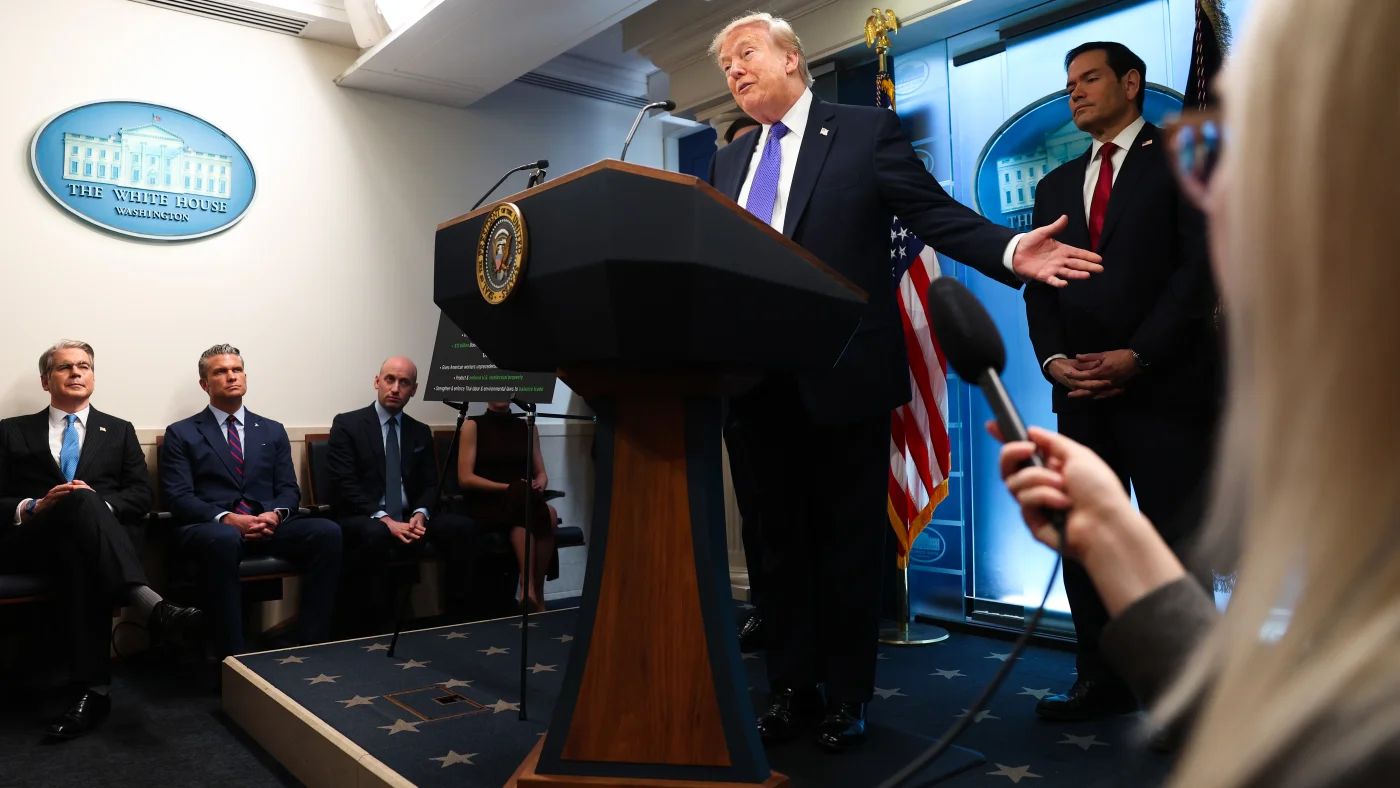
“It’s not artificial intelligence. It’s not artificial. It’s super,” President Donald Trump declared Friday, standing at the White House podium.
He had just returned from a three-day trip to Asia that produced the first-ever three-way meeting with Chinese President Xi Jinping and Russian President Vladimir Putin, yet yielded few concrete agreements on the globe’s most pressing conflicts.
The press conference, carried live from the briefing room, was a meandering affair that stretched past the 30-minute mark before Trump even addressed the summit. Flanked by Vice President JD Vance and Secretary of State Marco Rubio framed the journey as a projection of unmatched American strength.
His correspondents on the ground, however, described a different reality: a trip that resulted more in agreements to continue discussions than in tangible shifts on Ukraine, Iran, or trade.
The AI Pivot and the Nvidia Contradiction
The most substantive news broke mid-sentence. Trump announced that he and Xi had agreed to establish “joint guardrails” on artificial intelligence — or “super intelligence,” as Trump prefers to call it. “Problem is, it may be too super. So President Xi and I agree that we’re going to do some joint guardrails, the two of us, ’cause there really is no third place,” Trump said.
The phrasing matters. For two years, this administration has treated any regulatory friction on AI development as a strategic gift to Beijing. The shift toward bilateral guardrails, however vague, shows a recognition that the technology's path has outpaced purely national frameworks. NPR said that no details exist yet on what those guardrails entail, when they might be negotiated, or how they would be enforced across two mutually suspicious systems.
That ambiguity collided immediately with the administration’s chip policy. Greg Myre, NPR’s national security correspondent, pressed the contradiction: Trump insists the U.S. must keep the AI lead and has banned U.S. companies from building data centers abroad. “If it’s not this country, there’s somebody else outside. And we’re not going to allow our companies to build data centers outside of our country,” Trump said Friday.
Yet his Commerce Department, led by Howard Lutnick, has approved the sale of nearly 900,000 advanced chips to Chinese firms including Alibaba and Tencent — both listed by the Pentagon as linked to the Chinese military — as of May this year. The House Foreign Affairs Committee disclosed those figures just Thursday.
Former Nvidia CEO Jensen Huang, who resigned after acknowledging an affair with a woman who may be a Chinese spy, lobbied Trump to allow chip sales to China. Treasury Secretary Scott Bessent has argued internally for a harder line. The president, Friday, tried to split the difference: he claimed he only wants “older chips” sold to China, not the cutting edge. The licensing records suggest otherwise.
Cybersecurity Vacuum and the 2028 Question
“The agency that’s really important here is CISA, which deals with election security and protecting government networks from cyberattacks. And this agency has not had a director since Trump became president almost two years ago,” Greg Myre told NPR.
Allies Watching, Rivals Calculating
Franco Ordoñez, NPR’s White House correspondent, captured the geopolitical subtext. The summit was designed to demonstrate American power, he noted, but “power and influence are not the same thing.” When a reporter asked Trump whether Putin — whom he calls a friend — is also America’s friend, the president replied, “I can’t speak to America.”
The war in Ukraine grinds on with no diplomatic breakthrough from the trip. On Iran, Trump repeated his familiar formulation: Tehran cannot have a nuclear weapon, and he believes they want a deal. Meanwhile, Iranian attacks on oil tankers in the Gulf have intensified in recent days, a detail Myre flagged as the only significant development on that front.
Vance and Rubio: The Heirs Apparent
The visual staging Friday was deliberate. Vance, who remained in Washington, joked he felt like the kid in “Home Alone.” Rubio, by contrast, spoke with the fluency of a secretary of state who has logged the miles. Both offered glowing loyalty.
The Thailand trade agreement signed in Manila — marked only as a “substantial conclusion” with details pending — was the trip’s lone deliverable. The joint statement on AI guardrails, posted to the U.S. Embassy website, carries no timeline, no enforcement mechanism, and no third-party verification. In the briefing room Friday, the president called the trip a resounding success. The reporters who traveled with him saw something closer to a holding pattern.
“We are seeing allies start to build alliances with other nations as, you know, confidence in the U.S. falters, and they look to reduce their dependence on the U.S.,” Ordoñez said.
- Wis. Military Affairs Dept.: No Threat From Iowa Lead Azide Blast Plan
- No. 5 Texas Hosts Arkansas in Regular-Season Home Finale: TV, Streaming, Kickoff Time
- Trump Threatens Tremendous Tax on US Firms Building Data Centers Abroad (newsarchyuk.com)
- Trump Urges Nvidia to Reinstate Jensen Huang for ‘Second Chances (world-today-news.com)

Wis. Military Affairs Dept.: No Threat From Iowa Lead Azide Blast Plan
Wisconsin emergency managers said Thursday there is no threat to the state from a postponed military detonation in...

No. 5 Texas Hosts Arkansas in Regular-Season Home Finale: TV, Streaming, Kickoff Time
No. 5 Texas hosts Arkansas at 2:30 p.m. CT Saturday at Darrell K Royal-Texas Memorial Stadium in the...

No. 8 Iowa Erases Deficit, Hands Montana State First Loss 76-60
Iowa City — No. 8 Iowa erased a five-point deficit and handed Montana State its first loss of...

Jazz Host Suns on New NBA Cup Court at Delta Center
The Utah Jazz returned to Salt Lake City on Friday with a two-game winning streak that felt heavier...