President Donald Trump ordered the Army on Monday to halt the planned detonation of 68 drums of unstable lead azide at the Iowa Army Ammunition Plant until the Eighth Circuit Court of Appeals rules and Governor-elect Rob Sand agrees, NBC News reported.
- Detonation was scheduled for Wednesday after three date changes in five days.
- Lead azide has recrystallized into a shock-sensitive state; moving it is deemed unsafe.
- The blast could send a lead dust plume up to 100 miles across Iowa and neighboring states.
- Environmental groups sued; the Eighth Circuit issued an administrative stay on the EPA permit.
Trump defers to court and incoming governor
In a Truth Social post, Trump wrote that military leaders advised him the weather was optimal Wednesday and that experts believe the material has “a substantial chance that this material will explode of its own volition, perhaps sometime in the near future.”
He added: “I feel the proper course is to get rid of this longterm problem but, at the same time, have ordered the Military not to do so until such time as the Eighth Circuit agrees that we can go forward, and am further making this decision fully subject to the incoming Governor Elect, Rob Sand, agreeing to the operation.”
Public safety is the Army’s top priority, and I have directed Army Materiel Command to postpone tomorrow’s controlled detonation at the Iowa Army Ammunition Plant in Middletown, Iowa until Monday, November 23. This will delay the detonation until the latest possible moment prior…
Trump warned that if Sand or the courts do not agree, “we will have no choice but to not proceed with the controlled removal of these hazardous materials, and be forced to hold the incoming Governor responsible for any and all death or destruction caused by this very unfortunate, and longterm, situation.”
Inspection finds degraded drums and shifting blast schedule
An inspection in March found 68 drums — about 9,700 pounds of material containing 6,900 pounds of lead — had degraded and recrystallized, making the lead azide extremely shock- and friction-sensitive, Stars and Stripes reported. The Army said cold weather expected this week would further destabilize the stockpile and could cause a spontaneous explosion. Moving the drums was ruled out as unsafe.
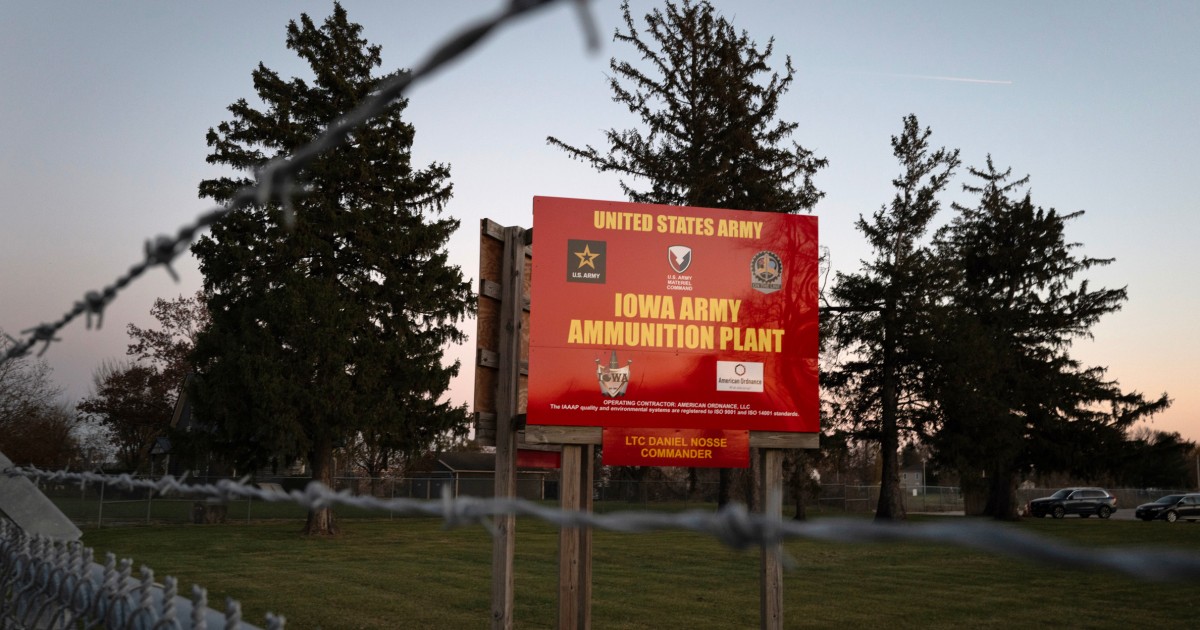
The detonation was initially set for Friday, then delayed to Monday, then to Wednesday. The Army said Sunday the latest postponement allowed “more optimal weather conditions and all mitigation measures to be emplaced,” according to Fox News.
The Department of Justice filed notice Saturday that temperatures dropping below 30 degrees created an “immediate risk” of unplanned detonation, which the Army argued allowed it to proceed under an emergency exception without the EPA permit.
Environmental groups sue EPA to halt detonation
Environmental groups including Earthjustice sued the EPA on Thursday to stop or delay the blast. The Eighth Circuit granted an administrative stay on the Army’s environmental permit to detonate the lead azide.
Lead is a potent neurotoxin with no safe exposure level. Airborne lead poses acute health risks, and deposited lead can remain in soil indefinitely. Exposure is linked to learning disabilities, reproductive problems, mental health issues, and hearing loss, with children at greatest risk.
Residents caught between two dangers
The Army covered the bunker with two stories of sand in modular barriers to dampen the explosion. Modeling shows the lead plume could disperse within an hour but travel nearly 100 miles, Stars and Stripes reported.
Residents in Middletown — less than eight miles west of the Mississippi River — were warned of broken windows and ground vibrations. Those farther out, including in Muscatine about 50 miles away, said they learned of the plan only last week.

Debra Ott, who lives five miles from Middletown with her granddaughter and three young children aged 13, 4, and 2, said she plans to stay inside for 24 hours whenever the blast occurs. “I have some heart issues, and I have a hard enough time breathing anyway,” Ott told NBC News.
“The bean dust and corn dust around here is bad enough without lead.” She described frustration with the shifting schedule: “If they’re going to do it, I wish they just do it and quit changing it every day.”
Jill Holler, who farms 20 miles west of Middletown, spent Sunday night gathering baseline soil samples, saying, “We thought it would be tomorrow.” So I was down in the dark getting the soil samples and it just, it’s frustrating,” Holler told NBC News. “If there really is an imminent threat and it’s very dangerous to explode at any time… But it seems like they’re delaying, so it just isn’t adding up.”
Next steps unresolved
Sand’s transition team did not immediately respond to requests for comment, NBC News reported. An Army spokesperson also did not respond. The Eighth Circuit has not ruled on the merits of the environmental groups’ challenge. With the emergency exception contested and the permit stayed, the timing of any detonation remains uncertain.
Keep reading
- MSU Denver Launches Culinary Nutrition Certificate Merging Cooking Skills With Dietetics
- UT Austin Launches CDC-Funded Center to Forecast Flu Seasons and Pandemic Threats
- What the FTC's Personalized-Pricing Orders Ask Delta, Uber and Walmart (daybreakwire.com)
- Trump Informed of Chinese Spy Links to Nvidia Associate, Report Says (archyde.com)

MSU Denver Launches Culinary Nutrition Certificate Merging Cooking Skills With Dietetics
Metropolitan State University of Denver has launched a Culinary Nutrition Certificate that pairs experiential cooking coursework from its...

UT Austin Launches CDC-Funded Center to Forecast Flu Seasons and Pandemic Threats
"We might have gotten people vaccinated a little bit earlier than usual and had better levels of protection,"...

Justice Department Sues to Void Arizona In-State Tuition Law
Justice Department sued in August to void Proposition 308, a 2022 voter-approved measure. Federal lawyers cite a 1996...

NPR: Thanksgiving Cost Forecasts Diverge; Grocery Prices up 22% Since 2019
Thanksgiving meal costs show conflicting forecasts as grocery prices sit 22% above five years ago, NPR reported. Grocery...