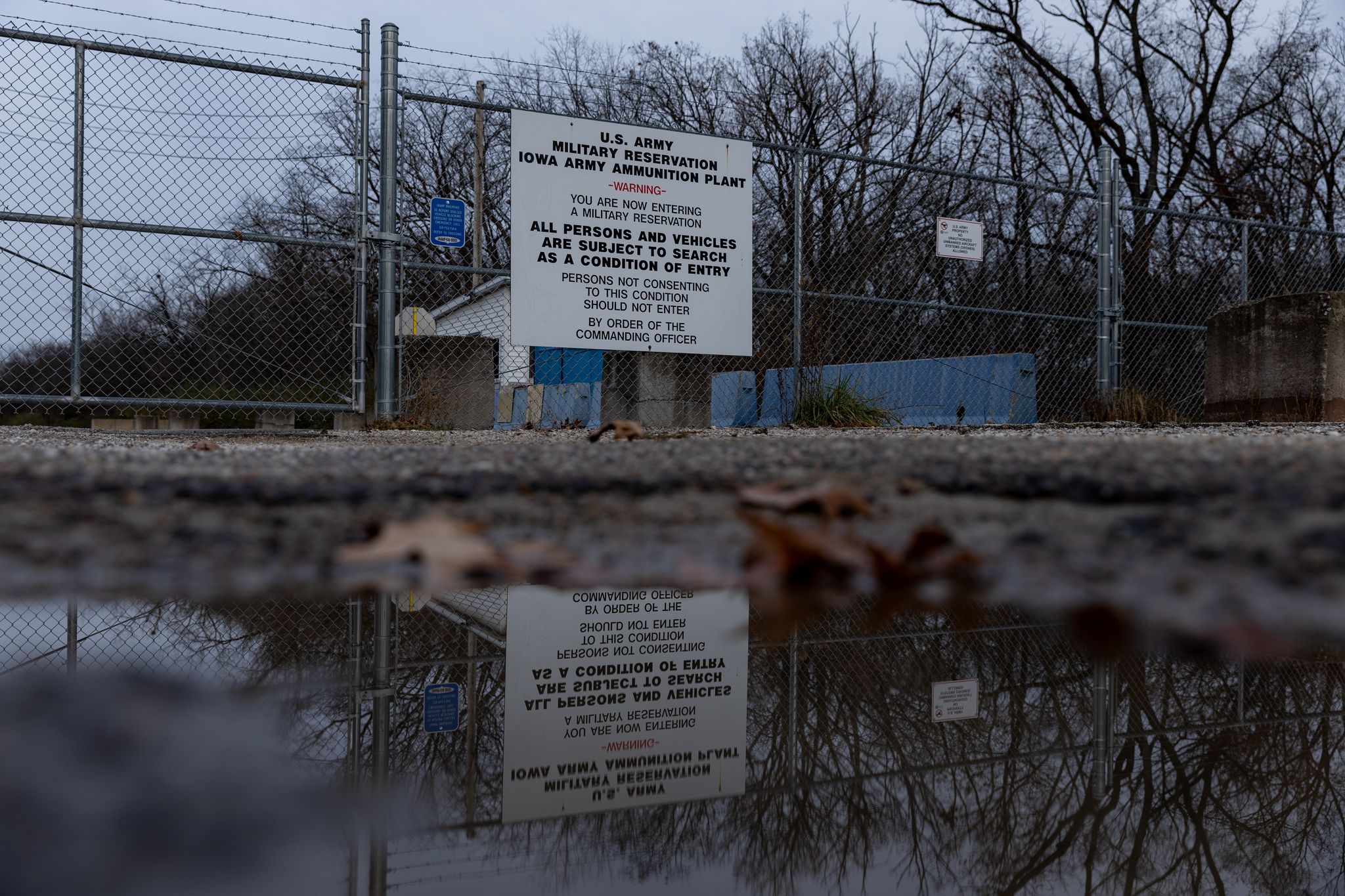
The U.S. Army detonated the nation’s entire stockpile of lead azide on Wednesday at the Iowa Army Ammunition Plant in Middletown, saying initial air monitoring detected no lead beyond the site.
Five tons of the explosive chemical — stored in 68 barrels — were destroyed in two controlled blasts around 9 a.m. local time, Maj. Gen. Eric Shirley, who led the operation, said at a news conference two hours later. EPA air monitors around the plant reported no lead in the air, and FEMA issued an all-clear for the area by late afternoon, the Army said.
President Donald Trump posted on social media that the Army’s mitigation efforts had “far exceeded expectations,” and Acting Secretary of the Army Adam Telle along with the Republican governors of Iowa and Missouri called the explosion well-contained, the Associated Press reported.
The lead azide had been consolidated at the plant in 2009 from bases around the country, according to Robert Cekada, director of the Bureau of Alcohol, Tobacco, Firearms and Explosives. During a March inspection, staff found the material had partially crystallized, making it sensitive to friction and cold temperatures and creating a risk of spontaneous detonation, the AP reported. “Inaction is no longer an option,” Shirley said before the blast.
The Army encased the two bunkers in concrete and sand barriers two stories high, applied ballistic gels and foam, and doused the site with more than 100,000 gallons of water to suppress dust, according to AP and U.S. News & World Report. A NASA research aircraft circled the area during the detonation. EPA contractors collected soil samples in Augusta, which lies along the plant’s perimeter, on Wednesday, the AP said.
Officials had urged residents within five miles to evacuate; schools canceled classes and some businesses closed ahead of the Thanksgiving holiday. An AP reporter filming from less than a mile upwind described two loud booms followed by wispy white plumes that dissipated in minutes. The Army attributed the smoke to the foam sprayed on the bunkers.

Andrew Whelton, an environmental engineering professor at Purdue University who has helped communities recover from chemical disasters, called the EPA air data promising but stressed that lab-tested samples are needed to determine health risks. “This should take days to weeks,” Whelton said. “But what we may see is different guidance issued to different communities based on how far they are from the detonation area and whether or not they were upwind or downwind.”
Colin Wellenkamp, executive director of the Mississippi River Cities and Towns Initiative, said water treatment facilities along the Mississippi and Missouri rivers will test periodically for detectable spikes, U.S. News reported.
Sarah Green, executive director of the Iowa Environmental Council, said legal action and public pressure forced the Army to adopt more protective measures after the original date was delayed. “Iowa and neighboring states deserve a full accounting of why the situation was allowed to get to the point of crisis,” she said.
Related reading
- Chris Kent Named President, CEO of North Little Rock Chamber of Commerce
- Egyptian Journalist Argues Manchester United Robbed by Disallowed Goal vs Sporting Lisbon
- Large Fire at Yara Fertilizer Plant Causes Millions in Damage (archyde.com)
- US Army detonates five tons of unstable explosives in Iowa (newsarchyuk.com)

Chris Kent Named President, CEO of North Little Rock Chamber of Commerce
Chris Kent will lead the North Little Rock Chamber of Commerce as its new president and CEO, the...

Egyptian Journalist Argues Manchester United Robbed by Disallowed Goal vs Sporting Lisbon
An Egyptian journalist who has covered football since 2006 argues in a column that Manchester United suffered a...

Montana Youth Diabetes Alliance Connects Families Through Camp, Education and Supply Reimbursement
Montana families managing childhood Type 1 diabetes are finding year-round education, supply reimbursement and peer connection through the...

Georgia Pushes to Flip No. 1 Prospect DJ Jacobs, Monitors Other 2027 Targets
Georgia is making a final-week push to flip the top prospect in the 2027 class, five-star edge rusher...