“Protection of human health and the environment demand action now, not delay,” government lawyers told the 8th U.S. Circuit Court of Appeals in a filing late Saturday.
The U.S. Army plans to invoke emergency provisions to detonate several tons of bomb-making chemicals in Iowa, despite a federal appeals court order that paused the permit for the operation.
The Justice Department argued in its Saturday filing that the court’s pause “does not enjoin or otherwise prohibit the Army from acting under a separate legal authority,” CNN reported. Acting Army Secretary Adam Telle said the material, discovered during routine stockpile surveillance in March, had crystallized into an “extremely unstable and sensitive” state that could detonate from slight friction or movement. Officials said temperatures are forecast to drop below 30 degrees Fahrenheit (-1 Celsius) in the coming days, increasing the risk of an uncontrolled explosion.
“Packing and transporting it poses an unacceptable risk of accidental detonation to personnel handling and transporting as well as to the public.” After coordinating with the EPA, experts and the community, officials “determined that a controlled detonation was the option that posed the lowest risk to the public in the immediate and surrounding area,” Telle said.
After pushback, the Army rescheduled the detonation to Monday – the “latest possible moment prior to a forecasted temperature drop, which would risk further destabilization of the material,” Telle said.
Environmental groups called the move an attempt to sidestep judicial review. “The Army seemed more concerned over the weekend with finding a way to sidestep the judicial process than on meeting the public’s demands for greater transparency, notice to affected communities, and far stronger protection of people, property, and the environment from serious harm,” Earthjustice attorney Thien Chau said in a statement Sunday.
The Iowa Environmental Council, Sierra Club, and Earthjustice argued that alternatives such as chemical neutralization were not fully considered and that the Army failed to adequately inform communities beyond Middletown until a public advisory last week.
Legal authority and the court order
The 8th Circuit on Thursday granted environmentalists’ request to stay the Environmental Protection Agency emergency permit that had cleared the way for the detonation, originally scheduled for Friday. The Army rescheduled the operation for Monday after public outcry, then signaled in its Saturday filing that it intends to proceed under emergency provisions that it says allow action without a permit.
Rachel Rintelmann, a managing attorney at Earthjustice, said the filing “laid the groundwork for a possible detonation without a permit, which would effectively bypass judicial process and review,” CNN reported.
Lead Particles Threaten Communities up to 100 Miles Away
Thousands more in surrounding areas — some up to 100 miles away — could be affected by lead-containing particles dispersing in the air and depositing on the ground. The Army advised residents to stay indoors, close windows and doors, bring pets and livestock inside, and clean outdoor surfaces afterward.
Vibrations from the two planned blasts could break old windows, prompting officials to recommend some Middletown residents vacate the area. Iowa Gov. Kim Reynolds activated the state emergency operations center Friday, while Illinois officials warned residents about potential dust crossing the Mississippi River. The Federal Aviation Administration restricted flights around Middletown from Monday through Wednesday. Iowa Gov.
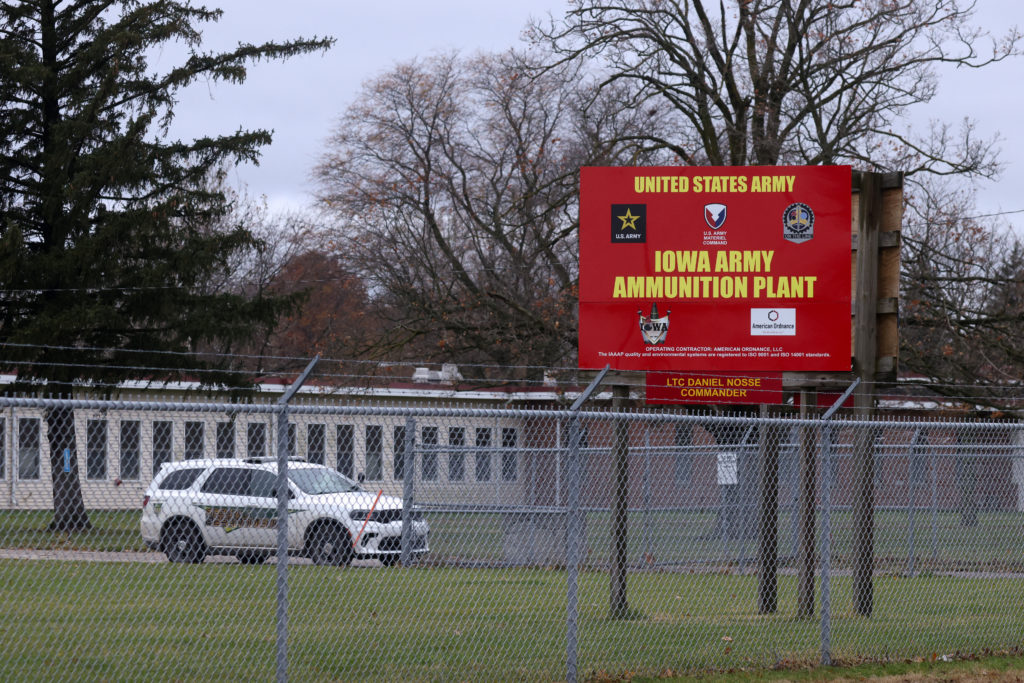
The planned detonations at the Iowa Army Ammunition Plant in Middletown, Iowa — a community of 360 people near the Mississippi River — were originally set for Friday, Nov. 20, before Acting Army Secretary Adam Telle delayed them to Monday, Nov. 23, citing a forecasted temperature drop that risked further destabilizing the material.
Army officials warned that vibrations from the two blasts involving 68 barrels of lead azide could break old windows, prompting a recommendation that some Middletown residents vacate the area, while lead-containing particles could disperse up to 100 miles away across eastern Iowa and northwest Illinois.

Degraded Lead Azide Discovered in March
Plant staff found several dozen barrels of degraded lead azide in March, a compound used in munitions production. Crystallization made the material too dangerous to handle or transport, Telle said. After consulting with experts in munitions chemistry, engineering, and environmental safety, the Army determined that a controlled detonation posed the lowest risk to the public.
Officials held a community meeting in Middletown on Oct. 15 to discuss a potential late-November detonation, but a wider public advisory was not issued until Nov. 15, when the Army announced a Friday detonation that was later pushed to Monday.
“The detonation will result in an air plume with some lead-containing particles which will disperse in the air and deposit on the ground,” an advisory states. “Lead is toxic to humans and animals.”
More on Iowa Gov
Public safety is the Army’s top priority, and I have directed Army Materiel Command to postpone tomorrow’s controlled detonation at the Iowa Army Ammunition Plant in Middletown, Iowa until Monday, November 23. This will delay the detonation until the latest possible moment prior…
The safety of Iowans now and in the future should be government’s top concern. An unacceptable lack of communication and clarity has made Iowans understandably concerned and angry about this situation. The public deserves to know, if this is the safest option, why other options…
In Iowa, a federal appeals court is blocking the U. S. Army from detonating several tons of bomb-making chemicals amid concerns over environmental and health risks. pic.twitter.com/x1pXBjYfsR
Worth a look

Indiana State AD Nathan Christensen Says Curt Mallory Will Not Return
Indiana State finished the season 2-10 after a 52-13 loss at No. 3 South Dakota State on Saturday,...

North Bergen Approves $230M Revella on Hudson Luxury Rental Complex
North Bergen has approved a $230 million, 358-unit luxury rental complex on a large vacant waterfront tract at...

Man Shot in Ear After Chuck E. Cheese Fight Sparks Siegen Lane Vehicle Shooting
A man suffered a non-life-threatening gunshot wound to the ear Saturday after an altercation at a Chuck E....
Moderate Democrats Drove Gains in Vermont, Nationally in Midterms
Moderate Democrats drove electoral gains in Vermont and across the country in the November midterms, even as the...