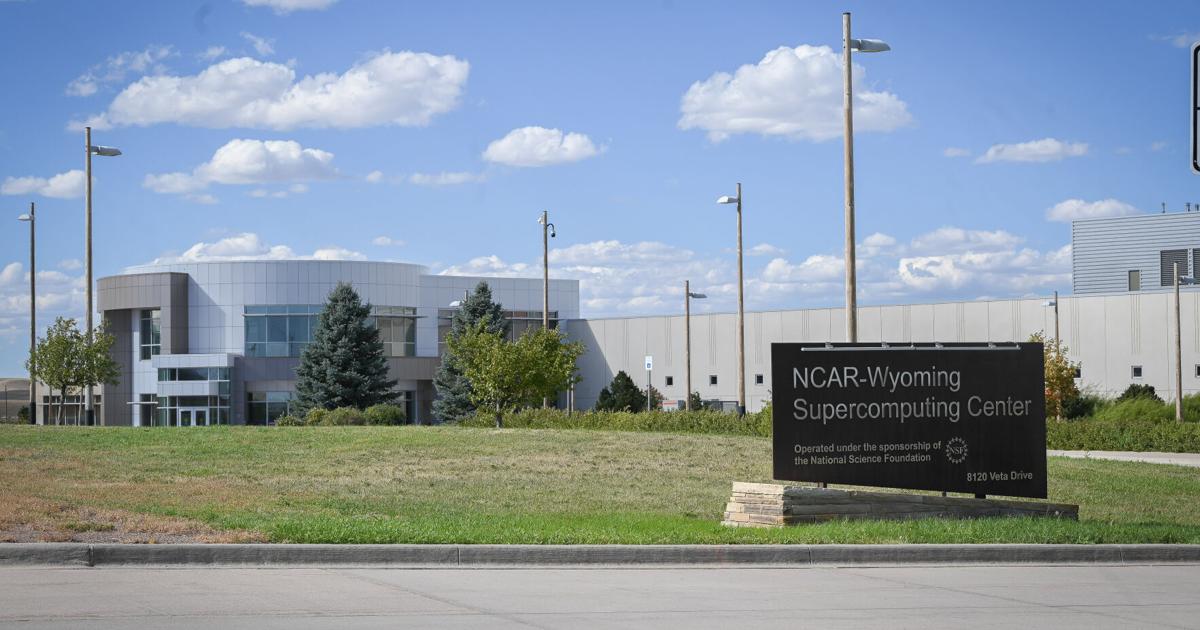
The future of the National Center for Atmospheric Research-Wyoming Supercomputing Center (NWSC) remains frozen in a high-stakes legal battle as a lawsuit filed by the University Corporation for Atmospheric Research (UCAR) continues to wind through the federal court system.
Located at 8120 Veta Drive in west Cheyenne, the facility currently serves as a critical node for geosciences, climate modeling, and storm prediction, but its operational control is the subject of a fierce dispute between the operator and the federal government.
The conflict traces back to December 16, when the Trump administration announced plans to dissolve the NCAR lab in Boulder, a facility managed by UCAR on behalf of the National Science Foundation (NSF). White House officials justified the move by labeling UCAR’s initiatives as “wasteful” and “frivolous,” while pointing to what they termed the organization’s “woke direction.”
In response, UCAR filed a lawsuit on March 16 seeking to block the federal government from stripping away its stewardship of the Cheyenne center. The organization argues the move is part of a broader pattern of political retaliation against Colorado, is not in accordance with law and would cause irreparable harm if allowed to proceed.
On June 1, U.S. Senior District Judge R. Brooke Jackson granted a preliminary injunction, officially halting any transfer of operations while the litigation proceeds.

This impasse leaves the facility—which has hosted computing systems including Yellowstone, Cheyenne, and the current model, Derecho—in a state of administrative paralysis. While the University of Wyoming had been offered the opportunity to submit a proposal to take over operations, that transition is currently on hold, and UCAR remains the operator.
“The supercomputing center and the Derecho NSF-supported computing facility within are great assets for the university and state, and UW is a heavy user of the computer, said Chad Baldwin, UW associate vice president of institutional communications, in a statement sent to the Wyoming Tribune Eagle. We are closely following the process laid out by the NSF for next steps, and have conveyed our interest in playing an appropriate role to support it in the future.”
The stakes extend far beyond administrative management. The NWSC provides essential data to the National Weather Service and the National Oceanic and Atmospheric Administration (NOAA). These federal agencies rely on the center’s climate models to forecast storm severity, a function that has become increasingly vital for public safety and infrastructure planning.
The legal fight intensified on August 26, when UCAR amended its initial complaint. This filing updated the original claims with new developments and added counts against the NSF, NOAA, and the Office of Management and Budget (OMB) for failures to comply with the Freedom of Information Act (FOIA).
According to the court filing, UCAR submitted multiple FOIA requests in March and April, but the agencies largely failed to meet their statutory deadlines for response.
The document shows communication regarding these records broke down. For instance, the OMB’s only response in nearly five months came on June 2, 2026, when the agency said that processing the request could take at least a year. UCAR asserts that the agency has sent no further communication and has not produced a single document to date.
Despite these new developments, the status quo remains protected by Judge Jackson’s preliminary injunction. The court order ensures that UCAR retains control of the NWSC, preserving the current operational structure while the lawsuit is fully litigated. For now, the supercomputer continues to run, but the long-term stewardship of the research tool remains tied up in the courts.
Worth a look

LA Metro Employee Among 8 Charged With Fraudulently Obtaining Public Benefits
Los Angeles County District Attorney Nathan Hochman announced on Thursday that eight people have been charged with fraudulently...

No. 22 UMD Women’s Basketball Starts 2026-27 Campaign in Mississippi against Arkansas
The No. 22 University of Minnesota Duluth Bulldogs tip off their 2026-27 season this weekend, facing a pair...

Maybe Happy Ending Musical to Debut at Denver Center in 2027
The Tony Award-winning musical Maybe Happy Ending is officially headed to the Denver Center for the Performing Arts...

Driver Clocked at 170 MPH on Phoenix Loop 202
A gray 2023 BMW M2 was clocked at 170 mph on the Loop 202 in Phoenix this week,...