
“Once you start, you become more conscious of your water usage,” said Tara Pike, UNLV’s recycling manager and campus sustainability coordinator, describing how a small plot of land in the Mojave recalibrates a gardener’s relationship with the Colorado River basin.
UNLV’s Community Garden is preparing to step beyond campus borders as a featured case study in a new permanent exhibition at the Springs Preserve exploring the Colorado River and sustainable living in Southern Nevada.
The garden, managed by students, faculty, and staff, demonstrates desert-adapted techniques — drip irrigation, native pollinator borders, pesticide-free pest control, and on-site composting — that the exhibition will hold up as a replicable model for households across the valley, UNLV reported.
The stakes are immediate. By October, the garden would typically be transitioning to cool-season crops such as lettuce, broccoli, and cauliflower. This year, temperatures remained in the 90s deep into autumn, keeping warm-season vegetables in the ground and delaying planting schedules that generations of growers once relied on.
Pike, who also serves on the board of Gilcrease Orchard, said orchard managers are watching winter chill hours shrink, threatening the apple harvest that has anchored the Las Vegas valley’s agricultural tradition for decades.
“You care about plants, and nature in general, more once you get into gardening,” said James Kearney, UNLV’s grounds superintendent. That shift in attention is precisely what the Springs Preserve exhibition aims to cultivate: a citizenry that understands the desert on its own terms rather than fighting it with sprinklers and chemical inputs.
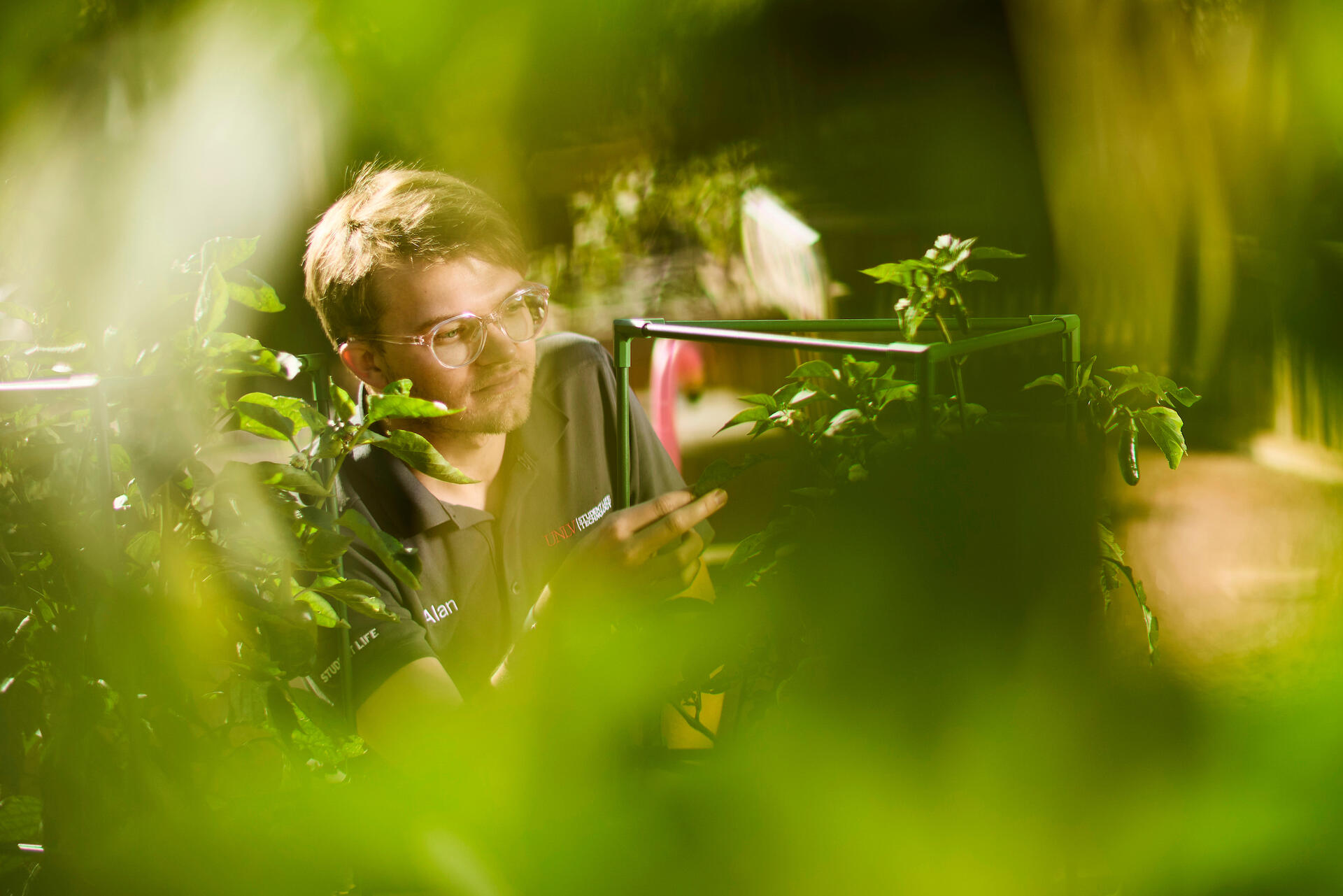
The garden operates as a living syllabus. Drip lines deliver water straight to root zones, cutting evaporation losses that broadcast sprinklers waste in air that routinely drops below 10 percent humidity. Flowering native species — globe mallow among them — line the perimeter, drawing native bees, moths, and hummingbirds that pollinate both the wild plants and the food crops beside them.
Squash bugs and hornworms are managed by hand; Pike has been known to vacuum squash bugs off leaves and hunt hornworms at night with a blacklight rather than reach for synthetic pesticides.
Composting closes the loop. Food scraps that would otherwise join the valley’s waste stream are broken down into organic matter that improves soil structure and moisture retention — a critical advantage in soils that drain as fast as the desert sun bakes them. Pike advises beginners to start simple: a drilled garbage can or a rotating tumbler, left largely alone to let microbes do the work.
The Colorado River supplies roughly 90 percent of Southern Nevada’s water. Allocations are governed by a century-old compact and a web of interstate agreements now straining under a climate that no longer matches the hydrology of 1922. The garden’s drip-irrigated beds and mulched rows mirror the conservation mandates the Southern Nevada Water Authority already enforces for residential yards: water budgets, seasonal restrictions, and incentives to replace turf with desert-adapted plantings.
Pike concedes the point: most Las Vegas residents lack the space to grow a meaningful fraction of their calories. But she frames the garden as a behavioral lever, not a caloric one.
UNLV’s Community Garden will be documented in situ, its raised beds and native borders photographed across seasons to show what cooperation with the Mojave looks like in practice — not as an aesthetic choice, but as a survival strategy for a region learning to live within a shrinking water budget.
Related reading

Ohio University Prioritizes Hands-On Learning From Campus Facilities to European Fashion Houses
Ohio University’s Department of Recreation, Sport Pedagogy and Consumer Sciences is doubling down on hands-on learning, sending students...

Amtrak Launches Second Daily Pennsylvanian Train Service Between Pittsburgh and New York
Pittsburgh riders can now catch a train to New York twice a day instead of once, a change...

Trinity Church Highlights Six Nonprofits Addressing Hunger as 300,000 NYC Households Risk Losing SNAP Benefits
An estimated 300,000 New York households risk losing SNAP benefits this winter after a federal budget reconciliation bill...
Albuquerque Launches Operation Silent Night to Collect Holiday Donations for Shelter Pets
Albuquerque's animal shelters are asking residents to shop for pets who will not be home for the holidays,...