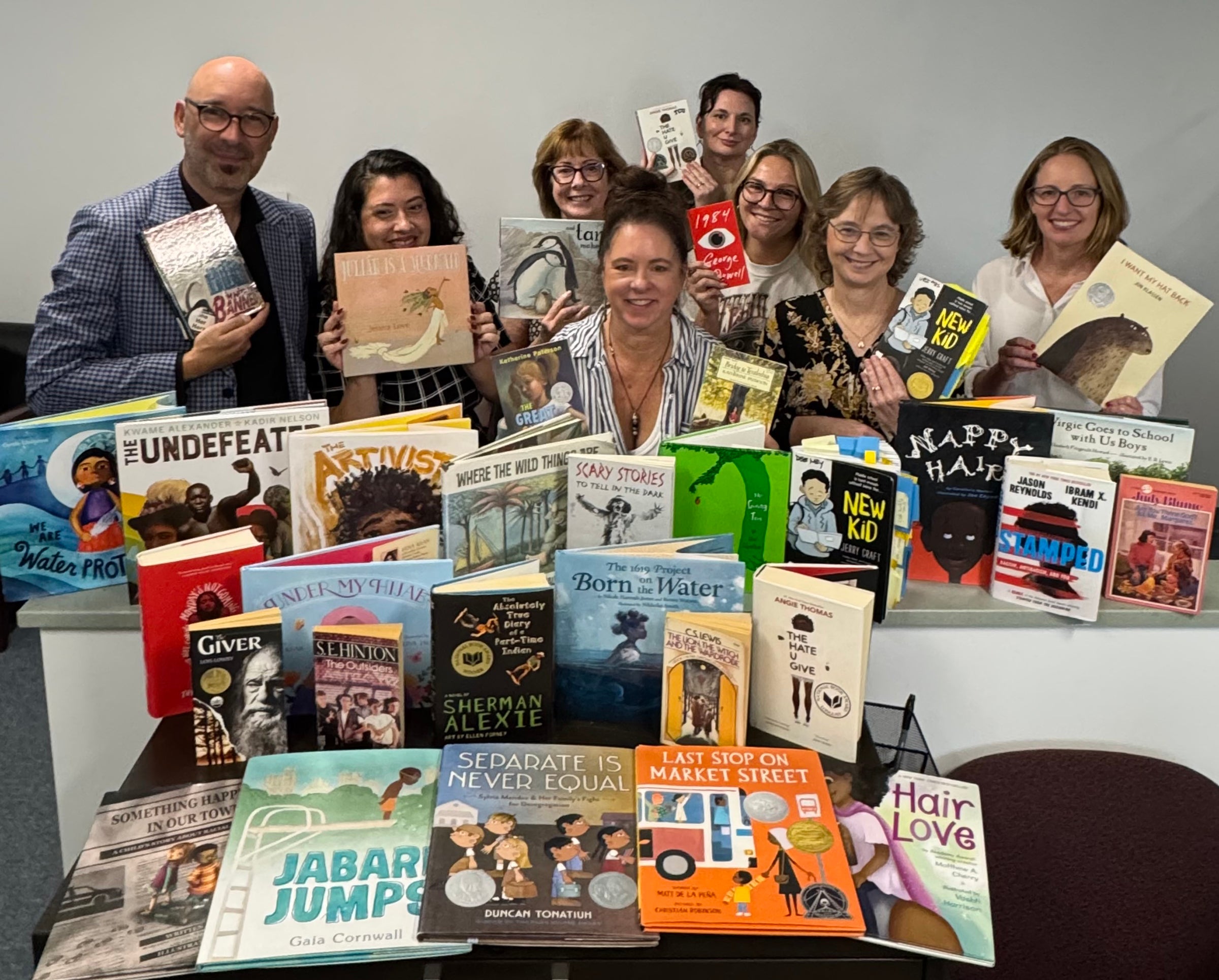
URI literacy professor Theresa Deeney is using National Family Literacy Month this November to prepare future teachers for classroom book challenges and the decline in student reading that follows.
Deeney, a professor of reading education in the Feinstein College of Education and coordinator of the Master of Arts in Education/Reading Education and Graduate Certificate in Dyslexia Knowledge and Practice, teaches URI education majors that student choice — even titles like “Captain Underpants” — drives engagement. “If that gets a student to pick up a book, so be it,” she said.
In her junior-level course EDC 423, Teaching Comprehension and Response in Elementary School, Deeney assigns “New Kid” by Jerry Craft, the first graphic novel to win a Newbery Award in 2020. “Challenging and banning books is a problem of access,” Deeney said. “Who decides which books are ‘legal’ and which are not? It’s a slippery slope.”
Deeney frames the stakes using a framework her students learn: K-12 readers need books that act as “mirrors to help them see themselves, windows to help them see into others’ lives, and sliding glass doors to experience other worlds.” Removing titles limits both self-recognition and empathy, she argues.
Pen America maps show Rhode Island remains a low-ban state alongside most of New England, while Texas and Florida recorded the most bans in the past year.
Deeney directs the URI After School Literacy Program and was named an Outstanding Teacher of Reading by the International Literacy Association and a URI Teaching Excellence Award recipient this year. She serves as a Literacy Ambassador for the Rhode Island Department of Education and sits on the Rhode Island State Literacy Council.
“Parents have the right to censor what their own children read,” Deeney said. “But sharing a reading with your children allows you to talk about issues in a safe space. What’s happening in a book isn’t happening to you, so it gives you that arm’s length to have a conversation.”
“Respect teachers’ professionalism,” Deeney said. “If a book raises challenging issues, teachers are going to talk about that issue with students.”
Related reading

WVU Honors Dawn West for Guinness Marching Band Record
West Virginia University honored Dawn West at halftime of the football game against Houston on Saturday at Milan...

Embark Georgia Builds Longitudinal Dataset for 6,000 Foster Youth
The Embark Georgia Research Consortium has built a longitudinal dataset linking child welfare, financial aid, and college enrollment...

TIME Selects Photos for 2026 Top 100: War, Weather, Artemis II, Protests, Sports
Collection published Nov. 24, 2026, spanning events from January to November. Images include Artemis II lunar flyby, Gaza...

Manchester University Secures $5M Lilly Endowment Grant for AI Integration
Manchester University has received a $5 million grant from Lilly Endowment Inc. to integrate artificial intelligence across teaching,...