The U.S. Army plans to detonate five tons of degraded lead azide Wednesday at the Iowa Army Ammunition Plant after a federal appeals court cleared the way Monday.
- Two controlled blasts of 68 barrels are scheduled for 10 a.m. Central time on Wednesday, the day before Thanksgiving.
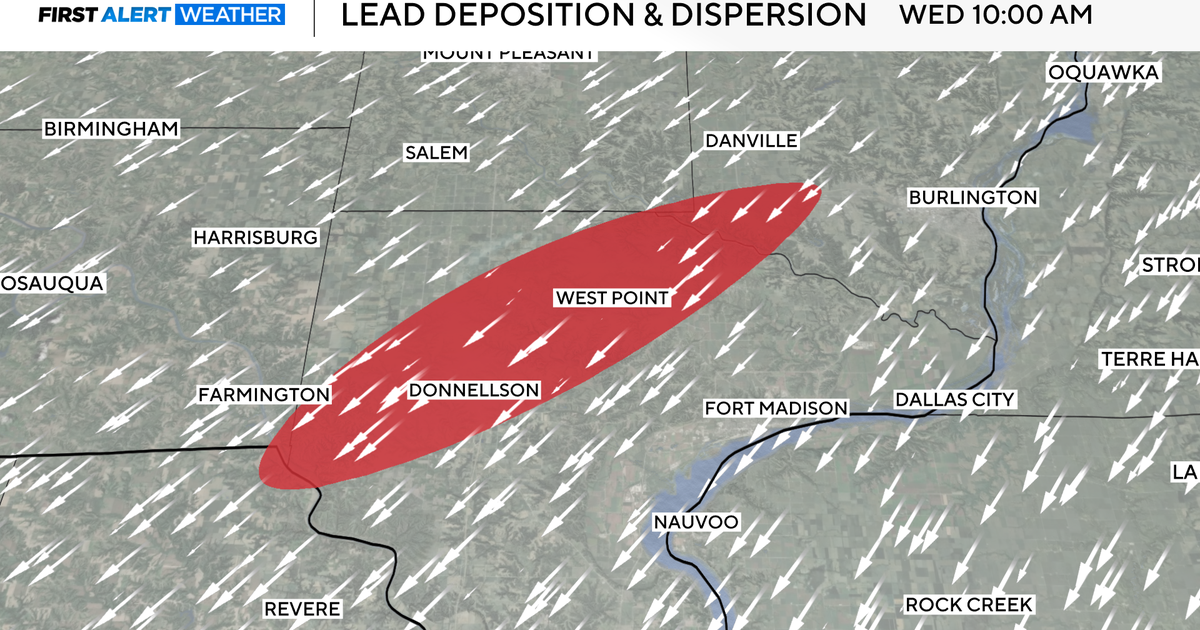
- Updated Army maps project a lead dust plume drifting southwest from Middletown into northern Missouri through 5 p.m. Wednesday.
- Residents within five miles southwest may be evacuated; those up to 20 miles away are told to stay indoors with windows closed.
- The Eighth Circuit Court of Appeals lifted a stay Monday, ruling environmental groups had not shown they were likely to succeed on their permit challenge.
Plume maps shift southwest toward Missouri
New Army modeling released Tuesday shows the toxic dust plume moving southwest of the plant near Burlington, stretching through southeastern Iowa and extending into northern Missouri. CBS News reported the shaded area reaches Knox City by early afternoon and narrows to a band toward Macon, Missouri, by late afternoon, with Quincy, Illinois, just southeast of the projected path.
Illinois officials said Monday that NOAA’s latest model showed no Illinois counties would be affected, though the Illinois EPA had asked the Army for updated modeling and had not received it, CBS News reported. The Army must update its plume forecasts six hours before the detonation and hourly afterward under the EPA emergency permit, CBS News reported.
Court clears path after delays and political pressure
The detonation was originally slated for Nov. 20, then Nov. 23, before environmental groups won a temporary pause. President Donald Trump said Monday the government would not go ahead until the appeals court ruled and unless Iowa Governor-elect Rob Sand signed off, though Sand’s input is not technically required.
Sand, a Democrat who does not take office until January, said Iowans are “entitled to know how Middletown came to this situation,” CBS News reported. Outgoing Governor Kim Reynolds said after speaking with Defense Secretary Pete Hegseth and military leaders that she supports the planned detonation.
NEW: The U. S. Army has released updated maps projecting the path of a toxic lead-dust plume from a controlled detonation set for Wednesday The latest projection shows the plume blowing southwest from the Iowa Army Ammunition Plant in Middletown, then continuing into northern… pic.twitter.com/YMyeqrccOB
Why the Army says it must act now
A routine inspection on March 11 found decades-old lead azide stored in earthen-covered containers had partially crystallized after water in the ethanol bath evaporated, making it increasingly sensitive to friction, shock and cold temperatures.
Department of Justice attorneys argued in a court filing Saturday that winter temperatures could “cause an uncontrolled dispersal of lead azide into the environment,” and that an uncontrolled detonation of nearly five tons of primary explosive would endanger soldiers, contractors and surrounding communities “without many of the protective measures meant to minimize the risks from the blast — harm that cannot be undone.”
The Army said blast doors on the bunkers were removed in preparation and cannot be replaced, increasing vulnerability to temperature changes.
Mitigation measures and public guidance
The Army has erected concrete and soil barriers about two stories high around the bunkers and plans to spray the soil with water and mist the air, CBS News reported. It will also apply ballistic gels and foams to absorb lead dust and douse the explosives with thousands of gallons of water.
Federal officials went door to door in Middletown Tuesday handing out flyers recommending residents evacuate and listing the Salvation Army in Burlington as a temporary shelter. The Army and Iowa Department of Health and Human Services recommend closing all windows and exterior doors, setting HVAC systems to recirculation mode, avoiding unnecessary travel, and cleaning indoor and outdoor surfaces that may be contacted by children.

Environmental challenge focuses on EPA permit validity
An attorney for the environmentalists emphasized their legal challenge centers on the permit’s validity — not the Army’s decision to move forward under the emergency provision. Senator Tammy Duckworth, an Illinois Democrat, called the rollout a “failure of leadership of epic proportions,” CBS News reported.
A bipartisan group of Illinois and Iowa elected officials asked the Army and EPA to delay and look for safer alternatives, citing poor communication with the public, CBS News reported. Evacuated residents will be notified by phone once they may return home, the Des Moines Register reported.
More on Missouri
This evening, the Eighth Circuit Court of Appeals issued an order that allows the Army to proceed with the detonation of long-ago-placed explosives (2009) at the Iowa Army Ammunition Plant. Likewise, the current Governor of Iowa, Kim Reynolds, has given her support to go forward,…
IOWA: Federal officials are going door to door in Middletown, handing out tape and flyers ahead of Wednesday's detonation. The flyer says the federal government recommends residents leave during the blast and lists the Salvation Army in Burlington as a place to go. pic.twitter.com/QsmM2cQcl9
The controlled detonation at Iowa Army Ammunition Plant is now scheduled on Wednesday, November 25, 2026 to allow for optimal weather conditions and all mitigation measures to be emplaced. The Army and our interagency partners have been working around the clock to safeguard all…
Related reading

Army Tests Autonomous Drone Boat to Guard Ammunition Terminal
A 24-foot drone boat patrolled Suisun Bay in April, the first time the Army tested an autonomous craft...
Community Rallies for St. Helena Graduate After Crash Leaves Him With Severe Spinal Cord Injury
"When someone in our community is hurt, we rally together," said Blaire Lent, founder and head of school...

Maryland Athletics Called Police on Student Reporters Outside Football Center, Records Show
University of Maryland athletics staff called campus police on two student journalists reporting outside the football training center...

SC Man Charged With Murder After Wife Found in Septic Tank 6 Years After Disappearance
A South Carolina man has been charged with murder after his wife's body was found in a septic...