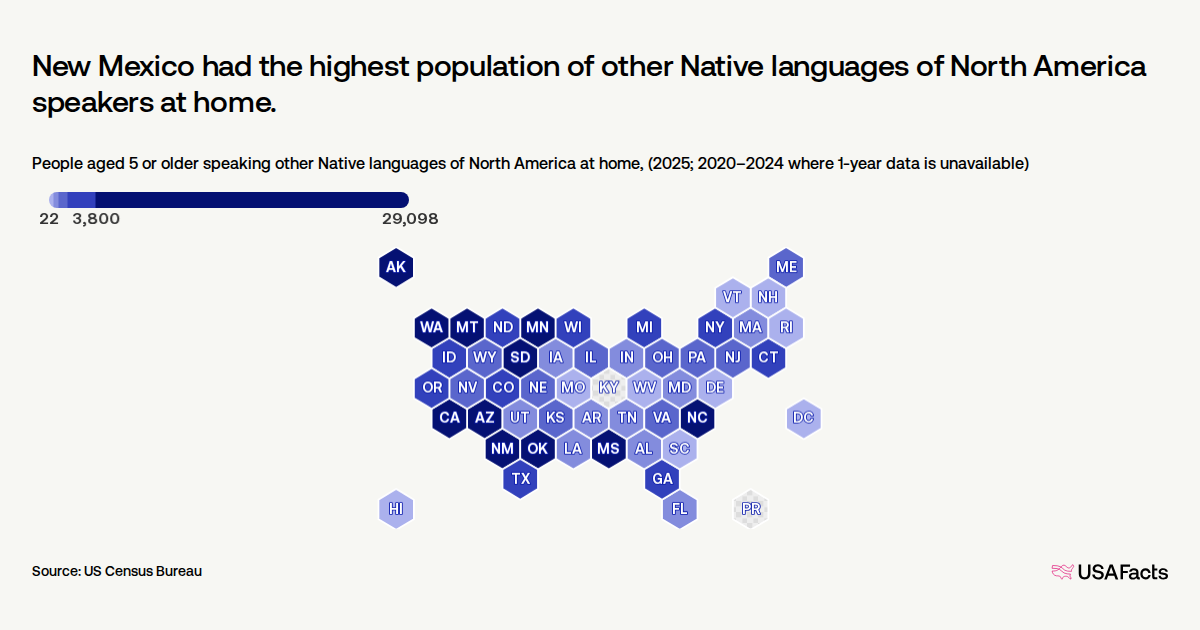
About 160,000 people age 5 and older spoke other Native languages of North America at home in 2025, USAFacts reported using data from the US Census Bureau’s American Community Survey.
That tally places this group of idioms 41st among the 42 non-English languages tracked by federal surveyors. The count covers a broad category of indigenous tongues excluding Navajo, which is measured separately due to its larger speaker base.
Geographic concentration remains a defining trait for these household speakers. In 2025, 44.4% of the US population speaking Native languages excluding Navajo lived in either New Mexico, Alaska, or Arizona.
Alaska and New Mexico lead state population shares
New Mexico held the biggest population of other Native languages of North America speakers at home, serving as home to 18.1% of everyone in the US speaking these languages domestically.
When measuring by state population share rather than raw totals, Alaska led the nation. In 2025, 3.6% of people aged 5 and older in Alaska spoke other Native languages of North America at home, according to the USAFacts analysis. New Mexico followed at 1.4%, while South Dakota recorded 1.1%. Across 41 states, speakers of these indigenous languages made up less than 0.1% of the local population.

Metropolitan data compiled between 2020 and 2024 shows the Albuquerque-Santa Fe-Los Alamos, NM CSA leading major urban areas with 16,400 speakers. The Minneapolis-St. Paul, MN-WI CSA recorded 2,700 speakers, while the Tulsa-Bartlesville-Muskogee, OK CSA registered 2,600.
Indigenous language speakers decline as English proficiency rises
The number of people speaking these indigenous languages domestically has declined over the past decade and a half. From 2010 to 2025, the total dropped nationwide from 197,480 to 160,585, marking an 18.7% decrease that trailed the 11.9% rise in the total US population aged 5 and older.
In 2025, 85.8% of people who spoke Native languages excluding Navajo at home reported that they spoke English very well.
Keep reading

Indiana Man Arrested in Gilbert Over Alleged $600 Million Ponzi Scheme
Federal authorities arrested 29-year-old Devin Allen Johnson of Zionsville, Indiana, in Gilbert on Wednesday, Nov. 18. The arrest...

Pochettino Managing Manchester United Against Liverpool at Anfield Sunday
Manchester United will travel to Anfield on Sunday with Mauricio Pochettino in the dugout for his first match...

Dr. Brooks Williams Says BREC Owes Baton Rouge More Than Another Argument
"We owe Baton Rouge more than another argument," said Dr. Brooks Williams, Superintendent. That is the message BREC’s...
City of Columbus Will Suspend Trash, Recycling, and Yard-Waste Pickup Nov 26
Columbus, Ohio, will suspend trash, recycling and yard-waste pickup on Thanksgiving Day, Thursday, Nov. 26, shifting collections forward...