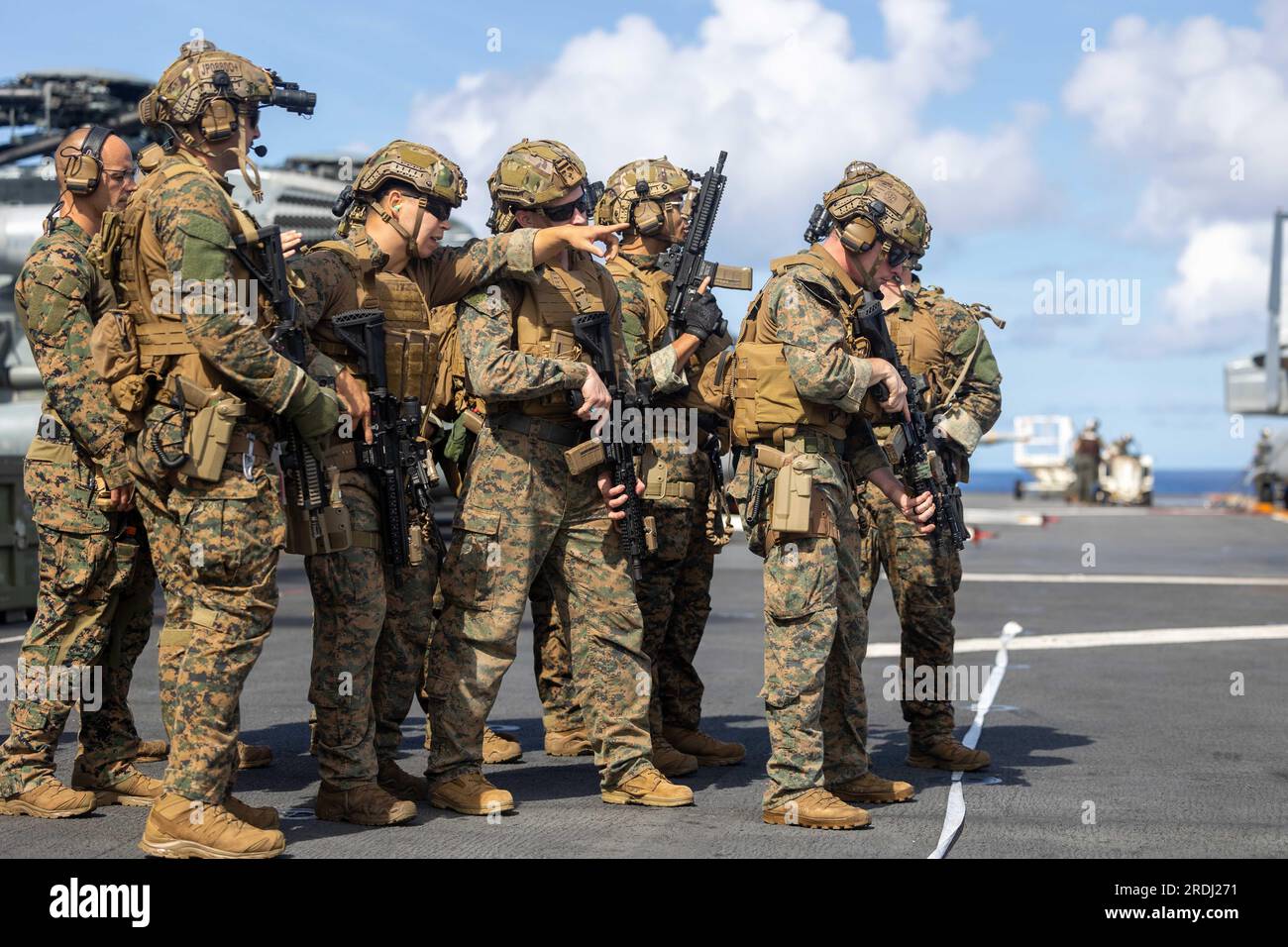
The Western Pacific remains a crowded theater this week, as naval vessels from across the globe conduct exercises, port visits, and surveillance patrols.
From the South China Sea to the waters off Japan, the movement of ships and aircraft underscores the ongoing regional focus on presence and interoperability.
According to the latest USNI News Western Pacific Pulse, the amphibious assault ship USS Makin Island (LHD-8) and the amphibious transport dock USS John P. Murtha (LPD-26) arrived in Sembawang, Singapore, on Friday.
These vessels, alongside the amphibious transport dock USS Anchorage (LPD-23) and the 13th Marine Expeditionary Unit, constitute the Makin Island Amphibious Ready Group. While Anchorage has been working through various movements in Japan, the arrival of these ships in Singapore highlights the sustained US commitment to the Southeast Asian maritime domain.
The stakes for these maneuvers are clear: for regional businesses and shipping lanes, this high-density naval presence serves as both a security guarantee and a friction point. While these exercises are framed as routine, they are occurring against a backdrop of heightened surveillance.
On Monday, a Chinese Y-9 electronic intelligence aircraft patrolled the East China Sea, prompting the Japan Air Self-Defense Force to scramble fighters in response. Similar responses were triggered on Thursday when a Chinese TB-001 reconnaissance/attack UAV flew west of Okinawa.
The complexity of these interactions is perhaps best illustrated by the diverse set of missions currently underway:
Japan, an island nation comprising over 14,000 islands, occupies a strategic position off the northeast coast of the Asian mainland. Its geography is defined by mountainous, heavily forested terrain, which has concentrated the country’s significant population along its eastern coastal plains.
Historically, the country transitioned from an isolationist shogunate to a global industrial power following the 1868 restoration of imperial authority. While Japan maintains one of the world’s strongest militaries today, it is unique in that it has constitutionally renounced its right to declare war. This balance between its modern defense capabilities and its post-1945 legal framework remains a cornerstone of its current role in regional security affairs.
| Vessel/Unit | Primary Activity | Location |
|---|---|---|
| USS Tulsa (LCS-16) | Port visit | Singapore |
| HMAS Stalwart (A304) | Regional presence | Manila |
| FS Vendémiaire (F734) | Search and rescue exercise | Vietnam |
| USCGC Harriet Lane (WMEC-903) | Exercise Maru 26 | Auckland |
The Canadian Armed Forces are also active in the region. HMCS Regina (FFH334) recently conducted a passing exercise with the Indian Navy’s INS Sahyadri in the East China Sea.
Regina is currently operating under Operation Horizon, Canada’s Indo-Pacific presence mission, and has recently concluded Operation Neon, which monitors North Korean maritime sanctions violations. This multi-layered approach to regional stability involves not just major powers, but a coalition of interests aiming to uphold maritime norms.
Keep reading

New Mexico Seven-Day Firearm Waiting Period Pause as AG Agrees to Stipulated Injunction
Seven days of waiting might finally end for New Mexico firearm purchasers as the state agrees to pause...

Indiana Man Arrested in Gilbert Over Alleged $600 Million Ponzi Scheme
Federal authorities arrested 29-year-old Devin Allen Johnson of Zionsville, Indiana, in Gilbert on Wednesday, Nov. 18. The arrest...

Pochettino Managing Manchester United Against Liverpool at Anfield Sunday
Manchester United will travel to Anfield on Sunday with Mauricio Pochettino in the dugout for his first match...

Dr. Brooks Williams Says BREC Owes Baton Rouge More Than Another Argument
"We owe Baton Rouge more than another argument," said Dr. Brooks Williams, Superintendent. That is the message BREC’s...