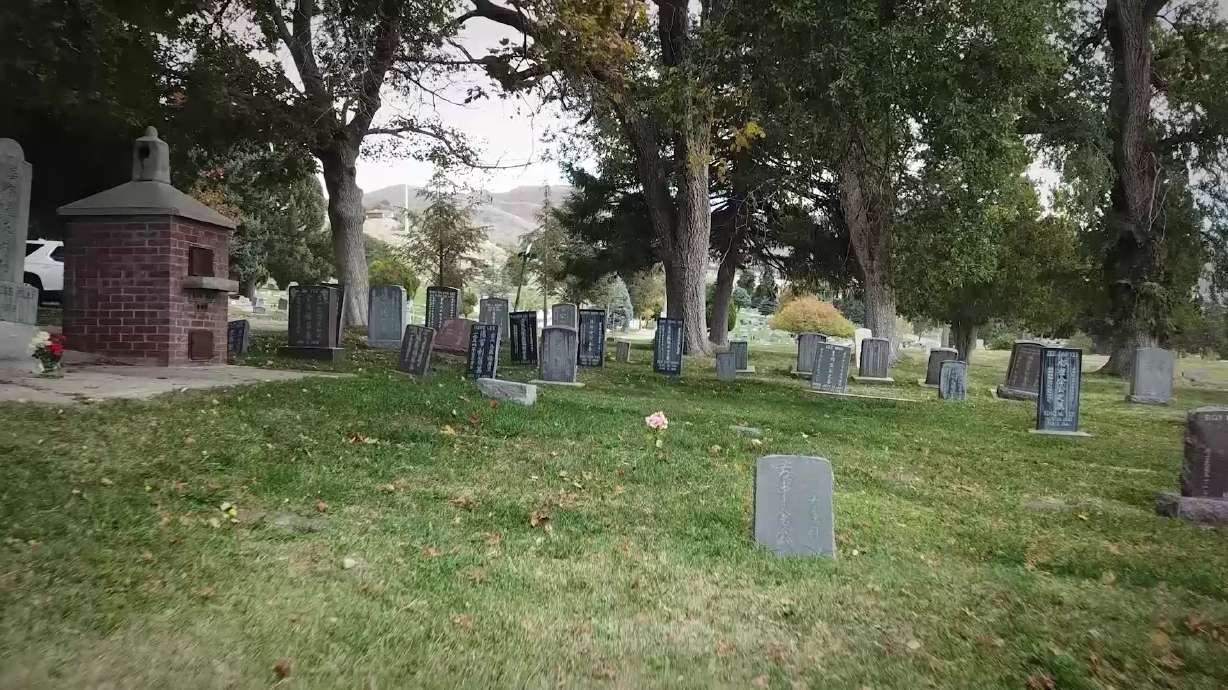
Plat 1919 was designated for Chinese immigrants, but early tradition of exhuming remains for return to China means current burials likely represent a third group interred there, Merritt told KSL.com.
English records frequently misspell names, and some immigrants entered the U.S. under purchased papers, creating disconnects between Chinese characters on stones and official documents. University of Utah Ph.D. student Chengru He and Henry Luu, originally from Vietnam, joined Chris Merritt and Amy Barry, the cemetery manager for the state, in sessions reading characters across Mandarin, Cantonese and Taishan dialects.
“In China, there is a very diverse group of folks with different languages, different cultures, different religions,” Merritt said. “But once they arrived in the United States, we labeled them all the same thing.”
Cemetery earns statewide historic recognition
The Salt Lake City Cemetery was documented as significant at the statewide level under National Register Criteria A and C for Exploration/Settlement, Social History, Art, and Landscape Architecture, with a period of significance from 1848 to 1977, the Utah State Historic Preservation Office reported. Officially established as a public burial ground in 1849 and incorporated with the city in 1851, the 122-acre site holds approximately 128,000 burials, including 13 presidents of The Church of Jesus Christ of Latter-day Saints, governors, and other territorial and state leaders.
The cemetery preserves its original grid layout reflecting Salt Lake City’s orderly plan and stands as a western example of the Rural/Park Cemetery movement, transformed from arid hillside to watered garden through municipal irrigation, the Preservation Office said. Monuments trace the work of local stone carvers and evolving artistic styles.
State Preservation Office details cemetery significance
Monuments on the grounds trace the work of local stone carvers and evolving artistic styles through a variety of materials and symbols, the Preservation Office said.

The Library of Congress holds Historic American Landscapes Survey documentation for the cemetery under call number HALS UT-2.
Dialect differences shape translation effort
During group sessions reading the Chinese characters on headstones, participants speak different dialects. “Chinese speakers who understand Cantonese, some only understand Mandarin,” said Chris Merritt, a preservation officer for the state. The characters can be read in three dialects: Mandarin, Cantonese and Taishan.
“It’s really an interesting discussion of what does every character mean,” Merritt said. University of Utah Ph.D. student Chengru He added that documenting the characters as they appear on the stone helps determine pronunciation in the original language.
Immigrants entered under purchased papers
Even when English documents labeled immigrants correctly, some arrived in the United States under different names to obtain official entry papers. “They bought somebody else’s paper to come to United States, so the Chinese name and the name on the paper is different,” said Henry Luu, originally from Vietnam.
Merritt noted the contrast between the diversity in China and the single label applied after arrival. “But once they arrived in the United States, we labeled them all the same thing.”
Restoration work set for spring
Hardwater staining, tipping stones, sinking markers, and gopher damage plague the Chinese plot, Barry told KSL.com. The team plans to clean the tombstones in April 2025, aligning with the traditional Qingming Festival when Chinese communities worldwide tend ancestral graves. “There is a proper way that has been scientifically studied with products that we can use that don’t harm the headstones,” Barry said.
So far, researchers have tied 66 birth certificates to the plat. The State Preservation Office intends to expand the translation and restoration model to Japanese immigrant plots and other cemeteries statewide. The Library of Congress holds Historic American Landscapes Survey documentation for the cemetery under call number HALS UT-2.
Related reading

Fairfax County Police Report Widespread Road Closures, Downed Trees, Signal Outages Across District Stations
Fairfax County police responded to widespread road closures, downed trees and traffic signal outages on Thanksgiving Day after...

State Works to Remove Grounded Atlantis Vessel Kapena From Fort DeRussy Beach
The Hawaii Department of Land and Natural Resources announced Thursday it is working to remove the 65-foot passenger...
Arizona Sees Mild Thanksgiving Weekend With 70s in Phoenix, Gusty Mountain Winds
Arizona will see mild, above-normal temperatures through the holiday weekend, with Phoenix highs in the upper 70s, while...

Broncos Activate Badie, Elevate Schrader for Black Friday Trip to Pittsburgh
The Denver Broncos entered Thursday with one running back on the 53-man roster and finished it with three,...