
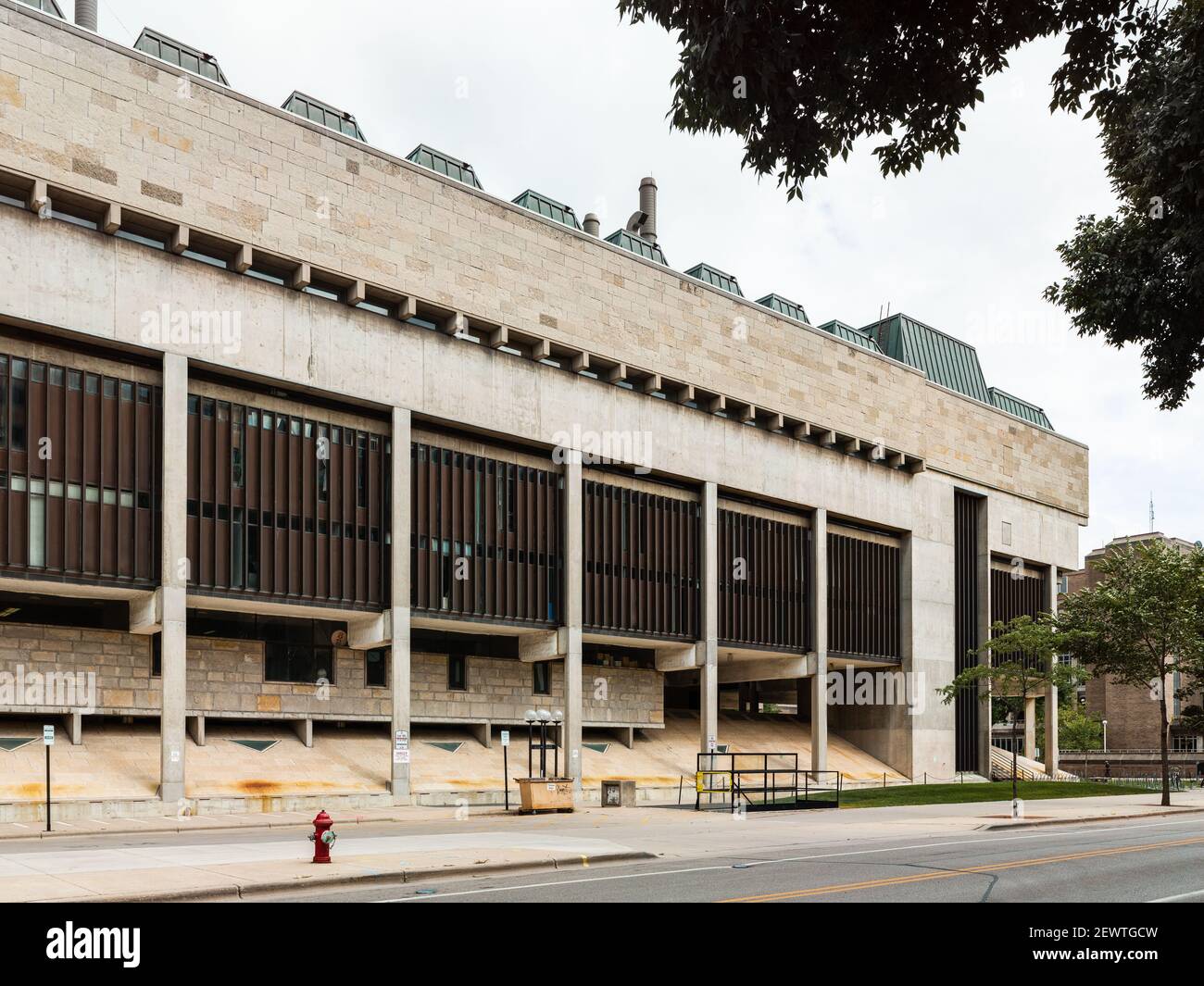
“PLEASE DO NOT PULL ANY CORDS,” read a polite but firm sign hanging above the exhibition map in Gallery 7 of the Mosse Humanities Building, setting the stage for a showcase of contemporary student art, The Daily Cardinal reported.
The exhibition titled “Pullcord” filled the gallery space from Nov. 3 to Nov. 7, featuring 15 numbered works created by 11 artists. The lineup included sculpture graduate students Indigo Conat-Naar, Chelsea Southard and Christian Ulloa, alongside other advanced students, faculty and staff members at UW-Madison.
Among the featured installations, Jon McComb displayed four miniature houses constructed from found materials, each dedicated to someone he loves and admires. McComb starts the creative process by listening to what home means to an individual, sometimes visiting their actual living spaces and taking photographs to guide his sculptural reconstructions.
One house portrays a Minnesota childhood cabin where a mother spent her early years, complete with three tiny interior eggs—one broken and two intact—symbolizing the loss of one of her children. McComb paid close attention to minor architectural details, noting that even the screen door the woman operated as a child carries a profound historical weight.
“I always feel like pieces that we’ve touched have a soul to it,” McComb told The Daily Cardinal.
Another miniature structure honors a Beaver Dam farmer whose barn was destroyed by a tornado. “Farmers do so much for this country, and they’re kind of like the unsung heroes,” McComb said.
A third piece recreates the Madison home of two orthopedic surgeons who regularly travel to Honduras to deliver free medical care to children. McComb incorporated a carved wooden figure, inspired by an artifact from the family’s history, as a gesture of gratitude for their humanitarian work.
The houses rely almost entirely on discarded items, utilizing cardboard for roofing, upside-down plant roots for trees, and baby’s breath flowers glued to sticks to mimic blooming foliage. McComb even repurposed a broken bamboo shade for one of the builds, turning everyday refuse into physical archives of personal memory.
Elsewhere in the gallery, artist Casey Fletcher used contrasting materials to investigate themes of sacrifice, vulnerability and power. Fletcher’s pieces “Light As A Feather,” crafted from wax and oak, and “Golgotha,” built from steel and oak, stem from a developing body of work inspired by the stigmata associated with Christ’s crucifixion.
Fletcher said that the works emerged from reflecting on how grace and mercy have recently felt under fire. By stretching and compressing religious iconography, the artist sought to emphasize flexibility and openness against rigidity and the pursuit of power.
The physical properties of the materials help articulate that tension. A beeswax form was cast using a mold of an earlier carving, allowing it to be bent and reshaped while warm before cooling into a rigid state.
Other contributions took a notably playful direction, such as Ulloa’s “Podium,” which features three humorous subtitles: “I Can’t Believe I Haven’t Been Punched Yet, Am I Really That Goated?,” “I’m Gold, but If You Prefer Silver That’s OK” and “Need a Room Full of Mirrors, So I Can Be Surrounded by Winners.”
Additional displays included Sarah FitzSimons’ “Fountain Devices (Continuing Experiments),” which lists concrete, aluminum, duct tape and the hydrologic cycle among its materials, alongside Alexander Wilcox’s “Weight? Awwww,” incorporating chains, a trident and a found object.
Keep reading

Cowboy State Daily Video Newscast: Thursday, November 12, 2026
As the National Weather Service states that 2026 will be the warmest year in Wyoming's recorded history, residents...
Gee and Ursula Discuss Calls for Washington Data Center Regulation
Washington lawmakers are preparing for a high-stakes legislative session as they look to impose new regulations on the...

West Virginia Secures $202 Million in Federal Rural Health Funding
West Virginia secured $202,081,355 in second-year federal rural health funding, pushing its two-year total past $401 million, according...
Virginia Beach School Board Rejects Trail Project for School Needs
Virginia Beach public schools plan to spend excess reserve funding on cafeteria air conditioning and staff wellness rather...