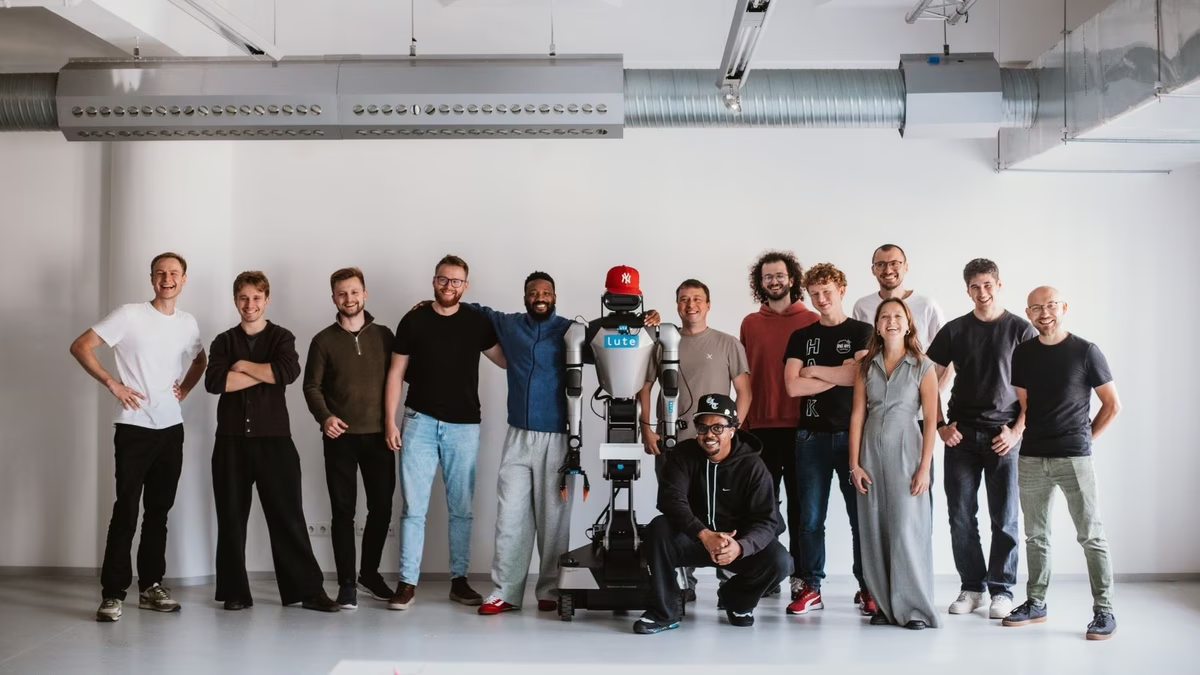
- OTB Ventures and FORWARD.one co-led the seed round; Seedcamp and Credo Ventures co-led the pre-seed.
- Lute-0, the first model, matched π0.5 on dexterous tasks using far less training data.
- Models are deployed at a European automotive distributor with $6 billion in revenue and in hospital corridors.
- Lute co-designed soft elastomer sensors and a portable rig to collect touch data at scale.
Most physical AI systems rely on cameras alone.
Vision shows where objects are, Lute’s founders wrote, but not how firmly a robot holds an item, whether it is slipping, or how fragile it is. “We believe touch is the missing signal that lets robots handle real work reliably,” said Paweł Budzianowski, co-founder and CEO, in a statement published by FORWARD.one.
With partners, Lute co-designed compact, elastomer-based tactile sensors and built them into a portable data-collection setup.
In internal retail tests, Lute-0 handled vegetables successfully 76% of the time versus 22% for Physical Intelligence’s open-source π0.5 model, and soft snacks at 98% versus 70%, The Next Web reported. Lute also said its model responds twice as fast. The figures come from Lute’s own evaluation; TNW has seen no independent results.
Investors gave slightly different efficiency claims. OTB Ventures wrote that Lute-0 used about a twentieth of the pre-training data and a quarter of the training steps of π0.5. FORWARD.one put the data ratio at about a tenth.
Models run at automotive distributor hospital retailers
Ten months after its January 2026 founding, Lute says its models run at what it describes as Europe’s largest automotive parts distributor, a company with $6 billion in annual revenue, according to OTB Ventures. Models also operate in hospital corridors, and Lute works on-site with some of the world’s largest retailers, Tech Funding News reported.
Robots at deployment sites run unattended about 90% of the time, with remote operators stepping in when needed, FORWARD.one said. Failures and fixes feed back into training so each deployment improves the next. “In physical AI, the slow and the perfect will both lose,” said Boy de Jonge, investment manager at FORWARD.one.
Founders and backers
Co-founder and CTO Krzysztof Walas was an associate professor at Poznań University of Technology, headed the Physical Interaction Robotics team at IDEAS NCBR, and advised warehouse robotics startup Nomagic. The team has 16 people across Warsaw and San Mateo, California.
Besides the lead investors, Inovo VC, Borusan Ventures, ff Venture Capital and angel investor Naval Ravikant, founder of AngelList, joined the round.
This is what nobody is showing you about AI. A 10-month-old startup already running robot models in hospitals, retail and automotive. Trained by watching video. $20M to scale it. https://t.co/L2VsGd2qmm pic.twitter.com/MXN3OVqB9i
Competitive field
Lute enters a growing physical AI field. Zurich-based Enact Intelligence emerged from stealth on October 22 with $30 million in pre-seed funding to build robots that sense force and touch. Zurich-based mimic raised $16 million in November 2025 for AI models trained on skilled-worker data.
Stuttgart-based Sereact raised a $110 million Series B in April 2026. Boston-based UNIT AI raised $12 million in July 2026 for modular warehouse automation. Italy’s Adaptronics raised €3.15 million in November 2025 for grippers combining electrostatic adhesion with tactile sensing.
Investors cite urgency and integrator support
Kris Pałucki, investment director at OTB Ventures, said many system integrators want to deploy AI-driven robots but lack in-house machine learning expertise.
Boy de Jonge, investment manager at FORWARD.one, said he hears the word urgency in almost every pitch but feels it immediately when walking into Lute’s lab.
seedcamp credo ventures back lute
Both firms co-led Lute’s pre-seed round alongside OTB Ventures and FORWARD.one leading the seed stage.
The pre-seed and seed money was announced on Tuesday.
Paweł Budzianowski, co-founder and CEO of Lute since 2025, previously co-founded K-Scale Labs (2024–2025) to build affordable, open-source humanoid robots aimed at democratizing embodied AI. Before that, he led the ML team at PolyAI (2019–2024), delivering conversational AI systems for research and production.
He earned a PhD from the University of Cambridge (2016–2020) focused on long-term conversational agents and reinforcement learning for dialogue management, and created the MultiWOZ dataset, a large-scale benchmark for multi-domain dialogue modeling. He also co-designed and taught graduate NLP curricula at the University of Warsaw and Jagiellonian University (2021–present).
Sereact raised series b funding
The funding highlights the capital intensity of the physical AI sector.
What comes next
Lute will use the funding to scale data acquisition, improve models and expand deployments. It is hiring across research, engineering and deployment in Warsaw and the Bay Area. The next challenge: proving tactile foundation models can generalize across different robots, objects and working environments.
Keep reading
- Thanksgiving Storms Cut Power to Nearly 1 Million, Delay 2,200 Flights, Force First-Ever Macy’s Parade Postponement
- Illinois Prison Chaplain Scams Federal COVID-19 Relief Funds Via PPP Fraud
- Pearland band raises $350k to stay for postponed Macy’s parade (newsarchyuk.com)
- Padua Surgeons Implant First Fully Invisible Cochlear Device Using Robot-Assisted Surgery (archyde.com)

Thanksgiving Storms Cut Power to Nearly 1 Million, Delay 2,200 Flights, Force First-Ever Macy’s Parade Postponement
A coast-to-coast storm system upended Thanksgiving across the United States on Thursday, knocking out power to nearly one...

Illinois Prison Chaplain Scams Federal COVID-19 Relief Funds Via PPP Fraud
An Illinois prison chaplain secured $20,832 in federal COVID-19 relief funds by fabricating a security business, according to...

Embattled Michigan Corrections Director Heidi Washington to Retire at Year’s End
Michigan Department of Corrections Director Heidi Washington announced Tuesday she will retire at year's end, The Detroit News...

Omaha Forward Brett Hyland Is Back Healthy and Making an Impact
Omaha forward Brett Hyland returned from an upper-body injury that sidelined him for four games and has produced...