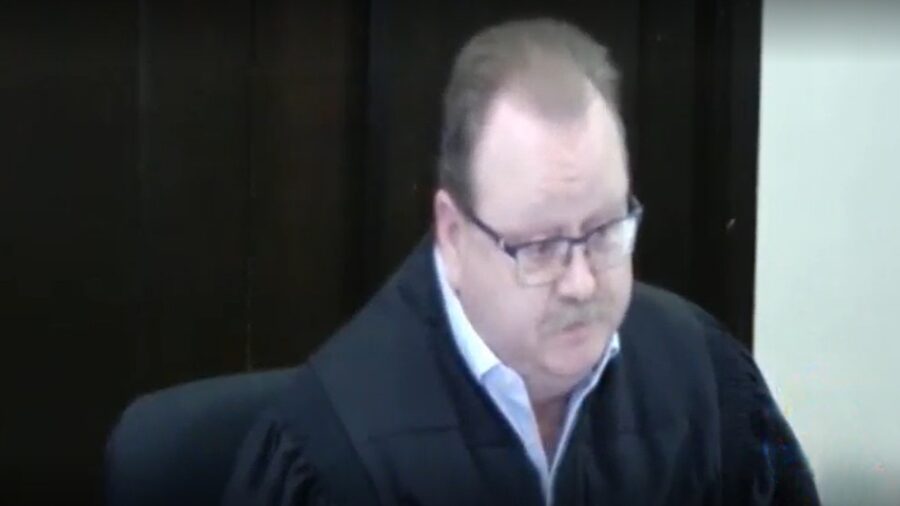
A Mason County Superior Court judge accepted an official admonishment on Friday after the Washington State Commission on Judicial Conduct found his comments during a February sentencing hearing violated judicial conduct rules by blaming a Native American community for the violence it experiences.
The commission’s Nov. 20 disciplinary order said Judge Monty D. Cobb’s remarks “could be perceived by a reasonable person, and were perceived by the complainants, to blame the Native American community for the violence it suffers,” according to MyNorthwest.
Cobb made the comments on Feb. 13 while sentencing Dale Red Hawk Laclair, a citizen of the Skokomish Tribe who pleaded guilty to second-degree manslaughter in the killing of another tribal member, Paul William Peterson Jr., on the Skokomish reservation.
“And it is extremely unfortunate that I see way too many acts of violence from the Native community,” Cobb told the court, according to the commission’s order. “It just seems disproportionate. You’re not the only place. It happens everywhere, but I see way too much coming out of your community, and it is sad, it really is.”

Witnesses described an audible gasp in the courtroom after the remarks, the commission wrote. Two people who attended the hearing filed complaints that triggered the investigation. The admonishment is the lowest level of sanction available and cautions Cobb against similar conduct in the future.
Cobb sentenced Laclair to 84 months in prison followed by 18 months of community custody, exceeding the standard range of 21 to 27 months and the 78-month cap prosecutors had agreed to recommend under a plea deal. The case unfolded amid tensions between the Skokomish Tribal government and Mason County, with some tribal members raising concerns that racism influenced the investigation and prosecution, MyNorthwest reported.
In his written response to the commission, Cobb accepted the sanction but defended his remarks as an attempt to recognize the trauma experienced by Indigenous communities, saying they were rooted in research and personal experience rather than racial bias.
“I certainly understand how the statement could be understood to say the violence is a result of the Native community and as that was never my intent, I feel terrible it has been received that way,” Cobb wrote in a letter to the commission.
He said he wanted the victim’s family to know their suffering had been heard, drawing on his experience as a judge and a previous homicide case involving Skokomish tribal members.
The disciplinary order, issued under CJC No. 13914-F-221, represents the lowest level of sanction available and required Cobb to promptly read and familiarize himself with the Code. Commission documents show no prior public disciplinary actions against Cobb in the commission’s published records.
The commission concluded, however, that his choice of words reinforced negative stereotypes. “Intention in words or actions does not override or cancel their impact on those receiving them,” the commission wrote, according to Native News Online. Commission documents also noted that courtroom observers believe Cobb “does not harbor a bias against Indigenous people or other marginalized groups, and that everyone is treated fairly in his courtroom.”
Worth a look

Unruly Passenger Attempts to Tamper With Cabin Door, Diverts American Airlines Flight to Phoenix
An American Airlines flight from San Diego to Chicago was diverted to Phoenix early Wednesday after a passenger...

Columbia Women’s Basketball Returns to Hawaii for Rainbow Wahine Showdown vs. Stanford, Hawaii, San Diego State
Columbia women's basketball travels to Honolulu this week for the American Savings Bank Rainbow Wahine Showdown, a three-game...

Uprise CEO Moves Startup to Las Vegas to Cut Noise, Focus on Customers
Fintech founder Jessica Chen Riolfi moved Uprise from Silicon Valley to Las Vegas in 2023 to cut the...

Syracuse vs. Albany: How to Watch Free Live Stream Wednesday (FuboTV, ACC Network Extra)
Syracuse hosts Albany at 6 p.m. ET Wednesday at the JMA Wireless Dome. The game streams free on...