
Whooping cranes are arriving late to their traditional Kansas stopover points this fall, according to reports from the Kansas Reflector.
The endangered birds, which typically begin appearing in early October, have been noticeably absent from key wetlands in Barton County. While birdwatchers usually expect the first sightings by now, the first local reports of the white cranes did not surface until last week. This delay has left observers at the Cheyenne Bottoms Wildlife Area waiting for the massive, seven-foot-wingspan birds to complete their journey along the Central Flyway.
“This has been an interesting year,” said Curtis Wolf, director of the Kansas Wetlands Education Center. Wolf’s center sits directly across K-156 from the Cheyenne Bottoms Wildlife Area, a wetland of international acclaim that serves as a vital pit stop for thousands of birds migrating from Canada to the Texas Gulf Coast.
The delay is largely tied to shifting weather patterns in the north. Mike Rader, a wildlife education supervisor for the Kansas Department of Wildlife and Parks, said that a warmer autumn in Canada has left the birds with little reason to depart their breeding grounds in Wood Buffalo National Park.
“They are finding what they need there,” Rader said.
These climatic shifts are becoming a recurring theme in avian migration patterns. Rader observed that the fall migration has been trending later in recent years, noting that whoopers were spotted at Quivira over Christmas in 2025, a time when the population has historically already moved south. This trend isn’t isolated to the whooping crane; other species, such as the sandhill crane, are also experiencing similar shifts in timing.

The uncertainty of the flyway
The lack of sightings in central Kansas creates a sense of unpredictability for conservationists and enthusiasts alike. Because the flyway is massive—stretching up to 1,500 miles wide—not every crane chooses to stop in Kansas, but the timing remains unusual. Wolf expressed concern that the delay might change the way the birds interact with the local refuges.
“They may arrive in one big mass or, feeling rushed, may bypass the refuges entirely,” Wolf said.
While the whooping cranes are late, the local ecosystems are still showing signs of life. Water levels at the Bottoms remain strong, and the area is seeing high numbers of ducks, shorebirds, and other waterfowl.
For those hoping to catch a glimpse of the elusive cranes, there is still a window of opportunity. The birds typically linger in the fall to feed on blue crabs and wolfberries before their final push to the Aransas National Wildlife Refuge in Texas.
The following table compares the current status of the species and its migration variables based on available data:
| Metric/Group | Details |
|---|---|
| Global Population | Estimated at more than 800 birds |
| Central Flyway Population | Approximately 550 birds |
| Florida Population | Around 80 nonmigratory birds |
| Louisiana Population | In the teens |
Whooping crane populations rebound despite ongoing threats
The recovery of the whooping crane is a fragile success story. While populations have begun to rebound over the last decade due to intensive conservation efforts, the species remains under constant threat. They face risks from habitat loss, power lines, natural predators, and illegal hunting. In the United States, killing a whooping crane is a federal crime that can result in a year in prison and a $100,000 fine.
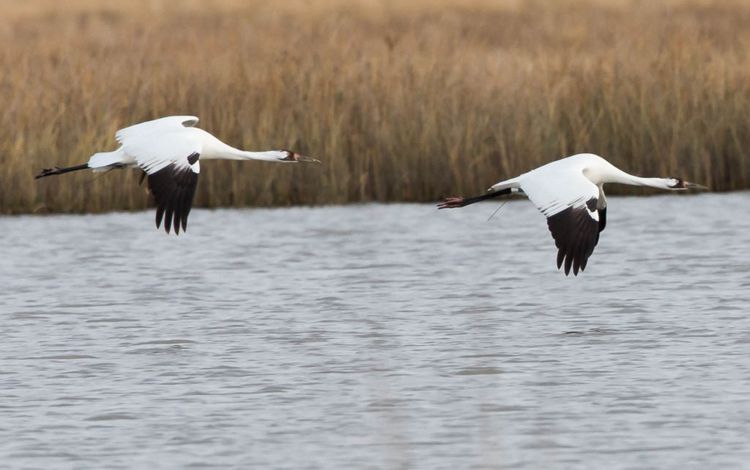
The biological reality of the species makes rapid population growth nearly impossible. It takes several years for a crane to reach breeding age, and even then, reproductive success is limited. Females often raise only one surviving chick per season.
“They just don’t have the capacity to keep up,” Wolf said.
“It’s a slow process,” Rader added, referring to the long-term effort of rebuilding the population.
The importance of the Kansas wetlands cannot be overstated. The 20,000-acre Bottoms and the 22,000-acre Quivira National Wildlife Refuge function as a complex designated under the Ramsar Convention as Wetlands of International Importance. These sites are among the most critical stopover areas in the Western Hemisphere for millions of migratory birds.
For birdwatchers, the cranes remain a “bucket-list” find. The first reports of this year’s migrants were noted by participants in the Audubon of Kansas annual Crane Festival, which was held last weekend in Sterling, just east of Quivira.

Mizzou Volleyball Beats Oklahoma 3-2 to Secure SEC Tournament Bye
Mizzou volleyball secured a first-round bye in the upcoming Southeastern Conference tournament by winning a five-set road battle...

USS North Dakota Arrives at Pearl Harbor to Join Submarine Squadron 1
The Virginia-class fast-attack submarine USS North Dakota (SSN 784) arrived at its new homeport of Pearl Harbor, Hawaii,...

Mayor Mamdani to Support CURB Act to Restrict NYPD Protest Tactics
Mayor Zohran Mamdani will announce Monday his support for a City Council bill designed to restrict how the...

FAA Ground Stop Causes Flight Cancellations and Delays at NYC Airports
A nationwide FAA ground stop triggered widespread flight cancellations and massive delays at New York City area airports...