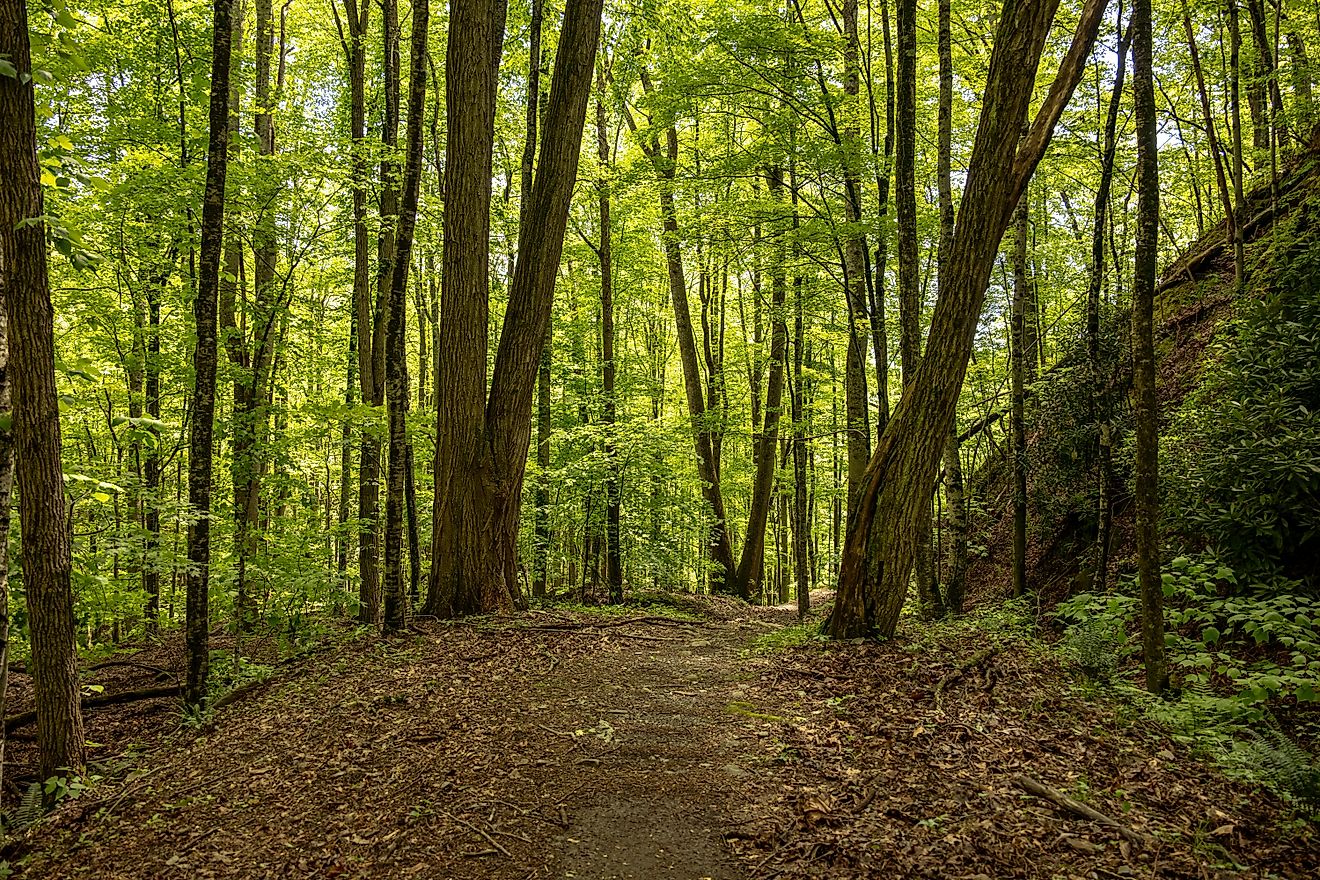
The Great Smoky Mountains’ Silent Record Holder
High above the forest floor, tucked away in a sheltered mountain cove within the Great Smoky Mountains National Park, stands a living monument to the region’s biological resilience. In 2011, a tree climber suspended by a rope dropped a measuring tape from the canopy to the earth, confirming a height of 191.9 feet. This tuliptree, known as the Fork Ridge Tuliptree, currently holds the title of the tallest known tree east of the Mississippi River. It is not merely a local curiosity; it represents the tallest native broadleaf tree ever accurately measured in temperate North America.
For ecologists, the tuliptree—also known as the tulip poplar or yellow poplar—is a masterclass in adaptation. In the rich coves of the southern Appalachians, these trees race toward the light, often reaching 85 feet before sprouting a single branch.
The Changing Guard of Eastern Giants
The crown of “tallest tree” has shifted over the decades as environmental factors and more precise measurement technologies have evolved. Before the Fork Ridge Tuliptree took the top spot, the record was held by the Boogerman Pine, an eastern white pine located in the park’s Cataloochee Valley. In August 1995, that pine was measured at 207 feet (63.1 m), the tallest accurate height recorded for any tree in the eastern United States in modern times. However, nature often intervenes in these records. Just weeks after that measurement, the remnants of Hurricane Opal tore through the region, snapping the pine’s top and reducing its stature to about 189 feet (57.6 m).
The transition from the Boogerman Pine to the Fork Ridge Tuliptree highlights the shift toward rigorous documentation. The Eastern Native Tree Society has been instrumental in this process, moving away from older champion-tree records to laser-assisted canopy mapping. Their methodology, which involves identifying the tallest crowns via aerial scans before conducting ground-level hand measurements, has provided a level of scientific accuracy that earlier foresters simply could not achieve.

This park contains a higher concentration of massive tuliptrees than any other location, a group that includes the Sag Branch Tuliptree, which possesses the greatest volume of any known tuliptree.
Why the Appalachians Retain Their Height
While the East has seen the majority of its original forests harvested for timber, the Great Smoky Mountains National Park offers a rare glimpse into the past. The park’s unique topography creates “sheltered coves” that minimize wind damage and provide the specific hydration levels required for such extreme growth. This geography acts as a natural sanctuary, allowing species to reach heights that are increasingly rare in fragmented forest tracts.
It is important to contrast these eastern records with the giants of the West. Although the Fork Ridge Tuliptree stands at 191.9 feet, it would appear quite small compared to the coast redwoods found in Northern California, a region where the Earth’s tallest tree reaches an elevation of over 380 feet (116 m).
The Search for the Next Record
The work of tree hunters remains ongoing, and the current record is by no means static. As technology improves, the likelihood of identifying even taller specimens in remote, unmapped coves increases. In 2023, for instance, a tree hunter identified a white pine in New York’s Adirondacks nicknamed “Little Foot” at just over 174 feet (53 m)—the tallest recorded tree in that state. These findings demonstrate that while the Smokies currently hold the regional championship, the potential for discovery across the eastern United States remains high.
Ultimately, these trees are survivors of a much taller, older forest that covered the continent before the era of industrial logging.
Keep reading

Cohen Habben leads Albany to 42-35 comeback win over New London-Spicer
Albany’s Second-Half Surge Secures State Tournament Berth The Albany Huskies were staring down a 21-point deficit in the...

West 13th Street is a nightlife destination, an InsideHook worker argues
The West 13th Street Nightlife Concentration In an essay published by InsideHook, a nightlife industry worker argues that...

Compromised New Mexico State team grateful for Gonzaga opportunity: ‘It’s really hard to …
New Mexico State Finds a Rare Opening in Gonzaga’s Schedule Jason Hooten, in his fourth season as coach...

Trenton Ironhawks to Honor 2005 Titans Championship
The rafters at CURE Insurance Arena are set to gain a piece of local history tonight. As the...