
The 1934 Meadow Gold sign, the size of a school bus with letters seven feet high, glows again in Tulsa after Claude Neon Federal Signs restored it.
Route 66 and the Tulsa company that first lit its roadside share a centennial this year, and the revival of neon along the old highway shows a change from LED retrofits back to hand‑bent glass. The National Park Service authorized a corridor preservation program in 1999, and a Tulsa Route 66 Commission grant program launched in 2019 has helped push the city’s count of lit neon signs past 100.
- Claude Neon Federal Signs, founded 1926, still operates in Tulsa with full‑time neon benders.
- Tulsa’s Neon Sign Park in Cyrus Avery Plaza displays recreated vintage signs including the Will Rogers Motor Court and Tulsa Auto Court.
- The 2019 grant program funds new neon, LED tubing, or restorations ahead of the Route 66 centennial.
- Interstate highways replaced Route 66 as a federal route in 1985, dimming most original signs for decades.
Craft survives on fire and mercury
Inside the CNF Signs studio, Tom Wolski heats glass tubes over open flame and bends them by hand, the same method Georges Claude pioneered in 1910.
“In this room you have extreme electricity. You have fire, you have phosphorus, you have mercury. It is kind of dangerous; you have to pay attention to what you’re doing. God knows why I would want to do this, but I love it,” Wolski said, laughing. He warned visitors to stand far back.
Senior designer Joe Kesterson argues the result cannot be matched by LEDs. “Neon glows, like a candle,” he said. “LED lights are brighter and sharper… once you see both of them together, you can see [the LEDs] have almost a harshness to the light.”
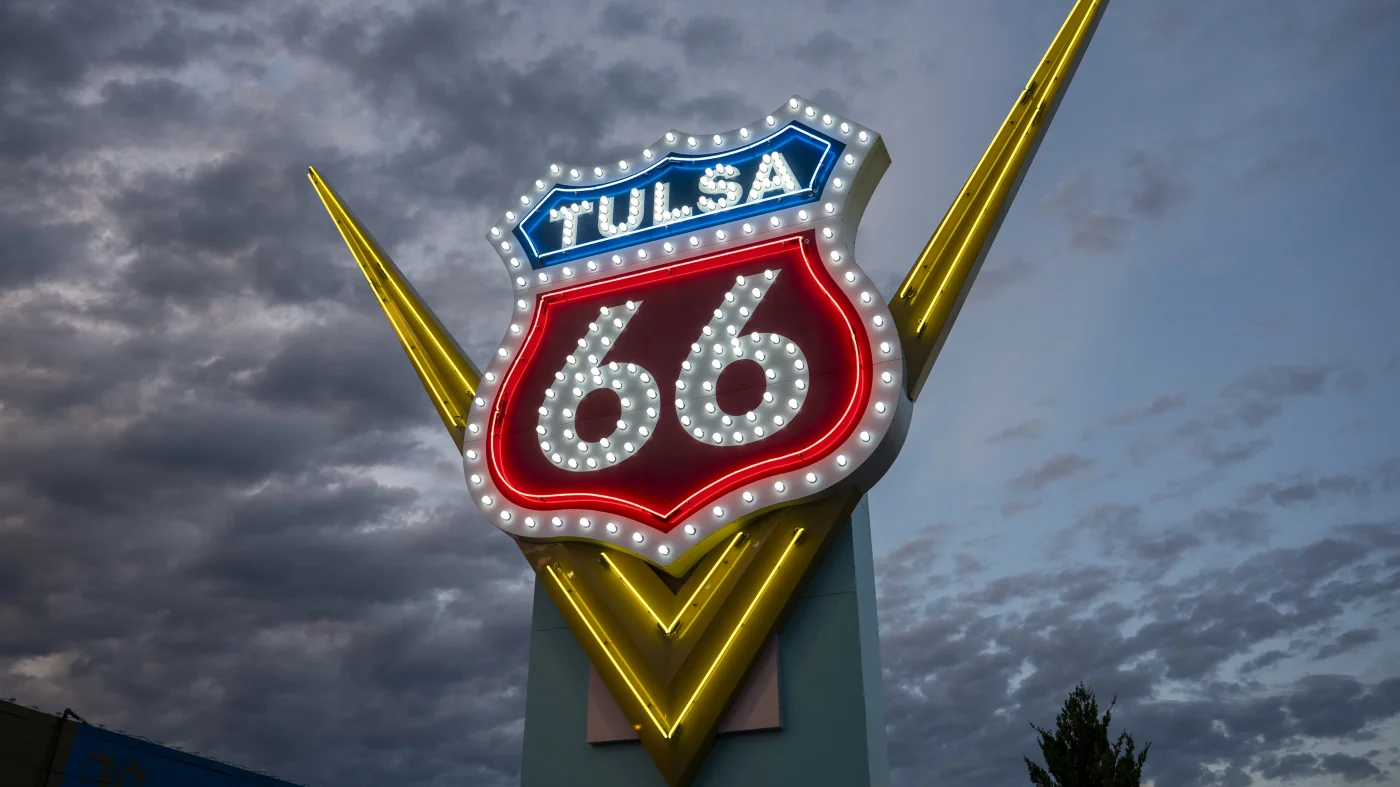
Neon gas creates red; argon powers cool colors
Not every “neon” sign uses neon gas. “Neon gas is red when it illuminates,” Kesterson told Georgia Public Broadcasting. “Anything that you see that’s got a warm color is usually going to have neon in it. But cool colors are made using argon gas.”
A few beads of mercury keep the gas molecules unstable and energized, and the argon‑mercury mix excites phosphor powder coatings inside the tubes to produce a spectrum of hues. “It never works like you think it would,” Kesterson said. “If I put blue gas in a yellow piece of neon, a lot of times it’s orange or some weird color that you would not expect.”
From migration route to neon corridor
Route 66 opened in November 1926 as the nation’s first paved highway, carrying Dust Bowl migrants, then World War II convoys, then vacationers. “Businesses that had neon seemed up‑to‑date, modern, new. Here’s a business willing to invest in itself,” said Kathleen Franz.
The 1950s brought Googie‑style animation — flashing arrows, looping lassos — and Tulsa went particularly big. The Meadow Gold sign, originally built by Claude Neon, was relit in 2009 after the building it adorned faced demolition. Now it anchors a district named for the dairy.
Neon signaled safe lodging to highway travelers
That impression signaled to travelers that the motel or restaurant was clean and safe, she added. Franz described the highway as a place where businesses needed something that would stop traffic and bring customers to their doorstep.
Joe Kesterson, senior designer at CNF Signs, said the bright colors are part of the mystique of Route 66 and what families saw traveling across the country.
The highway served first as the primary route for migrating farmworkers during the Dust Bowl and later as a military transport corridor in World War II, Georgia Public Broadcasting reported. That traffic created the gas stations, restaurants and motels that turned the road into a vacation corridor.
Tulsa park displays recreated vintage signs
Georgia Public Broadcasting reported that the signs cannot be seen from the modern highway but glow there nonetheless.
Nick Oxford for NPR photographed a neon sign beckoning visitors to the Desert Hills Motel along Route 66 in Tulsa. Kesterson said those bright colors are part of the mystique of Route 66 and what a child would have seen traveling with parents across the country. The park and the relit 1934 Meadow Gold sign anchor a district named for the dairy.
Preservation meets tourism
The 1999 National Park Service Route 66 Corridor Preservation Program authorized federal support for local restoration. Tulsa’s commission followed in 2019 with grants for neon or LED tubing, new or restored.
The Neon Sign Park sits on a quiet stretch of the old road beside the Arkansas River and railroad tracks, directly under I‑244. “You can’t see the signs from the modern highway, but they’re there, glowing,” Georgia Public Broadcasting reported.
Worth a look
- DOJ Awards Nearly $150 Million to Hire Over 1,000 Officers Through COPS Hiring Program
- Idaho Paid Hunters $24,000 to Kill 12 Newborn Wolf Pups in April
- Australia Passes Digital Diligence Law Letting Users Switch off Algorithms, Fines up to 5% Revenue (archyde.com)
- New Zealand's ruling coalition falls one seat short of majority in final election count (newsarchyuk.com)
DOJ Awards Nearly $150 Million to Hire Over 1,000 Officers Through COPS Hiring Program
The U.S. Department of Justice announced Tuesday it has awarded nearly $150 million in grants to 269 law...

Idaho Paid Hunters $24,000 to Kill 12 Newborn Wolf Pups in April
Idaho promised to manage wolves like other native carnivores but paid hunters $24,000 to kill newborn pups in...

Wyoming Unemployment Rate Rises to 3.1% in October, Still Below US 4.1%
Wyoming’s seasonally adjusted unemployment rate rose to 3.1% in October, up from 3.0% in September, the Research &...

Brown Men’s Hockey Travels to New Hampshire Saturday at Whittemore Center
The Brown men's hockey team (2-6-0, 2-6-0 ECAC) will travel to New Hampshire (7-6-1, 3-3-1 AHA) for a...