
24/7 Wall St. published an analysis Friday detailing how a $500,000 portfolio of four monthly-paying REITs and business development companies can generate roughly $28,450 in annual income while shielding the full amount from federal taxes inside a Roth IRA.
The report identifies Realty Income (NYSE: O), Main Street Capital (NYSE: MAIN), LTC Properties (NYSE: LTC) and EPR Properties (NYSE: EPR) as confirmed monthly payers whose distributions are taxed as ordinary income in standard brokerage accounts.
At the 24% marginal bracket — which for 2026 covers single filers with taxable income between $103,350 and $197,300 and joint filers between $206,700 and $394,600 — that portfolio would remit $6,828 to the IRS each year in a taxable account, according to 24/7 Wall St. calculations.
“Qualified Roth IRA distributions are not included in income,” the outlet wrote, citing IRS Publication 590-B and 26 U.S.C. § 408A(d)(1). The five-year holding period and age 59½ thresholds still apply for qualified status.
Yahoo Finance, covering the same strategy, framed the math around a $4,925 monthly target — roughly $59,100 annually — requiring about $768,000 at a 7.7% blended yield across six holdings including the Goldman Sachs Nasdaq-100 Premium Income ETF (NASDAQ: GPIQ), Broadstone Net Lease (NYSE: BNL) and Carlyle Secured Lending (NASDAQ: CGBD).
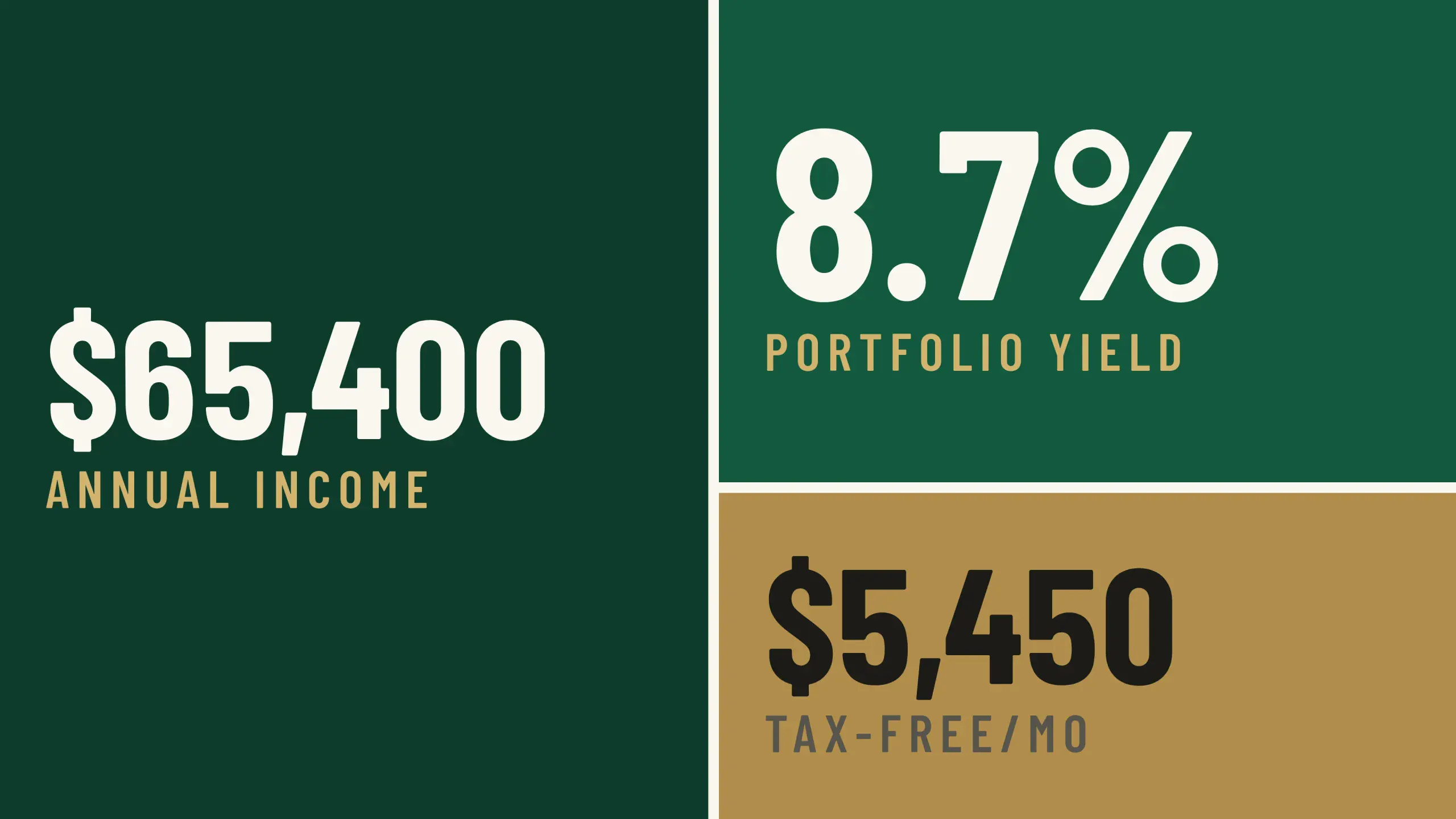
AOL later published a similar model targeting $5,450 monthly on roughly $754,000 using an 8.7% yield portfolio weighted toward option-income funds such as QQQI and Hercules Capital (NYSE: HTGC).

The Bottom Line:
- A $500,000 equally weighted portfolio of O, MAIN, LTC and EPR yields $28,450 annually; at the 24% bracket the Roth wrapper saves $6,828 per year versus a taxable account.
- Reinvesting that annual tax savings at 4% compounds to roughly $82,000 over ten years and $203,000 over twenty, assuming no share-price appreciation.
- Main Street Capital’s $0.30 December supplemental dividend pushes its trailing 12-month payout to $4.34 per share, all taxed as ordinary income.
Coverage Metrics Anchor the Four Picks
Realty Income’s forward dividend of $3.288 per share sits comfortably below 2026 adjusted funds from operations guidance of $4.45 to $4.46. Occupancy held at 98.8% and the REIT notched its 116th consecutive quarterly increase in September. Growth increasingly depends on European assets and a private-equity joint venture, adding currency and execution risk.
Main Street Capital posted third-quarter distributable net investment income of $0.96 per share, covering the $0.795 regular quarterly payout. Net asset value rose to $34.22. Non-accruals reached 3.5% of the portfolio at cost, and falling benchmark rates would compress floating-rate loan income.
LTC Properties maintained its $0.19 monthly payment since 2017. Third-quarter Core FFO of $0.71 covered the $0.57 dividend; 2026 guidance of $2.76 to $2.78 implies continued coverage. The REIT’s shift toward operating senior housing exposes results to third-party operator performance — total SHOP occupancy was 88.6%.
EPR Properties pays $0.31 monthly for a 6.32% yield, the highest of the group. 2026 FFO as adjusted guidance of $5.49 to $5.57 covers the $3.72 annualized dividend. Theaters represent 34% of base rent and the top ten tenants account for 68.0%. EPR suspended its $0.3825 monthly dividend in 2020 and restarted at $0.25 in 2021.
The Tax Drag Compounds
24/7 Wall St. modeled the 20-year opportunity cost: reinvesting the $6,828 annual tax savings at a conservative 4% return generates roughly $203,000 in additional capital that never materializes in a taxable account. At the 32% bracket the annual advantage widens to $9,104; at 37% it reaches $10,527.
The outlet recommends three steps before the next filing season: pull the prior year’s 1099-DIV to total nonqualified REIT and BDC dividends, multiply by the marginal rate, and compare the one-time Roth conversion tax against the recurring annual delta. A phased conversion starting with the highest-yield ordinary-income payers — Main Street’s supplementals and EPR — allows quarterly coverage monitoring.
Smart Money Tracker
Option-income ETFs such as GPIQ and QQQI pay monthly distributions that can fall when volatility contracts.
A senior credit analyst at a Mid-Atlantic asset manager said the monthly payment cadence is a marketing feature, not a credit feature. The analyst added that when a BDC trades at a premium to net asset value yielding 10%, the market is pricing in perfection — and perfection rarely survives a recession.
Main Street Bridge
For the typical investor contributing the $7,500 annual limit ($8,600 if 50 or older), building a $500,000 Roth portfolio takes decades. Conversions during low-income years — early retirement before Social Security and RMDs — remain the primary mechanism. The 2026 joint-filer phase-out for direct Roth contributions begins at $242,000 modified AGI, closing the front door for high earners and redirecting them to backdoor or mega-backdoor strategies.
Yahoo Finance said that a married couple with no other income converting roughly $151,000 annually for five years can fill the 22% bracket and fund a sizable Roth without climbing into higher marginal rates. That window narrows once required minimum distributions begin at age 75 under current law.
What Comes Next
Main Street Capital’s $0.30 December supplemental dividend is payable December 30 to shareholders of record December 16. Realty Income announced its 116th consecutive quarterly increase in September.
Realty Income was founded in 1969 by William and Joan Clark in Escondido, California, starting with a single Taco Bell sale-leaseback. The REIT went public in 1994, joined the S&P 500 in 2015, and has since declared 677 consecutive monthly dividends.
Its portfolio now spans more than 15,450 properties across the United States, the United Kingdom, and six other European countries, all under long-term net leases. The company holds a trademark on the phrase “The Monthly Dividend Company.”
Disclaimer: The information provided in this article is for educational and market analysis purposes only and does not constitute financial, investment, or legal advice. Always consult with a certified financial professional before making investment decisions.

Des Moines Council Ends Argonne Armory Talks With White Lotus
The Des Moines City Council will vote Monday on whether to kill a second redevelopment deal for the...

NU Regents Call Emergency Meeting to Vote on Project Health Hospital
The University of Nebraska Board of Regents called an emergency session for Friday at 10:30 a.m. to decide...

Trump Administration Moves to Dismiss Lawsuit Challenging Peltola Win
"Now that the election is over and the voters sent a very clear message about the direction they...

Bears Host Saints at Soldier Field After Bye Week
The Chicago Bears, sitting at 7-2 after a bye week, host the 3-6 New Orleans Saints on Sunday...