Beyond the Skyscrapers: The Peculiar Identity of Illinois Small Towns
When most people think of Illinois, their minds drift toward the architectural canyons of Chicago or the sprawling industrial hubs of the Midwest. Yet, a different kind of landscape exists just off the major interstates—a collection of towns where the local identity is defined not by global finance, but by 55-foot-tall wind chimes, prehistoric mounds, and a devotion to pop-culture iconography that borders on the surreal. According to a report by World Atlas, these small towns have cultivated identities that are anything but ordinary, turning roadside curiosity into a distinct economic and cultural engine.
This isn’t merely a matter of eccentric lawn art. For these communities, these “giant” installations serve as a deliberate strategy to capture the attention of a mobile, digitally-connected public. By leaning into the unconventional, places like Casey and Atlanta are transforming the traditional “drive-through” experience of rural America into a destination-based economy.
The Architecture of the Oversized
In Casey, the skyline is dominated by the Guinness World Records-holding “big things.” Local businessman Jim Bolin spearheaded an initiative to construct 12 massive objects, including a rocking chair and a mailbox, to anchor the town’s tourism sector. The centerpiece, a set of wind chimes standing over 50 feet tall, requires a steady breeze of at least six miles per hour to function. It is a striking contrast to the typical economic development models that rely on tax incentives to attract corporate headquarters; here, the investment is in the tangible, the bizarre, and the highly photographable.

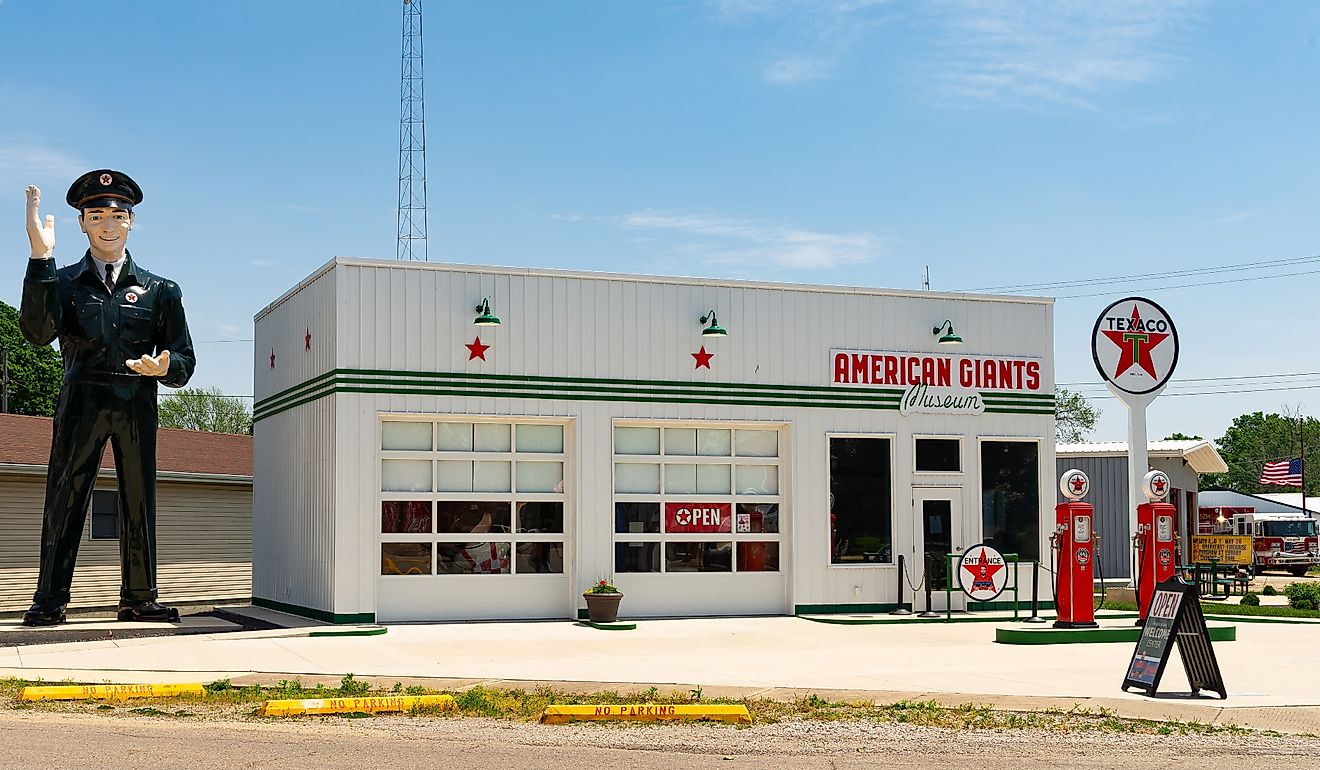
Atlanta, Illinois, offers a different look at this phenomenon. Located along the path of historic Route 66, the town hosts a collection of “Muffler Men”—fiberglass giants originally manufactured in the 1960s as roadside advertisements. While these statues were once ubiquitous across the American landscape, Atlanta has curated a density of them that is arguably unmatched. The American Giants Museum, housed in a structure designed to mimic a 1960s Texaco station, serves as the primary repository for this slice of Americana. Just a few blocks away, visitors can encounter a physical remnant of history on the Illinois Route 4 Driving Exhibit, which preserves a stretch of concrete roadbed laid down in 1924, grounding the town’s kitsch in genuine historical infrastructure.
Ancient Mounds and Modern Industry
Collinsville presents a rare collision of eras. It is home to the Cahokia Mounds State Historic Site, preserving the largest prehistoric earthen mound in the Americas—the 100-foot-tall Monks Mound. This site represents the remains of the largest prehistoric Native American city north of Mexico. Yet, just miles from this testament to ancient urban planning, one finds the World’s Largest Catsup Bottle. Originally a 170-foot-tall water tower built in 1949, it has been restored to its iconic form, capable of holding the equivalent of 640,000 bottles of catsup. Beyond these visual oddities, Collinsville maintains a significant hold on the global food supply, producing roughly 60% of the world’s horseradish, an industry celebrated annually at the International Horseradish Festival.

Cultural Icons as Economic Anchors
In Metropolis and Chester, the town identity is tethered to the fictional worlds of Superman and Popeye. Metropolis, which received its name in the 1800s, found its destiny redefined in 1972 when D.C. Comics officially declared it the home of Superman. The town now hosts a 15-foot-tall statue and the Super Museum, which claims to house memorabilia valued at $2.5 billion. The annual Superman Celebration draws nearly 30,000 visitors, a massive influx for a small municipality.
Chester, the birthplace of Popeye creator E.C. Segar, takes a similar approach. The Popeye Character Trail features 19 statues of the comic’s various figures, each equipped with QR codes that link to detailed character profiles. It is a sophisticated use of modern technology to deepen engagement with legacy media, proving that these towns are not simply resting on the laurels of the past, but actively managing their cultural assets.
The Amish Tradition and Dutch Heritage
Not all of Illinois’ peculiar identities are rooted in pop culture. Arthur remains the largest Amish settlement in the state, maintaining a rhythm of life defined by horse-drawn carriages and agricultural tradition. The Illinois Amish Heritage Center provides an educational counterweight to the town’s commercial attractions, such as the Great Pumpkin Patch, which grows 300 varieties of gourds from over 20 countries. Meanwhile, in Fulton, the town’s Dutch heritage is celebrated via the De Immigrant Windmill. Prefabricated in the Netherlands and shipped to the U.S. in 2000, the 100-foot-tall structure serves as a functional piece of cultural heritage on the historic Lincoln Highway.
These towns challenge the prevailing narrative of rural decline. While the economic stakes are high—often centering on the precarious nature of tourism—the success of these seven towns suggests that a unique, well-defined identity can be as valuable as any major industrial investment. As these communities continue to balance their eccentric local attractions with the realities of modern infrastructure, they offer a blueprint for how small-town America might thrive by leaning into the unusual.
Related reading

49ers Injury Update: Bosa and McCaffrey Cleared, While Evans and Samuel Ruled Out vs. Raiders
The San Francisco 49ers will head into their Week 9 matchup against the Las Vegas Raiders without three...

Joe Ricketts’ Straight Arrow News to Cease Operations
Straight Arrow News to cease operations as Omaha-based outlet winds down Straight Arrow News, the Omaha-based media organization...

Ella Swindle helps Texas volleyball sweep Missouri in Columbia
A Homecoming Performance: Ella Swindle Sparks Texas Volleyball For Texas Longhorns setter Ella Swindle, the return to Columbia,...

Historic Shift in the South: Scott Colom Leads in Mississippi Senate Race
In the Deep South, a political earthquake is currently measured not in tremors, but in a razor-thin margin...