
Astronomers have directly confirmed four white dwarf stars hiding within 65 light-years of Earth. Researchers used the Hubble Space Telescope to separate the dim dead stellar cores from the brighter red dwarf stars that previously masked them, updating the local stellar census within our cosmic neighborhood.
Four burned-out stellar remnants have been directly confirmed in the Sun’s immediate neighborhood. Lost for decades in the glare of brighter red dwarf partners, the objects lie within 20 parsecs, or about 65 light-years, of Earth according to findings reported in the Monthly Notices of the Royal Astronomical Society. A joint research team from the University of Warwick and the University of Colorado Boulder used ultraviolet observations to separate each faint remnant from its brighter companion.
Unmasking White Dwarfs in Visible Glare
A white dwarf is the compact core left behind when a star comparable in mass to the Sun exhausts its nuclear fuel and completes its lifecycle. Roughly the size of Earth, these objects pack immense density into a small volume, but their low luminosity makes them exceedingly difficult to detect directly when paired with larger stars. In ordinary optical images, the binary systems appeared as single points of light.

The first clues to their existence came from gravitational pull rather than direct sight. Researchers observed a substantial radial wobble in the red dwarf companions, a subtle back-and-forth motion indicating an unseen massive mass orbiting nearby. While the wobble confirmed a heavy companion was present, visible-wavelength surveys could not pierce the light of the larger red dwarfs.
To overcome this, the team turned to space-based ultraviolet instruments. Scientists used the Hubble Space Telescope and its Space Telescope Imaging Spectrograph to capture ultraviolet light, a spectrum where white dwarfs emit relatively more radiation than cooler red dwarfs.
“Nearby isolated white dwarfs are usually easy to find, but we couldn’t see these four stars directly in visible wavelengths because their red dwarf companions were drowning out their light. It’s a reminder that even in our own cosmic neighbourhood, we can still find surprises if we look in the right way, at the right wavelengths.”
Mairi O’Brien, University of Warwick
Because red dwarfs are notorious for throwing off intense stellar flares that can mimic ultraviolet white dwarf signatures, the team utilized the Swift observatory to ensure none of the systems were caught mid-flare, alongside custom calibration techniques to extract the faint signals.
The Long Search for Binary System G 203-47
The standout system among the four is G 203-47, located roughly 25 light-years away. The system was initially flagged as a binary in the 1990s, meaning pinning down its companion white dwarf took 27 years of investigation. That confirmation officially establishes G 203-47 as the ninth closest white dwarf to the Sun.
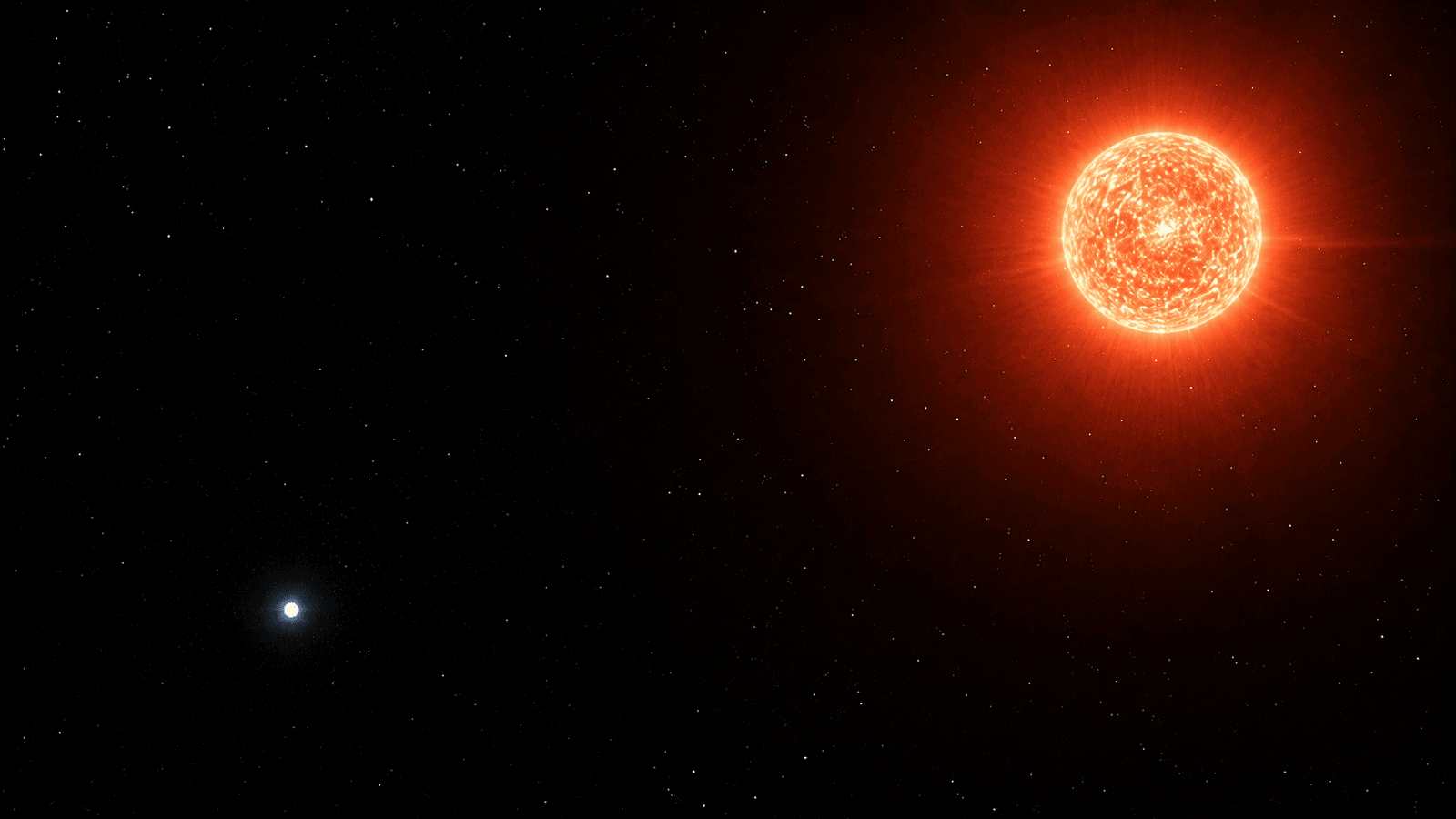
The system also exhibits unusual rotational mechanics. Its red dwarf completes a rotation once every 100 days or more, yet the two stars orbit each other every 14.9 days. In typical tight binaries, gravitational forces force the pair into a tidally locked state similar to the Moon and Earth, where the same face points inward continuously. The red dwarf in G 203-47 rotates far too slowly to be tidally locked.
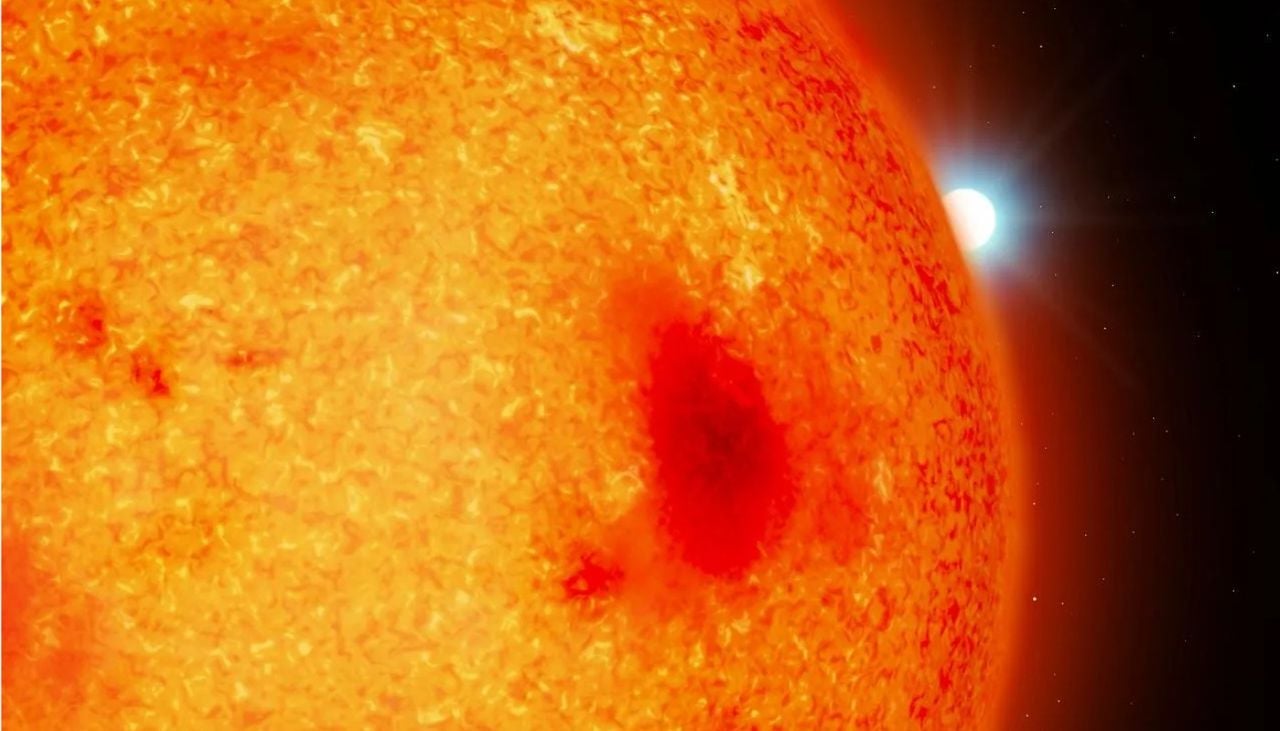
“What’s fascinating is that G 203-47 shouldn’t be rotating this slowly if it formed the same way as similar systems. This suggests that these binaries have had very different evolutionary histories. Some underwent violent, prolonged interactions early on that locked them tidally. Others, like G 203-47, experienced gentler, briefer encounters that left them in this unusual state.”
David Wilson, University of Colorado Boulder
These systems are classified as post-common envelope binaries, formed when a dying primary star swells into a red giant and briefly engulfs its companion in a shared envelope of gas before collapsing into a white dwarf core.
Validating Local Census Models and Stellar Evolution
Nonetheless, theoretical population models had estimated that four to five pairs of white dwarfs and red dwarfs should orbit closely together within 20 parsecs, aligning cleanly with the team’s discovery of exactly four.
Researchers note that only a fraction of nearby red dwarfs have been systematically examined for hidden companions, leaving open the possibility of additional discoveries in our immediate stellar neighborhood.
“Only about 30 per cent of red dwarfs within 20 parsecs have been systematically surveyed for hidden white dwarf companions. We think there could be as many as 9 or 10 additional binary systems in our local stellar environment that we haven’t found yet.”
Pier-Emmanuel Tremblay, University of Warwick
Further research will be necessary to confirm the existence of these hypothetical companions and determine their potential impact on our understanding of the local stellar landscape.
Keep reading

SpaceX Launches Final Three O3b mPOWER Satellites for SES
SpaceX successfully launched the final three O3b mPOWER satellites for SES on September 13, 2026, from Cape Canaveral...

Japan Launches Kaguya Spacecraft to Map Moon in 2007
On September 13, 2007, Japan launched its advanced Kaguya spacecraft from the Tanegashima Space Centre aboard an H-IIA...

Astronomers Identify Eos, a Massive Molecular-Hydrogen Cloud Near the Sun
Astronomers have identified Eos, a massive molecular-hydrogen cloud located roughly 300 light-years away and spanning 40 full-Moon widths...
Researchers Find Diamond Melting Point Is Lower Than Previously Measured
Researchers zapping synthetic diamond plates with a powerful ultraviolet laser discovered the mineral's melting point is more than...