
Astronomers have discovered what appears to be the first known pair of supernova remnants in the Milky Way. Using 16 years of data from NASA’s Fermi Gamma-ray Space Telescope alongside eROSITA X-ray observations, researchers linked a faint, overlooked remnant to a binary star system near the Jellyfish Nebula.
Yet until now, astronomers had never identified a definitive pair of surviving supernova remnants that originated from the exact same stellar pair.
That missing link may have finally surfaced in the cosmic backyard of the well-studied IC 443, commonly known as the Jellyfish Nebula. Researchers studying high-energy gamma-ray emissions noticed something peculiar tucked right beside the famous nebula, revealing a hidden companion with an extraordinary evolutionary past.
Uncovering G189.6+3.3 in the Shadow of the Jellyfish Nebula
The discovery centers on a faint, previously overlooked supernova remnant designated as G189.6+3.3. Researchers originally set out to characterize this neglected object, which had spent years completely overshadowed by its bright neighbor, IC 443. IC 443 is celebrated among astronomers as one of the best-studied remnants in the galaxy and serves as a premier laboratory for understanding how shock waves accelerate protons to produce cosmic rays.
By mining roughly 16 years of data collected by the Large Area Telescope aboard NASA’s Fermi Gamma-ray Space Telescope—spanning from August 4, 2008, to October 7, 2024—the research team successfully extracted the faint signal of G189.6+3.3. They paired those gamma-ray observations with ultraviolet, optical, radio, and X-ray data.
Instead of glowing uniformly, the newly analyzed remnant displayed a stark environmental split. Its northern half was dominated by accelerated protons, while its southern half was driven by electrons. Ultraviolet observations confirmed that the northern shock wave had slammed into a dense cloud of hydrogen gas, causing the shock to slow down and forcing fast-moving protons to collide and generate gamma rays.
Proving a Binary Origin Through Statistical Simulation
Finding two supernova remnants sitting side-by-side does not automatically prove they shared a single cradle. To rule out a mere coincidence of proximity, the scientific team constructed rigorous statistical models.
Because IC 443 interacts with that exact same dense hydrogen cloud, astronomers knew both remnants sat at roughly the same distance from Earth. To test whether their close quarters were accidental, the team simulated 1 million hypothetical binary star systems to calculate the probability of two unrelated remnants winding up so close together purely by chance. Depending on the simulation method, the odds landed between 1 in 1,000 and 1 in 100, making a shared stellar origin overwhelmingly likely.
The team also estimated the timeline of the twin explosions. The two blasts were separated by tens of thousands of years, a pacing that matches theoretical predictions for massive binary evolution. One star would explode first, disrupting the binary system, while its surviving companion continued moving through space until it eventually reached the end of its life and detonated as well.
Testing Stellar Evolution Beyond Theoretical Models
For generations, researchers have had to rely almost entirely on computer simulations and abstract calculations to understand how massive binary stars interact, alter each other’s lifespans, and ultimately die. This newly identified pair offers a rare real-world testing ground.
By measuring the exact distance between the explosion centers of the two remnants, astronomers gain a direct method for calculating the actual energy released by each supernova—a figure that previously relied purely on theoretical estimation. The findings were published in Nature Communications.
With this first verified analog now on the books, researchers plan to scan the rest of the galaxy for similar paired remnants. Uncovering more of these systems could finally answer long-standing questions about how companionship alters the final, violent chapters of stellar life.

SpaceX Launches Final Three O3b mPOWER Satellites for SES
SpaceX successfully launched the final three O3b mPOWER satellites for SES on September 13, 2026, from Cape Canaveral...
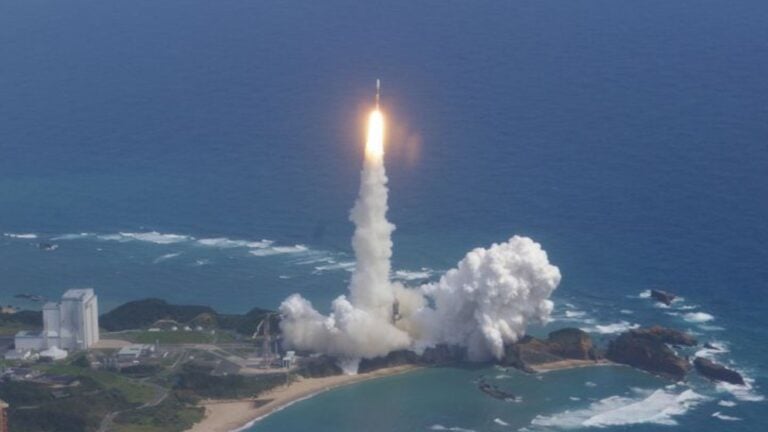
Japan Launches Kaguya Spacecraft to Map Moon in 2007
On September 13, 2007, Japan launched its advanced Kaguya spacecraft from the Tanegashima Space Centre aboard an H-IIA...

Astronomers Identify Eos, a Massive Molecular-Hydrogen Cloud Near the Sun
Astronomers have identified Eos, a massive molecular-hydrogen cloud located roughly 300 light-years away and spanning 40 full-Moon widths...
Researchers Find Diamond Melting Point Is Lower Than Previously Measured
Researchers zapping synthetic diamond plates with a powerful ultraviolet laser discovered the mineral's melting point is more than...