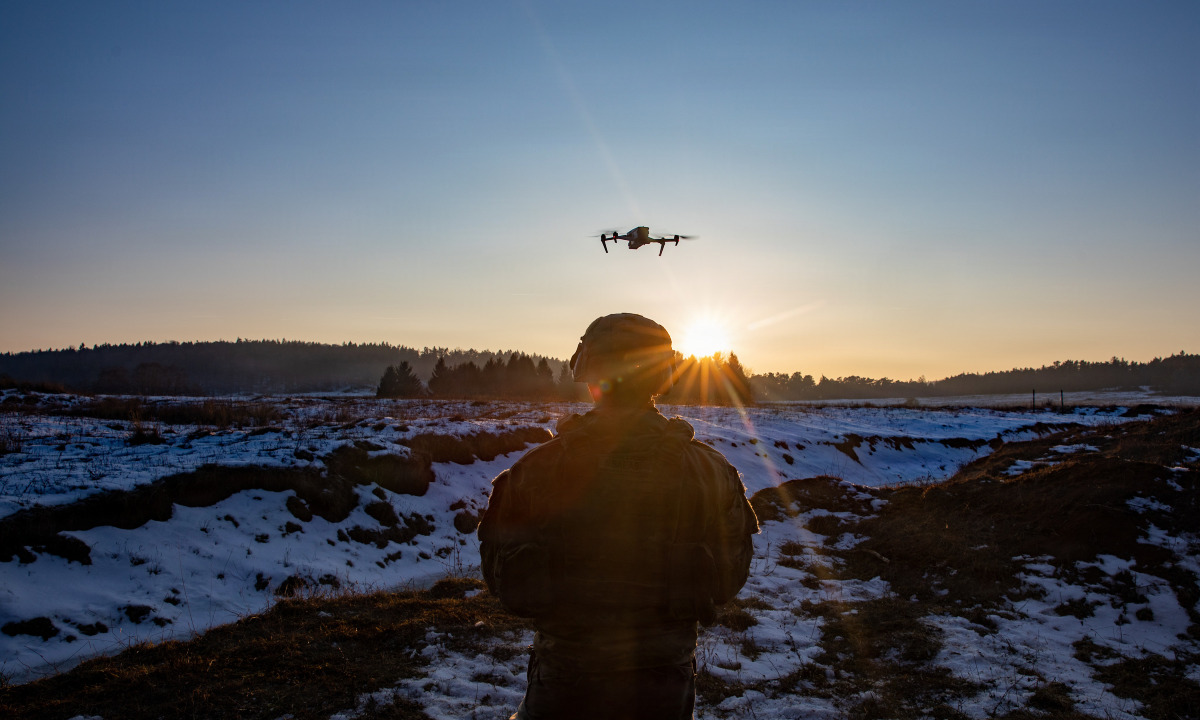
During NATO’s Hedgehog-2025 exercise in Estonia last spring, a British-Estonian battle group simulating standard battlefield movement was effectively wiped out by a small Ukrainian team operating drones and the Delta battlefield management system, demonstrating the devastating impact of saturated airspace on conventional military formations.
The Lethal Mathematics of a Transparent Battlefield
Modern military exercises are increasingly exposing the uncomfortable reality of combat in a saturated airspace. During NATO’s “Hedgehog-2025” exercise in Estonia last spring, a high-intensity scenario pitted a British-Estonian battle group numbering several thousand troops against a modest opposition force. Operating with tents deployed, vehicles positioned without cover, and traditional movement patterns, the allied force ran directly into the realities of modern surveillance.
Opposing them was a 10-person Ukrainian team utilizing the Delta battlefield management system. Within half a day, the small unit simulated the destruction of 17 armored vehicles and conducted 30 additional strikes. The drone density during the simulation reached 30 unmanned aerial vehicles over an area of less than 10 square kilometers—a figure representing only half of the density routinely observed on active parts of the Ukrainian front.
An officer participating as the adversary summarized the grim efficiency of the exercise with a stark metric: under those conditions, you can eliminate two battalions per day. The deeper shock of the scenario was the total elimination of traditional rear areas. When uncrewed systems, ranging from first-person-view quads to intelligence, surveillance, and reconnaissance platforms, maintain persistent watch, everything emits a signature, and logistics parks or assembly areas become instantly targetable.
Collapsing the Kill Chain Against Institutional Delay
The battlefield advantage demonstrated in Estonia relies on compression. Ukraine effectively squeezes detection, identification, decision, and strike into minutes. Data moves rapidly and widely, largely unencumbered by the institutional reflexes that drive conventional Western militaries to over-classify information.
By contrast, NATO units struggle with decision speed and information flow. The instinctive caution required to restrict sensitive data creates fatal delays. On a modern drone-saturated battlefield, delay equals destruction. While Western forces train for deliberate coordination, modern adversaries adapt continuously, pairing FPV drones with complementary platforms, deepening kill zones, and extending targeting persistence.
General David Petraeus noted that lessons are not absorbed automatically, requiring deliberate overhauls to doctrine, procurement logic, training pipelines, and personnel policies. Without structural reorganization around a permanently observed battlespace, traditional formations risk being outpaced by forces that treat information sharing as an immediate operational imperative rather than an administrative hurdle.
The Last Mile of Command and the Illusion of Control
Yet technology alone does not solve the fundamental mechanics of military leadership. The battlefield in Ukraine is increasingly transparent, lethal, and difficult to command. While unmanned aircraft watch far beyond the forward line, electronic warfare jams communications, and digital networks push targeting information at unprecedented speeds, these innovations leave the core challenge of leadership untouched.

Commanders face the persistent challenge of turning higher intent into effective action by real units operating under exhaustion, fear, incomplete information, and enemy action. Army Doctrine Publication 6-0 on Command and Control emphasizes decentralized execution precisely because headquarters cannot control every important action. This friction is hardly new. Nearly a century ago, Russian military theorist Aleksandr Svechin described the regimental commander as the individual responsible for translating high command plans into the language of life
, emphasizing the vast chasm between a written order and setting the physical bodies of soldiers into motion.
Contemporary headquarters possess vastly superior observation tools compared to their historical predecessors, but visibility creates its own hazard: the illusion of control. A brigade commander watching live drone imagery can observe events previously visible only to platoon leaders. While digital tools provide shared data, they do not automatically generate shared understanding. A digital icon shows unit location, but it cannot convey whether soldiers have slept in 48 hours, whether trusted noncommissioned officers were lost, or whether remaining combat power is sufficient for the assigned task as analyzed by the Modern War Institute. Greater visibility risks tempting higher echelons to micromanage tactical engagements, straining an already fragile chain of execution.
Bridging the Gap Between Intent and Execution
As armed forces navigate these pressures, the fundamental tension persists between technological transparency and human execution. The ability to watch a battlespace in real time does not replace the arduous work of command, nor does it guarantee that digitized forces can overcome the friction of combat without fundamental structural reform.

South Africa Mass Shootings in Wedela and Lwandle Kill 27 People
Two separate mass shootings in South African townships over the weekend killed 27 people within hours of each...

Malaysia to End Search for 55 Missing Citizens in Nepal
Thirty-three days after glacial flash floods struck Nepal, families of 55 missing Malaysians pressed government officials in Putrajaya...

Tigst Assefa Wins Berlin Marathon Despite Injury and Cramps
Ethiopian Tigst Assefa won the Berlin Marathon on Sunday, September 27, 2026, clocking the third-fastest time in history...

Bangkok Governor Chadchart Sittipunt Declares Citywide Flood Disaster
Bangkok Governor Chadchart Sittipunt declared a citywide flood disaster across all 50 districts on Saturday after nearly 300...