
Ghanaian Attorney-General Dr Dominic Akuritinga Ayine swore in an 11-member Constitution Review Implementation Committee on August 28, 2026, tasking the bipartisan panel chaired by Marietta Brew with drafting constitutional amendments to be placed before Parliament by November and subjected to a national referendum in 2027.
Mandate, Bipartisan Structure, and the November 2026 Deadline
Attorney-General and Minister of Justice Dr Dominic Akuritinga Ayine formally inaugurated the 11-member Constitution Review Implementation Committee at the Law House in Accra on Friday, August 28. The ceremony involved the administration of the official oath and the oath of the Constitution Review Implementation Committee by Dr Ayine. Dr Ayine emphasized that the committee has been given a time-bound mandate requiring the first set of constitutional amendment bills—specifically those addressing non-entrenched provisions—to reach Parliament by November 2026.
Describing the group during the proceedings, Dr Ayine stated, Your task is deliberately bipartisan and deliberately time-bound.
The inauguration follows the government’s position paper on recommendations contained in the report of the Professor H. Kwesi Prempeh Constitution Review Committee, which was established by President John Dramani Mahama last year. The government’s position paper, which endorses a substantial package of constitutional reforms, is paired with a prepared “zero draft” designed to assist the CRIC in its work. This foundational draft incorporates recommendations either fully accepted by the government or accepted with modifications from the earlier report, reflecting recommendations accepted by the government and those accepted with modifications alongside previous draft Bills prepared by an earlier implementation committee.
Translating Public Consultation Into Lawful Frameworks
The reforms stem from nationwide consultations that cataloged public demands regarding governance structures, executive limits, and citizen protections. Dr Ayine noted that the recommendations of the Constitutional Review Committee represented the views of Ghanaians gathered through consultations across the country.
What the committee gave us was not a technical document written for lawyers. It was the voice of the Ghanaian people on questions that touch every one of us, Dr Ayine said
Those core questions involve foundational aspects of the 1992 Constitution: how long a President should serve, the size of Parliament, how district assemblies should be elected and led, and how the fundamental rights and freedoms of citizens should be protected. The new committee must reconcile the government’s position paper with the recommendations accepted by the government, aligning them with the government’s position paper and previous draft Bills prepared by an earlier implementation committee. Dr Ayine observed that the country had done its part by stating what it wanted, while the government had also taken a position on the recommendations, adding, What is left is the most exacting part, getting the drafting right, and doing it in a way that keeps fit with the consultations that got us here.
The Chairperson of the CRIC, Marietta Brew, said the committee accepted the responsibility with an appreciation of its constitutional and historical importance, noting that the committee was not established to conduct another general review of the 1992 Constitution. Our responsibility is to translate the recommendations accepted by government into lawful, coherent and practical measures capable of implementation,
she said. Mrs Brew added that some of the reforms would require amendments to entrenched provisions and would therefore have to go through the referendum process, while others would require parliamentary legislation, subsidiary legislation, institutional reforms or administrative action.
Committee Roster and Institutional Representation
The 11-member roster reflects wide cross-sectoral representation, drawing from legal practice, state ministries, parliament, local government, and civil society. Marietta Brew, a presidential legal counsel and former Attorney-General and Minister of Justice, leads the committee as Chairperson.
Other key figures named in the official statement from the Ministry of Justice include Deputy Attorney-General Dr Justice Srem-Sai and Deputy Finance Minister Thomas Ampem Darko (also identified in reporting as Thomas Ampem Nyarko). Administrative roles are filled by Oliver Barker-Vormawor (also cited as Oliver Baker Vormawor) as Secretary and Salamatu Iliasu as Draftsperson.
Path to the 2027 Referendum
The current phase represents only the initial procedural hurdle. Because certain proposed reforms alter entrenched provisions of the 1992 Constitution, they cannot be enacted by Parliament alone. Those specific measures require approval via a national referendum.
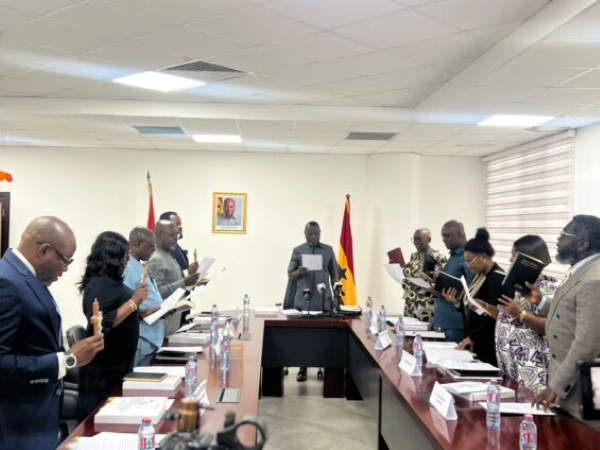
Government planners have aligned the referendum timeline directly with upcoming local elections. Dr Ayine confirmed that the constitutional amendments would ultimately lead to some of the proposed constitutional amendments being subjected to a referendum alongside the 2027 district assembly elections. Meanwhile, non-entrenched provisions and administrative changes will advance through standard parliamentary legislation, subsidiary rules, or institutional reforms managed directly by the committee to develop a comprehensive framework for implementing the proposed reforms.
Keep reading

King Harald V of Norway Dies at 89; Succeeded by King Haakon
King Harald V of Norway has died at the age of 89 at Oslo University Hospital, the royal...
Ombudsman Seeks Recusal of Justice Moreno in Revilla Malversation Trial
The Office of the Ombudsman has asked Sandiganbayan Associate Justice Ronald Moreno to inhibit himself from former Senator...
Police Captain and Suspect Killed in Knysna Shootout During Operation
A Western Cape police captain and a 38-year-old suspect died during an early Wednesday shootout in Knysna.

Quntis Monitor Light Bar Glow Features RGB LEDs and Ultrawide Support
The Quntis Monitor Light Bar Glow introduces a 20.1-inch metallic gray lighting system featuring an 88-front LED task...