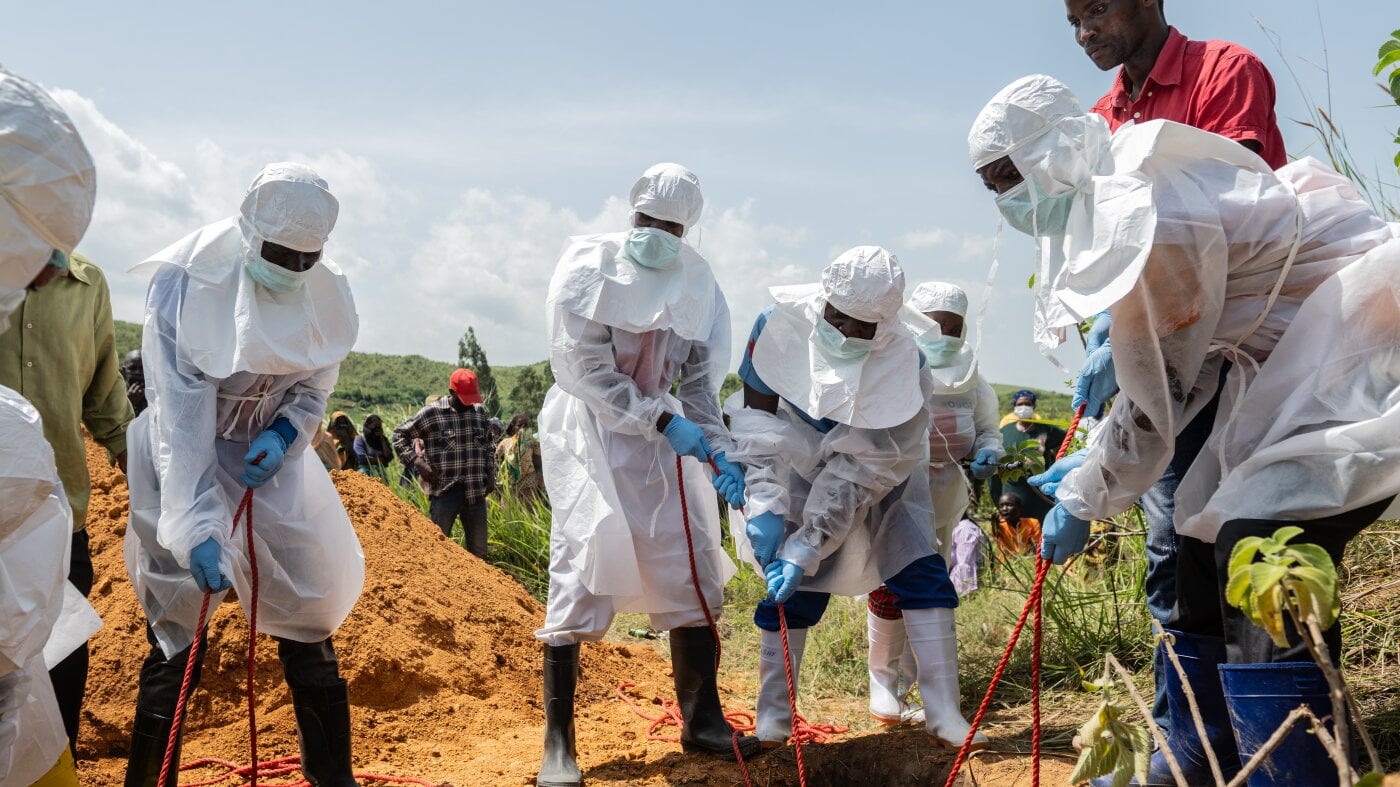
Health authorities in the Democratic Republic of the Congo began vaccinating frontline medical workers against Ebola in Bunia on Saturday, targeting an outbreak driven by the Bundibugyo strain that has surpassed 6,757 confirmed cases and 3,267 deaths.
The Democratic Republic of the Congo launched a targeted immunization drive on Saturday, administering the Ervebo vaccine to healthcare staff in Bunia, the epicenter of what public health officials describe as the deadliest Ebola outbreak in the country’s history. The campaign prioritizes front-line medical personnel in Ituri and North Kivu provinces, where workers face extreme operational hazards and heightened exposure to the virus.
Vaccinating Frontline Medics in Ituri Amid an Uncontrolled Spread
The vaccination rollout focuses on the Bunia and Mongbwalu health zones in Ituri province, areas that have experienced intense transmission and severe insecurity. Military Governor Maj. Gen. Gaby Kasongo Mulumba emphasized the vital role of medical personnel in containing the public health emergency, noting that health workers are particularly exposed and deeply involved in the response. Backed by the World Health Organization and Doctors Without Borders, the campaign aims to reach approximately 20,000 frontline workers over the next six to nine months across Ituri and North Kivu.
Government figures released on Saturday put the national total at 6,757 confirmed infections and 3,267 fatalities, with 1,590 recoveries. The epidemic, officially declared on May 15, 2026, has outpaced previous national crises and spreads under severe operational constraints, including armed conflict, population displacement, and localized health worker strikes.
The Scientific Challenge of the Bundibugyo Strain and Compassionate Use
Unlike previous equatorial outbreaks driven by the Zaire species of the virus, the current epidemic is caused by the Bundibugyo virus, a rarer strain for which no licensed vaccine or proven treatment currently exists. Health authorities are deploying the Ervebo vaccine—which was designed and licensed for the Zaire strain—under a compassionate-use framework because laboratory and animal data suggest it may provide some protection against related filoviruses.

The international allocation, secured through the International Coordinating Group on Vaccine Provision, delivered 70,000 doses of Ervebo to the country.
“We don’t know to what degree it might be effective against the Bundibugyo strain.”
Steve Ahuka, Congolese official on the Ebola health task force, via Aljazeera
Dr. Jeannot Elua acknowledged the necessity of the campaign at a local health facility, stating that we healthcare workers don’t really have a choice: we are going to receive it. Another clinician, Dr. Jean Paul Uzele, who received Ervebo during the country’s 10th Ebola outbreak, raised questions about revaccination protocols, asking whether we need to be vaccinated a second time.
Decentralizing Care and Facing Severe Staffing Deficits
As the virus stretches across six provinces, the World Health Organization and national health planners are shifting away from centralized facilities, constructing smaller treatment units closer to newly affected communities. Luca Fontana, a WHO technical officer, noted that nearly 1,400 treatment beds have been established across 59 centers. However, independent estimates indicate that an additional 1,600 beds are required to keep pace with transmission, bringing the target capacity to roughly 3,000 beds.

This physical expansion highlights a severe workforce deficit. WHO calculations dictate that operating each treatment bed requires approximately three trained medical personnel to maintain infection control protocols and continuous care. Meeting the 3,000-bed objective demands an estimated workforce of 9,000 medical staff, leaving health authorities short by roughly 5,000 trained health workers.
Logistical Strain, Financial Deficits, and Community Distrust
Fontana pointed out that outfitting personnel with complete personal protective equipment for a single entry into a patient zone costs roughly $25, an expense multiplied across hundreds of daily staff rotations. Compounding these financial pressures is a broader contraction in international humanitarian funding, which has left only a handful of major organizations capable of operating treatment centers in remote conflict zones.
In eastern Congo’s Ituri and North Kivu regions, responders also face entrenched community mistrust and misinformation. Local health clinics in Mongbwalu and Rwampara have faced violent attacks from residents influenced by rumors attributing the deaths to supernatural causes. These security incidents, combined with poor road infrastructure and active militant groups such as the Cooperative for Development of the Congo and the Allied Democratic Forces, continue to severely disrupt contact tracing and safe burial operations.
Related reading
Congo Begins Bundibugyo Virus Vaccinations for Health Workers in Bunia
Congo launched Ebola vaccinations in Bunia on Saturday for healthcare staff and frontline workers in the deadliest outbreak...

UK Government Urges Everyone to Take Daily Vitamin D Pill from October 1
People across the UK have been urged by the Government to begin taking a daily vitamin D supplement...

Chronic Stress And Inflammation Cause Silent Structural Heart Damage
A major UK study of nearly 480,000 adults reveals that chronic stress and long-term inflammation cause silent, lasting...

Max Planck Institute Unveils New Tools to Identify Pathogenic Variants
Researchers at the Max Planck Institute for Molecular Genetics have unveiled new bioinformatics tools called Dicast and TandemTwister...