
Researchers at the Georgia Institute of Technology have unveiled a wireless networking system that uses the human body’s natural conductivity to connect tiny medical implants and wearable devices. Described in the journal Science on September 24, 2026, the technology bypasses traditional radio waves like Bluetooth to enable coordinated bioelectronic treatments.
Turning Human Tissue Into an Onboard Wiring Harness
While consumer wearables easily track heart rates and sleep patterns using short-range radio signals, placing devices deep inside the body creates a hostile environment for radio waves. Bluetooth and Near Field Communication require bulky antennas, power-hungry communication electronics, and batteries that simply cannot fit inside microscopic medical instruments.
Engineers at Georgia Tech decided to stop treating human tissue as an obstacle. Instead of trying to punch radio signals through water-rich and ion-filled flesh, they built a system that uses the body as part of the network. The Smart Wireless Autonomous Networking System, or SWANS, transforms the body’s natural conductivity into a communication channel.
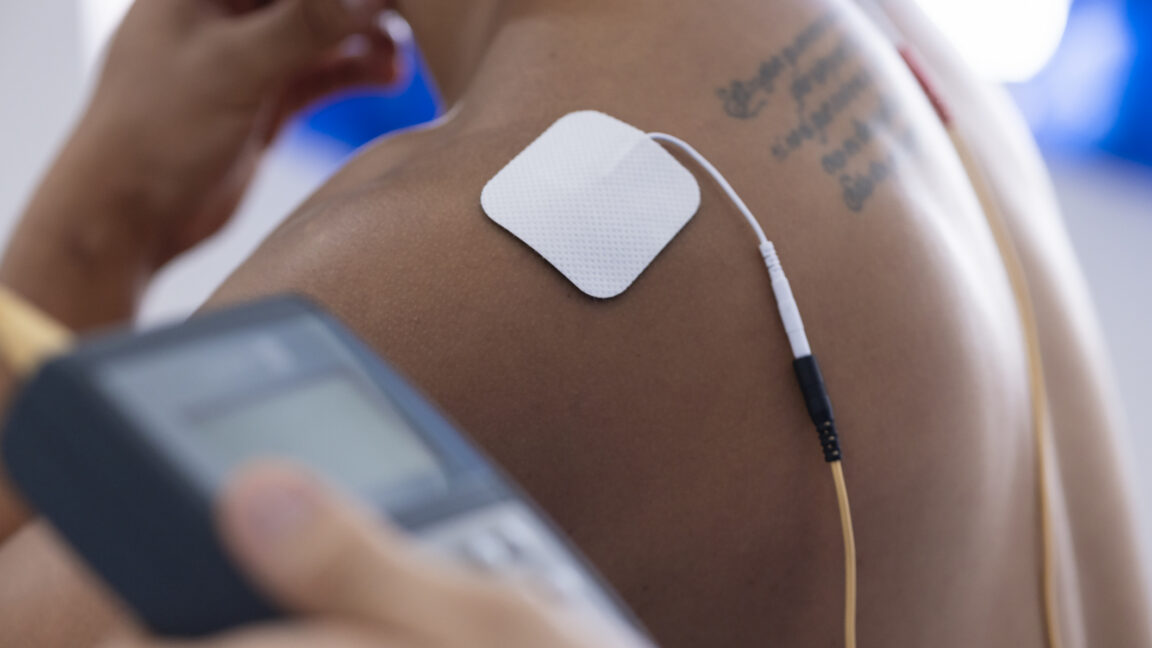
A wearable hub introduces imperceptible electrical pulses into the tissue, generating a localized voltage gradient. Tiny implants equipped with conductive pads and transistor circuits detect this threshold shift. When the signal exceeds a set level, the device switches on. Because different implants respond to distinct combinations of voltage and pulse duration, the hub can selectively target individual devices without turning on every implant at once. Lead study author Ramy Ghanim and co-author Joy Jackson tested the small implantable devices alongside Assistant Professor Alex Abramson, collaborating with researchers such as W. Hong Yeo, Yoon Jae Lee of Georgia State University, and Aristide Gumyusenge and Camille Cunin from the Massachusetts Institute of Technology.
Power Efficiency and Syringe-Injectable Scale
Because the internal implants use passive electronic components rather than active radio transmitters, they draw virtually no power while waiting for a command. This passive listening architecture makes the communication components more than 15 times as power-efficient as Bluetooth and NFC alternatives.
That extreme thrift translates directly to physical size. The complete implant with a battery measures 3 by 1.1 by 17 millimeters, while simpler network configurations can build implants smaller than 3 millimeters, allowing them to pass through a 6-gauge needle or be implanted via a syringe rather than invasive surgery. By the team’s findings, a tiny actuator triggered once a day can run for approximately a year before needing replacement.

“Pork belly is a very thick and heterogeneous tissue,” Abramson said.
Alex Abramson, Assistant Professor at the Georgia Institute of Technology
To test how signals travel through real organic material, researchers installed the system in chicken breasts, skin-on and bone-in pork bellies, and living rats. A single 10-volt pulse produced a detectable voltage gradient stretching more than 30 centimeters across tissue and up to 14 centimeters deep. That coverage reaches more than 10 times the distance of standard Bluetooth or NFC links inside the body.
Demonstrating Dual-Limb Control in Laboratory Testing
In proof-of-concept experiments involving rats, the research team successfully coordinated a full-body network of sensors and neural interfaces. Flexible strain sensors attached to the animals’ front limbs detected movement. A wearable hub translated that motion into a specific electrical pulse sent through the body tissues.
The signal reached an implant on the hind leg, which stimulated the sciatic nerve and triggered a natural walking twitch. The team also demonstrated an implant-to-implant relay where a temperature sensor passed a signal to a second implant only when it registered a fever above 40° C (104° F).
“We put our wearable on the stomach of the rat, and then we were able to get actuation in the back of the rat,” Abramson said.
Alex Abramson, Assistant Professor at the Georgia Institute of Technology
Safety evaluations during a two-month rat study showed that while scar tissue up to a millimeter thick grew around the implants, raising the voltage within safe limits maintained communication. The pulses did not alter heart electrical activity, disrupt untargeted nerves, or cause more cell death or oxidative stress than needles and implants that weren’t electrified.
Translating Bioelectronic Networks From Rodents to Humans
While the initial demonstrations in rats validate the underlying physics, moving the technology into human medicine introduces new scaling hurdles. Independent experts note that human bodies are bulkier and contain more fat than rats, which could limit how far internal signals can propagate without amplification.
Security is another critical design challenge for any implanted network. Hyowon “Hugh” Lee, a biomedical engineering professor at Purdue University and program manager at the U.S.
Despite those hurdles, the research team envisions broad applications ranging from automated drug delivery to advanced prosthetic integration. As first author Ramy Ghanim noted, automation improves outcomes and simplifies treatment regimens, while Abramson expressed the team’s ultimate hope to fully automate human health by delivering therapies exactly when and where needed in a coordinated fashion across disparate locations of the body. Yet the Georgia Tech team’s passive, tissue-wired approach offers a fresh path toward personalized bioelectronic medicine.
Related reading

PM Lawrence Wong Urges Economists to Prioritize Foundational Principles
Prime Minister Lawrence Wong cautioned Singaporean economists against easy policy solutions and uncritical reliance on artificial intelligence during...
AirPods 5 Earn Slightly Better Repair Score in Teardown Analysis
Apple's entry-level AirPods 5 introduce Active Noise Cancellation at a starting price of $129, while teardown analysts report...

Nvidia and AMD GPU Prices Surge Up to 40 Percent Ahead of Q4 Hike
Graphics card prices have risen in 2026, driven by factors such as memory shortages, rising silicon costs from...