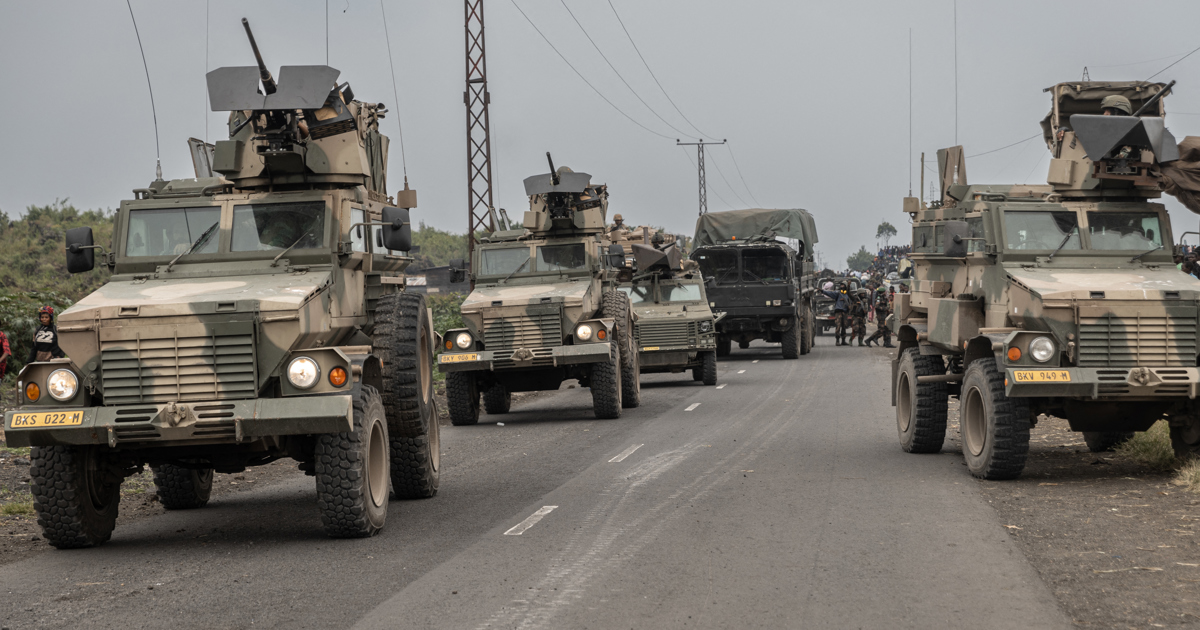
In January 2025, as M23 militia forces closed in on Goma, the Democratic Republic of Congo government deployed a coalition of international military contractors and local allies, including Romanian military contractors and Erik Prince-linked firms, to mount a last-ditch defense of the North Kivu capital.
As the Mouvement du 23 Mars militia advanced on Goma in January 2025, the government in Kinshasa attempted to defend the North Kivu provincial capital using a combination of local and international military partners, according to an investigation titled ‘Violence for Sale’ by the Geneva-based Global Initiative Against Transnational Organised Crime.
Contractors and Foreign Forces in North Kivu
Backing up the Armed Forces of the Democratic Republic of Congo during the campaign were Romanian military contractors, Israeli military trainers, and companies associated with Erik Prince, the founder of Blackwater and former US Navy SEAL. The GI-TOC report states that Prince secured a multimillion-dollar Congolese government contract, with Prince-linked contractors later providing drone surveillance and technical assistance to government forces.
_(cropped).jpg/1920px-Erik_Prince_(54359572482)_(cropped).jpg "DRC Deploys Erik Prince Contractors and Foreign Mercenaries to Defend Goma")
The investigation outlines a wider security apparatus involving multiple foreign entities. Israeli advisers were brought in to train two Congolese special forces battalions, while private security contractor Agemira RDC supplied aviation and procurement support to the FARDC. Vectus Global provided expertise to Congolese institutions to help protect natural resources, defend economic interests, and strengthen sovereignty over mineral assets.
The Role of Erik Prince and Vectus Global
Erik Prince’s efforts to establish a security presence in Congo trace back to at least 2023. Back then, United Nations specialists documented that Prince spearheaded talks regarding a proposal to station 2,500 security personnel from Argentina, Mexico, and Colombia in North Kivu to stem the M23 advance and safeguard mineral zones. That proposed deployment involved the United Arab Emirates and stemmed from an agreement between the DRC and the UAE brokered by Prince and engineered by an adviser to Congolese President Félix Tshisekedi. The UAE denied the existence of such an agreement, and the plan was ultimately abandoned.
Prince subsequently pursued other channels, visiting Kinshasa, meeting with officials, and eventually meeting Tshisekedi directly. In December 2024, Prince signed a five-year contract with the Congolese ministry of finance valued between $100m and $200m. The mission focused on the mining sector, specifically protecting mineral wealth, improving revenue collection, and tackling cross-border smuggling.
Vectus Global and Quantum Global Consulting act as representatives for Prince’s commercial activities within the DRC, according to GI-TOC findings. UN experts reported that Quantum Global Consulting, based in the UAE, established a Congolese subsidiary in June 2025, which subsequently registered Vectus Global in the country.
Rwanda Deploys Troops to Support M23 Rebellion
GI-TOC describes M23 as a proxy for Rwanda, citing documentation from UN experts regarding Rwandan military support. Documented assessments indicate that by December 2025, between 6,000 and 7,000 members of the Rwanda Defence Force had been deployed across North and South Kivu to back the M23 rebellion. While Rwanda has framed its involvement around security concerns regarding the Democratic Forces for the Liberation of Rwanda, the GI-TOC report argues that economic factors, including access to minerals and cross-border trade route security, are also central to understanding Rwanda’s involvement.
Kinshasa faced this offensive with an army plagued by well-documented internal struggles. The FARDC has suffered from poor coordination, corruption, inadequate logistics, and ineffective leadership. In December 2025, President Félix Tshisekedi acknowledged these shortcomings publicly, stating he had inherited an army of vagabonds
, while parliamentary reports also detailed serious deficiencies within the military.
The Congolese government, the country, was attacked by an external force. That’s the starting point.
Zobel Behalal, senior expert at GI-TOC and lead author of the report
Zobel Behalal on the Coalition and Wazalendo
Zobel Behalal noted that private military contractors were brought in to operate alongside Wazalendo, the local self-defence militia. Behalal cautioned that what started as a response to an urgent security crisis has ultimately created security conditions that are significantly more difficult to control.
Related reading
Captain Smit Machchhar Fights Off Attacker on Flydubai Flight
Captain Smit Machchhar fought off a mid-air cockpit attack during a Flydubai flight from the United Arab Emirates...
Downing Street Tests Public Support for UK Rejoining the EU
Downing Street is gathering evidence and testing public opinion on rejoining the EU, with senior officials consulting pollsters...

Trump Bans Canadian Alcohol Imports Under Smoot-Hawley Tariff Act
President Donald Trump implemented a trade ban on $800 million worth of Canadian alcoholic beverages on September 29,...

Pope Leo XIV Challenges Nvidia CEO Jensen Huang Over AI Safety Risks
Pope Leo XIV publicly challenged Nvidia Chief Executive Jensen Huang on September 28, 2026, rejecting claims that artificial...