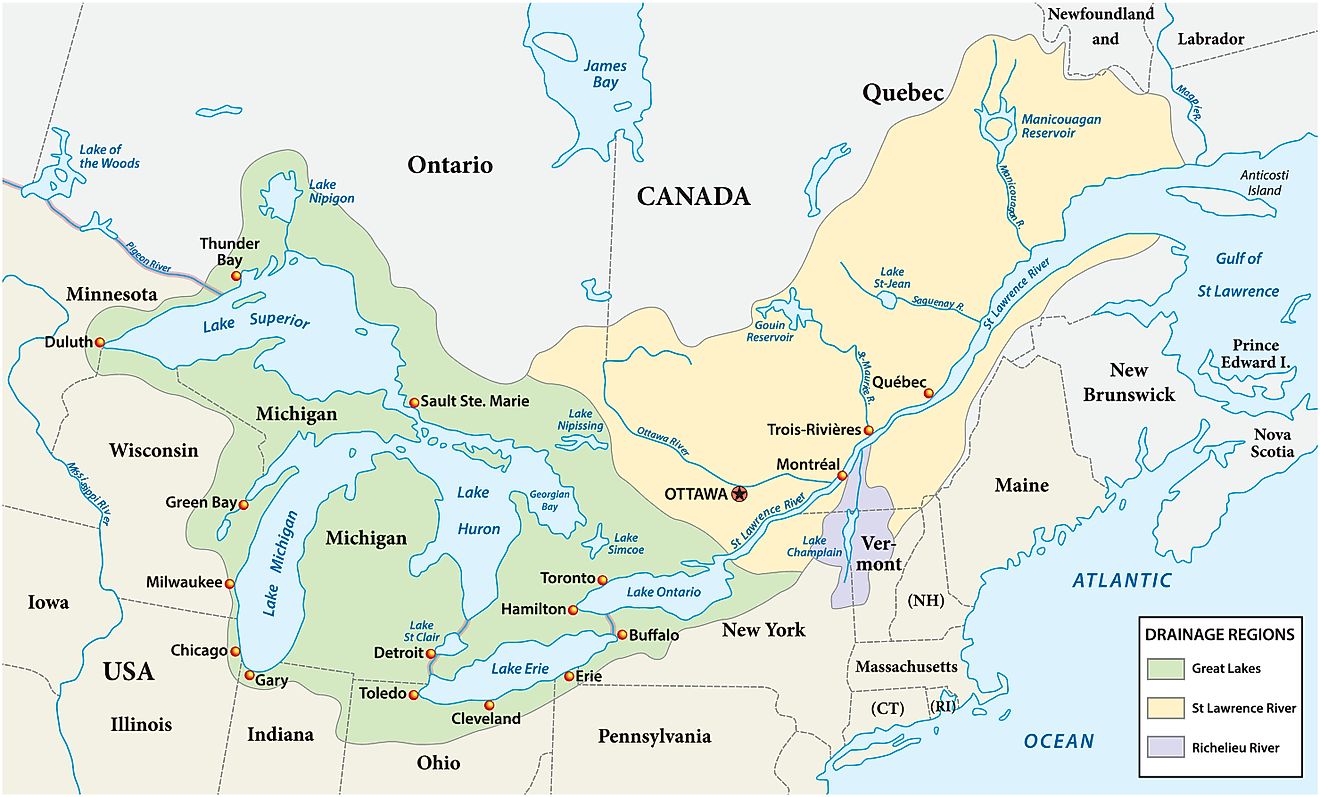
The Great Lakes do not drain into the Mississippi River because of a continental divide that is just 15 feet above Lake Michigan’s surface, a feature so low that French traders once carried canoes over it.
The divide at the Chicago portage sits roughly 15 feet above the surface of Lake Michigan.
The reason the lakes do not flow south today is due to their elevation and the path of least resistance. The sources explain that Lake Michigan is at 577 feet above sea level, and water must first climb twelve feet to cross the divide.
The eastern route, however, is downhill at every step, from Lake Michigan and Huron at 577 feet to Lake Erie at 569, and a dramatic 326-foot plunge at Niagara to Lake Ontario at 243 feet, before flowing to the Atlantic.
The current arrangement is not permanent. World Atlas reports that for a stretch of the late Pleistocene era, the Great Lakes did drain south into the Mississippi. Meltwater from the retreating ice sheet pooled in what was then Glacial Lake Chicago, which spilled over the Valparaiso Moraine, carving the Chicago Outlet River and flowing into the Mississippi system via the Des Plaines and Illinois valleys.

This natural connection was eventually severed when the ice retreated east, opening a lower St. Lawrence route, but human intervention became necessary to settle the matter. World Atlas states that it took a Supreme Court decree to determine how much water, if any, could still be diverted, ensuring the lakes’ primary flow remained eastward.
While the lakes and the Mississippi are geographically close, they are in separate drainage basins. Mikegravel.org clarifies that a drainage basin is an area of land where all surface water converges to a single point. The Great Lakes form a system that drains east into the Atlantic via the St. Lawrence River, while the Mississippi drains south to the Gulf of Mexico, separated by a continental divide.

“The definitive answer is no. While the Great Lakes and the Mississippi River are geographically connected within the same continent, they belong to entirely separate drainage basins, meaning that no water from any of the Great Lake directly flows into the Mississippi River.”
For early explorers and traders, the Chicago portage’s low divide was a critical link between the Great Lakes and Mississippi River systems. Around 1673, French explorers Louis Jolliet and Jacques Marquette, guided by the Kaskaskia tribe, traversed this six-mile portage, which connected the Chicago River to the Des Plaines River and enabled access from the Atlantic to the Gulf of Mexico.
Native Americans had used this route for nearly 2,000 years prior, facilitating trade in goods like shells from the Gulf Coast, galena from Illinois, and copper from Lake Superior, as evidenced by archaeological finds dating to 500 BCE.
Mikegravel.org notes that although man-made canals allow for limited water transfer between the basins, they are primarily for navigation and do not represent a natural drainage pattern. The continental divide remains the key factor, directing water in opposite directions based on gravity and the lowest point available.
Worth a look

Arizona Flu Cases Rising Early Faster Than Usual Ahead of Thanksgiving
Statewide cases reached 5,416 this season, with 1,484 in the past week alone Gateway Urgent Care visits up...

Hertz Hiring Manager Trainee in Albuquerque With Path to Branch Manager in 12-18 Months
Hertz is hiring a Manager Trainee for its Local Edition branch at 9231 Coors Blvd NW in Albuquerque,...

Devils Sweep Blue Jackets with Shootout Win Behind Hellebuyck
The New Jersey Devils beat the Columbus Blue Jackets 3-2 in a shootout Wednesday night at Nationwide Arena,...

Aubameyang Names Pedri as Barcelona Standout Ahead of Deportivo Reunion
Deportivo La Coruña striker Pierre-Emerick Aubameyang named Pedri as the Barcelona player who impresses him most ahead of...