One Thursday evening in May 2023, a New Hampshire audience heard how men once labeled “undesirable elements” became essential to winning a war for liberty they were denied.
Historian Glenn Knoblock traced that contradiction at the Laconia Public Library, drawing on research that shows free and enslaved Black men serving in state militias, Continental Army regiments, and on privateers and navy vessels throughout the nearly seven-year conflict. The program, funded by a NH Humanities Council grant, asked how African Americans came to fight for independence when their own freedom was not guaranteed.
Knoblock detailed how enlistment bans gave way to necessity, how Black soldiers served alongside white troops in integrated units rather than segregated ones, and how their post-war treatment ranged from manumission to broken promises. The presentation covered battlefield roles, interactions with white comrades, enemy perceptions, and officer assessments.
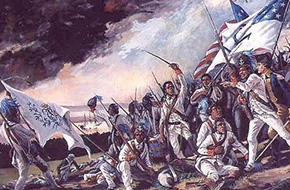
The NH Humanities program description posed the question: “Prohibited from serving in military units and largely considered ‘undesirable elements,’ how is it that these African-American soldiers came to fight for the cause of liberty, even when their own personal liberty was not guaranteed?”
That question captures the tension at the center of Knoblock’s work. The Laconia Public Library calendar listed the event for 6:00 p.m. on Thursday, May 11, 2023, in the Laconia Rotary Hall, open to the public at no charge.
African Americans, both free and enslaved, were key to New Hampshire’s Revolutionary War effort in militias, Continental units, and the Navy. Knoblock’s research restores the names and service of Black soldiers and sailors whom the historical record often reduced to a footnote or omitted entirely.
Both NH Humanities and the library calendar identify the same presenter, topic, date, and venue, confirming the event as a single public program rather than separate occurrences.
The contrast is stark: a colony that barred Black men from arms came to depend on them for manpower across land and sea. Knoblock examines the shift from exclusion to recruitment, the reality of integrated service, and the uneven aftermath — freedom for some, continued bondage or neglect for others.
No other outlets in the provided material cover this program. The NH Humanities description and the Laconia library calendar are the only verified sources. Both agree on the essential facts: the speaker, the subject, the sponsor, the date, the location, and the absence of an admission fee.
The library’s schedule shows the event nested among recurring community programs — storytimes, book groups, craft sessions — marking it as a one-time historical lecture within a regular civic calendar.
Knoblock’s talk addressed a question the Revolution itself never resolved: how a people denied liberty became indispensable to securing it for others.
OKC Animal Welfare Halts Dog Adoptions After Distemper Outbreak, Three Dogs Euthanized
Oklahoma City Animal Welfare suspended dog adoptions and intakes Thursday after five shelter dogs tested positive for canine...

Morris County Students and Their Families Will Breathe Cleaner Air on the Daily Commute
Morris County students and their families will breathe cleaner air on the daily commute after state officials directed...

LSU Travels to No. 9 Tennessee as 1.5-Point Road Favorite Saturday
LSU travels to Neyland Stadium on Saturday as a narrow 1.5-point road favorite against No. 9 Tennessee in...

MSU Denver Beats Colorado Mesa in Five, Plays Angelo State Friday
MSU Denver survived a five-set grinder Thursday afternoon, knocking off Colorado Mesa 3-2 in the NCAA Division II...