
Morris County students and their families will breathe cleaner air on the daily commute after state officials directed $3.61 million toward electric buses and chargers for two local districts.
The New Jersey Department of Environmental Protection announced the awards as part of a nearly $15 million statewide round that will put 44 zero-emission buses on the road and install 40 charging stations. Dover Public Schools will receive up to $1.05 million for three buses and three fast chargers, while Washington Township School will get up to $2.56 million for eight buses and eight fast chargers through its contractor, Highland Electric Fleets.
“We’re on a mission to deliver cleaner air and healthier communities, and the Electric School Bus Grant Program is delivering real results for our children and their families,” said DEP Commissioner Ed Potosnak.
The Morris County grants represent 11 of the 44 buses funded in this third round of the program, which was established by legislation signed in 2022 and draws money from the Board of Public Utilities’ Clean Energy Fund. Statewide, the latest awards bring the total number of electric school buses funded to 145, with 129 charging stations installed or planned.
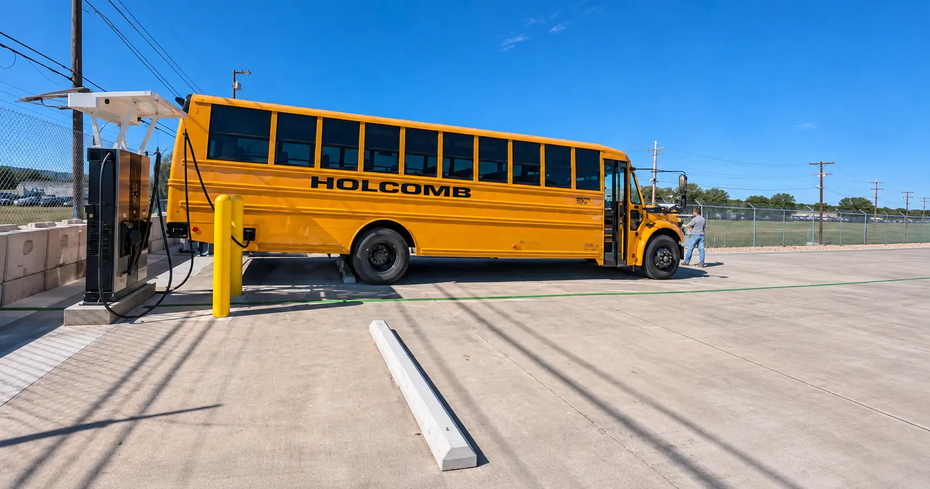
More than 99 percent of the roughly 21,700 school buses registered in New Jersey still burn fossil fuels, the DEP notes. Diesel exhaust carries sulfur dioxide, fine particulate matter and formaldehyde — pollutants the agency links to reduced lung function, worsening asthma and increased cancer risk. Children face outsized exposure because their lungs are still developing and they breathe at faster rates than adults.
Electric buses eliminate tailpipe emissions entirely, cutting that exposure at the source and improving air quality in the neighborhoods where the buses idle and travel.
The investment carries a second benefit. NJBPU President Ben Hertz-Shargel pointed to the newly announced Power Up NJ program, which will allow parked buses to feed stored electricity back onto the grid when they are not transporting students.
“When the buses aren’t in use transporting students, their batteries can be used to help balance the grid, earning money for schools and improving grid reliability for the community.”
NJBPU President Ben Hertz-Shargel
Hertz-Shargel said.
Grant recipients will also receive technical assistance through New Jersey Fleet Advisor, including a personalized Fleet Electrification Roadmap that outlines vehicle recommendations, projected costs and electrical infrastructure assessments. Eight of the ten recipients statewide are located in communities the state identifies as overburdened, and the awards split between six direct district grants and four to bus contractors.
The New Jersey Department of Environmental Protection was established on April 22, 1970, America’s first official Earth Day, making New Jersey the third state to consolidate environmental activities into a single agency. It began with about 1,400 employees in five divisions under Governor William T. Cahill.
Today the department operates with a staff of approximately 2,850 and carries out responsibilities from air quality enforcement and water monitoring to site remediation and the management of state parks and forests.
The latest funding follows $15 million awarded in 2024 for 48 buses and $18 million announced in January 2026 for 53 additional buses and charging infrastructure.

One Passenger Remains Hospitalized Week After Mississippi River Tanker Crash Into Docked Cruise Ship
One passenger remains hospitalized in serious condition a week after a tanker crashed into the docked river cruise...

Certified 2025 Mercedes-Benz GLB 250: 1,943 Miles, AMG Line, Driver Assist, Panorama Roof
Mercedes-Benz of Virginia Beach lists a certified pre-owned 2025 GLB 250 with 1,943 miles, below the market average...

Willamette Law Graduates Fill Critical Rural Attorney Shortage Across Oregon
Willamette University School of Law graduates are stepping into critical roles across Oregon’s rural counties, where 85% of...
Benson County Defeats North Star to Advance to ND Class B State Semifinals
Fifth-seeded Benson County toppled fourth-seeded North Star 3-1 in the North Dakota Class B state quarterfinals Thursday night...