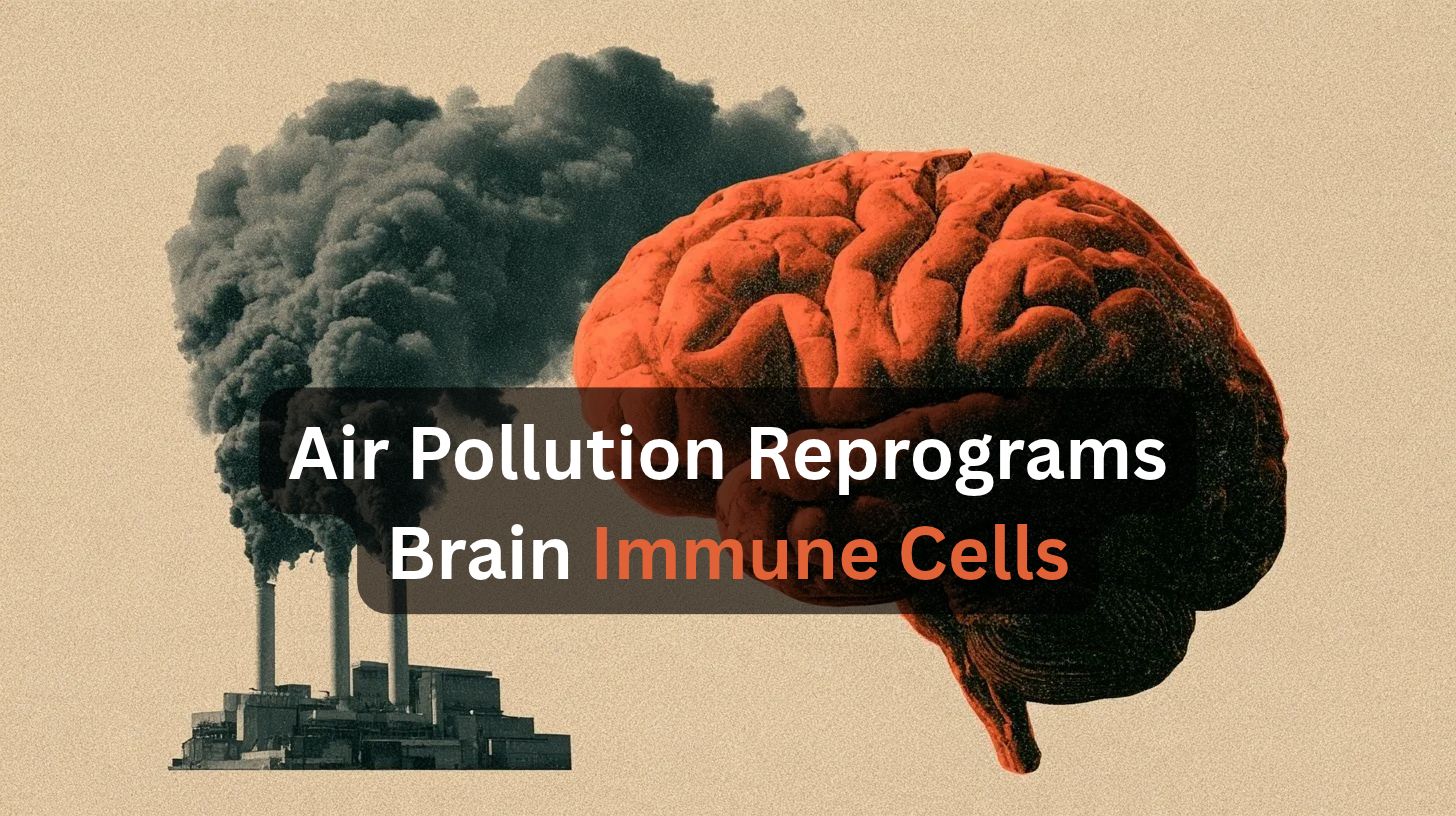
New research links long-term exposure to fine-particle air pollution with a 25% higher risk of dementia, and shows the damage occurs even in brains without the amyloid plaques that define Alzheimer’s disease.
The findings, published November 11 in the Journal of Neuroinflammation, combine epidemiological data from nearly half a million people with controlled mouse experiments that recreate the polluted air of major global cities.
- People in the most polluted third of U.K. areas had a 25% greater risk of Alzheimer’s or related dementias over 14 years.
- Risk rose regardless of genetic susceptibility, and the combined effect was smaller than simply multiplying the two risks.
- Mice breathing concentrated Cleveland air for five months developed memory deficits, a leaky blood-brain barrier, and hippocampal neuron loss.
- Microglia — the brain’s immune cells — were reprogrammed toward a pro-inflammatory state even without amyloid plaques.
Researchers analyzed health records from 475,325 U.K. Biobank participants tracked for up to 14 years, News-Medical reported. Those living in areas with the highest PM2.5 concentrations faced a 25% higher incidence of Alzheimer’s disease and related dementias than those in the cleanest third, after adjusting for age, smoking, diabetes and other factors. The association held across all levels of genetic risk.
A statistical interaction between pollution exposure and polygenic risk score was significant but sub-multiplicative (interaction HR 0.981, 95% CI 0.965–0.998; p = 0.026), Neuroscience News noted, meaning the joint risk was less than the product of the two individual risks.
To test causation, the team exposed otherwise healthy mice to outdoor Cleveland air concentrated to PM2.5 levels matching the world’s most polluted cities. After five months, the mice showed impaired memory, blood-brain barrier leakage, brain inflammation, a reduced NAD+/NADH ratio indicating depleted cellular energy, and increased death of newborn neurons in the hippocampus.
“By recreating in mice what happens when people breath polluted air, we found that pollution causes major changes in which genes are active in the brain’s immune cells,” said Sanjay Rajagopalan, professor of medicine and director of the Cardiovascular Research Institute at Case Western Reserve School of Medicine and co-senior author.
“These cells normally keep the brain healthy by clearing away debris and fighting infection. Seeing how pollution disrupts them helps explain how a stress that affects much of the world’s population harms the brain, and it points us toward a way to treat it.”
The microglial gene-expression shifts occurred in mice that never developed amyloid plaques. In mice genetically engineered to develop Alzheimer’s, the same pollution exposure accelerated plaque buildup alongside the other harms.
“We’ve identified a key way that air pollution harms the healthy brain and speeds up Alzheimer’s disease,” said Andrew Pieper, the Rebecca E. Barchas MD DLFAPA Eminent University Professor in Translational Psychiatry at Case Western Reserve and co-senior author.
“This helps us understand how factors in our environment can accelerate and intensify brain diseases of aging. It also opens the door to studying other environmental stresses on the brain, and to finding ways to keep the brain resilient even when we can’t avoid those stressors.”
U.K. Biobank is a long-term prospective study housing de-identified biological samples and health-related data from half a million volunteers recruited between 2006 and 2010 across Great Britain, with participants consenting to be followed for at least 30 years.
The resource holds more than 10,000 variables per participant — including genetic, imaging, and lifestyle data — enabling researchers to analyze 475,325 records tracked for up to 14 years and link residential PM2.5 exposure to a 25% higher dementia incidence while adjusting for genetic risk scores and covariates.
Worth a look
5.3 Magnitude Earthquake Strikes Nepal Near Sikkim Border, Tremors Felt Across North Bengal, India, Bhutan, Bangladesh, China
A magnitude 5.3 earthquake struck eastern Nepal near the Sikkim border on Tuesday at 7:02 am IST, shaking...

Taiwan CDC Confirms 4 Local Dengue Cases in Two Kaohsiung Clusters
Taiwan health officials confirmed four new locally acquired dengue fever cases on November 21 and 22, linked to...

EU and Indonesia Sign CEPA, Agree on ‘E-Commerce Moratorium’ – Digital Watch Observatory
The European Union and Indonesia signed a Comprehensive Economic Partnership Agreement on November 20 that will eliminate duties...

Scoping Review Finds LSD May Reduce Anxiety and Depression but Evidence Remains Preliminary
A scoping review of 51 clinical studies registered since 2014 finds that supervised LSD-assisted treatment may reduce anxiety...