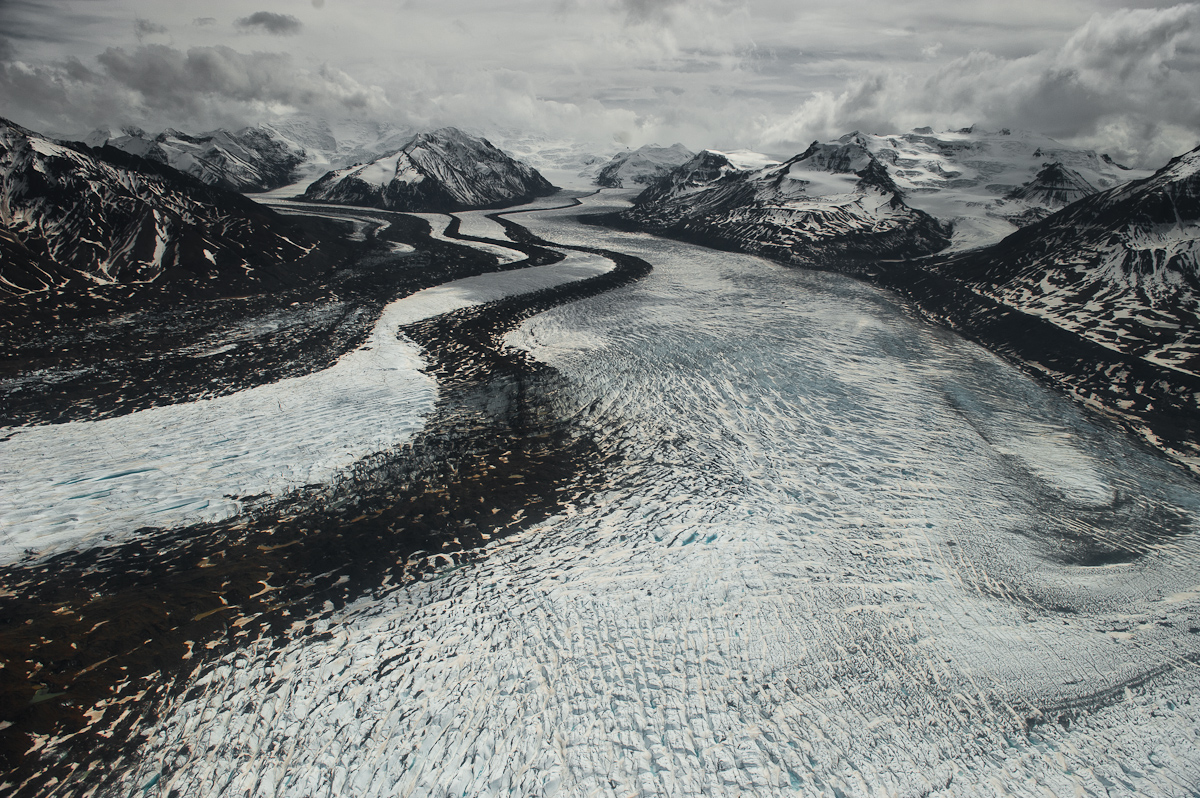
Alaska could lose as much as 75% of its glacial mass by the year 2100, according to research highlighted by the AGU Newsroom.
The scale of the projected melt depends heavily on the trajectory of global climate warming. Under various climate scenarios, the state is expected to see between 49% and 73% of its total glacial mass—measured against 2015 levels—vanish by the end of the century.
The implications for the region extend far beyond the loss of ice. Shrinking glaciers threaten to reduce the amount of meltwater available to downstream ecosystems and human communities, while simultaneously contributing to rising sea levels and increased flooding hazards. In all projected scenarios, every glacier currently smaller than one square kilometer in area is expected to disappear entirely.
A study published in Earth’s Future suggests that even the glaciers predicted to survive until 2100 face a precarious future; between 15% and 60% of those remaining will have stopped adding new ice, which will lead to their eventual disappearance.
Researchers attribute this massive loss of ice to two primary factors. While direct melting from a warming atmosphere is the main driver, a shift in how moisture reaches the Alaskan mountains is also accelerating the decline. Scientists expect a higher percentage of Alaskan precipitation to fall as rain rather than snow.

This change in weather patterns makes it significantly harder for glaciers to replenish themselves. When precipitation falls as rain, it lacks the ability to accumulate as the thick layers of snow required to build and maintain glacial ice. Without this consistent “recharging” of the ice mass, the existing glaciers continue to thin and retreat.
The loss of these frozen reservoirs creates a cascading effect on the physical landscape. For instance, recent research into debris-laden avalanches suggests that as ice and dirt mix, the resulting movement can become even more volatile. In a study in JGR Earth Surface, researchers found that tumbling ice and debris create vibrations that reduce friction, allowing avalanches to race down mountainsides faster than they would on a smooth slope.
The situation in Alaska mirrors broader, more systemic struggles to meet international environmental goals. While many nations have joined the Global Methane Pledge to cut emissions, current trajectories suggest policy is not meeting targets.
Under the 2021 pledge, most countries committed to a 30% reduction in global methane emissions between 2020 and 2030. However, a study in Global Biogeochemical Cycles indicates that current plans would likely only achieve an 11% reduction. While researchers note that existing technologies in the energy sector could still help humanity hit the target, the current pace remains insufficient.
These shifts are also being felt acutely in Europe, where warming is occurring at twice the global average. This is not solely due to greenhouse gases; expanding urban centers and agricultural fields are absorbing more sunlight and altering how air moves over the land, further intensifying the heat.
The economic consequences of these warming trends are often distributed unevenly. In China, for example, every half-degree Celsius of warming increases economic losses from flooding by 22% in impoverished regions, compared to a 19% increase in wealthier areas. This disparity highlights how climate instability disproportionately impacts those with the fewest resources to adapt to changing environments.
The 2026 AGU Annual Meeting in San Francisco, scheduled for December 7 to 11, will serve as a major venue for scientists to discuss these evolving data points and their long-term impacts on global stability.
Keep reading

Obituary: Dr. Raymond Russin, Distinguished Academic and Community Leader
Dr. Raymond Russin passed away on November 6, 2026, leaving behind a legacy defined by academic rigor and...

NWS Meteorologist Predicts Brief Showers and Thunderstorms for Phoenix
Phoenix could see showers and isolated thunderstorms as early as Friday afternoon, according to a forecast from the...

Gill: Asset Allocation and Diversification Drive Value in Wealth Management
Private wealth managers are increasingly shifting their value proposition from simple product selection to sophisticated asset allocation and...

Four UW-Eau Claire Volleyball Players Earn All-WIAC Honors
Four University of Wisconsin-Eau Claire volleyball players have been named to the 2026 Wisconsin Intercollegiate Athletic Conference (WIAC)...