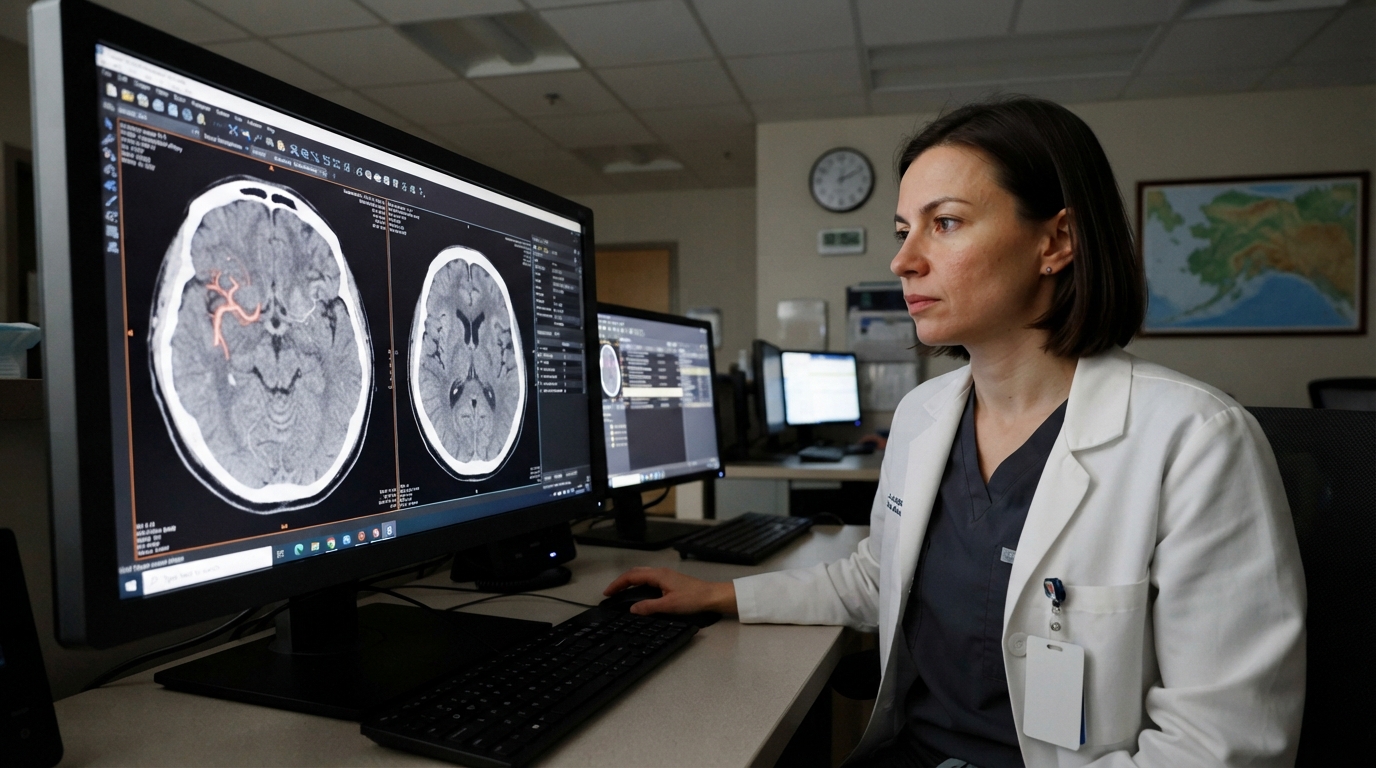
Alaska hospitals are flagging large-vessel strokes with AI in seconds, but no data yet show patients recover better because of it.
The Alaska Stroke Coalition, a volunteer nonprofit formed in 2023, has deployed RapidAI software across a network that will soon reach 21 acute-care hospitals and two CT-equipped clinics, Medical Daily reported. When a head CT suggests a large vessel occlusion, the system alerts the local emergency physician and the on-call neurointerventionalist in Anchorage simultaneously. A doctor must review every alert before a transfer is arranged.
The stakes are measured in minutes and miles.
Alaska is more than twice the size of Texas, and most of it cannot be reached by road. Only five neurointerventionalists in the state can remove clots from brain arteries, STAT reported. Some patients must travel roughly the distance from Dallas to New York to reach a thrombectomy suite, Dr. Lucy He, a neurosurgeon who sponsors the coalition, told AuntMinnie at the program’s launch.
Faster alerts, earlier transfers
The software flagged a suspected blockage seconds after his scan, and the local team called Providence Alaska Medical Center to arrange a transfer less than 30 minutes after his arrival — two minutes before the official radiology report came in, STAT reported. His clot was removed 4 hours and 23 minutes later, at least an hour sooner than the process would have taken without the AI, according to the account.
At Anchorage hospitals that perform thrombectomies, the time to begin the procedure has improved by about 30 percent, Medical Daily reported. Statewide clot-removal volumes have also risen recently, which may partly reflect the program, though the coalition has not formally published these results.
Outcomes still unmeasured
“Can I give you statistically significant information that RapidAI has made a big difference in the state of Alaska?” said Kelly Isaacs, Providence’s stroke program manager. “I can’t, really.”
Patient outcomes such as long-term disability and death cannot yet be measured.
Comprehensive Alaska stroke statistics have been lacking, and monitoring of results launched roughly when the software rollout did, Medical Daily reported. The technology also produces false positives, requires good image quality, and depends on perfusion imaging that smaller hospitals have not adopted consistently.

Coalition leaders stress technology not meant to move every patient
Kevin Myrick, a Providence stroke program coordinator and coalition co-founder, said the network was not installed to transfer every patient to Anchorage. The goal is to identify who truly needs thrombectomy and who can be treated locally, avoiding unnecessary flights across a roadless state.
Statewide clot-removal volumes have also risen recently, which may partly reflect the program, though the coalition has not formally published these results.
Foundation grant seeds expansion to six more hospitals
In exchange, those health systems agreed to report their performance for three years.
STAT reported on November 24 that hospitals in the network say the system is getting patients to treatment faster.
The Alaska Stroke Coalition, a volunteer nonprofit founded in 2023 and sponsored by neurosurgeon Dr. Lucy He, announced a three-year “Rapid AK” initiative with RapidAI on September 4, 2024, to advance health equity for stroke patients across the state.
The partnership deployed RapidAI’s core stroke imaging and workflow products to six additional hospitals, joining four already using the technology to expand a network dedicated to improving detection and treatment speed in rural regions.
Through collaboration with healthcare providers, stroke survivors, and community stakeholders, the coalition aims to enhance prevention, treatment, and rehabilitation to achieve better outcomes for residents in every region.
Funding and the road ahead
The coalition secured $3.2 million in initial funding from Alaska’s portion of the Rural Health Transformation Program, a five-year, $50 billion federal undertaking, Medical Daily reported. All six grant-funded hospitals have said they want to keep paying for the software after the grant period.
Alaska passed a law in June to set statewide standards for stroke and heart-attack care. The coalition hopes for at least two more years of federal funding. Medical Daily will report when Alaska publishes outcome data.
Related reading

Boise Venues Offer Homeschool Field Trips on Raptors, Rivers, History
Boise offers a diverse calendar of homeschool programs and free educational resources for families. The Idaho State Museum...
Pentagon Contractor Designed Nevada Bunker for UAP Materials, Says BAASS
A Pentagon contractor designed a 5,000-square-foot underground bunker in Nevada to store "exotic material or tissue" related to...

Author Reflected on 15 Years of Iowa Wildflower Wednesday Series
In a column for Bleeding Heartland, an author reflected on 15 years of the "Iowa wildflower Wednesday" series....
Monroe Spent Thanksgiving at Home After Nearly 14 Hours Pinned Under ATV
Marvin Monroe, 69, will spend Thanksgiving at home with his wife after surviving nearly 14 hours pinned beneath...