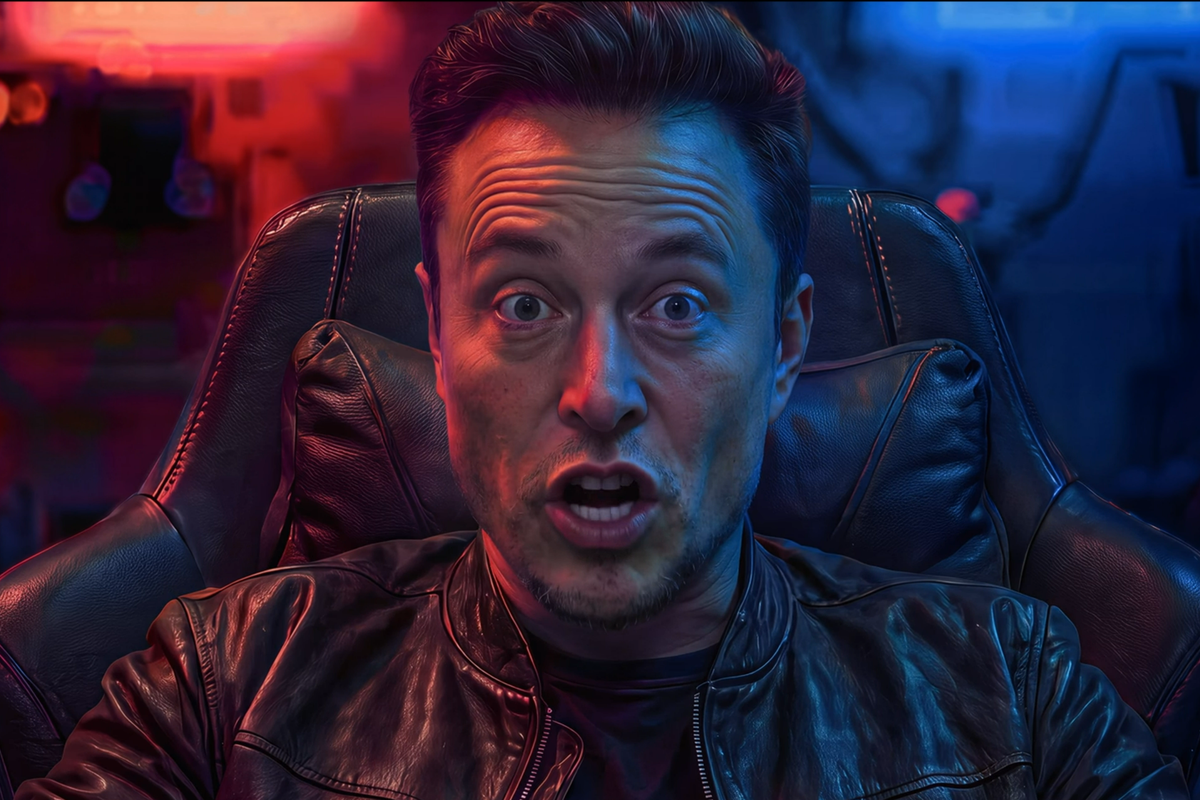
Alex Gibney’s four-hour documentary Musk opens with a simulation, but the most synthetic thing in the film isn’t the subject’s theory of reality—it’s the director’s choice to build an AI stand-in for the billionaire himself.
Three hours and fifteen minutes into the runtime, a video-game avatar of Elon Musk picks up a chainsaw from the Resolute Desk in a first-person shooter sequence, lightning arcing from the blade as it destroys government buildings labeled USDA, 404 Media reported.
But the AI avatar—rendered with an oversized head, exaggerated features, and seated in a gamer chair bathed in dated Twitch-stream lighting—appears throughout as a simulated interviewer. Gibney told the International Documentary Association he leaned into the "air of unreality" because Musk believes we live in an ancestor simulation, using the avatar to "explore the tools of deception and manipulation to get out the other side."
In practice, the device backfires. Every line the AI Musk speaks is a direct quote from real interviews—with Jordan Peterson for The Daily Wire, Bill Maher on Real Time, Kara Swisher, Joe Rogan, and at CPAC—and in every instance the original footage, with its context and crosstalk, is more revealing than the approximation.
When the avatar recites Musk’s line about his estranged daughter Vivian—”They call it dead naming because, uh, your son is dead. So my son is dead. Killed by the woke mind virus”—the Peterson interview’s tension vanishes. When it paraphrases the “most entertaining outcome” catchphrase, the Swisher and Rogan dynamics disappear.
The Video-Game Metaphor Feels Like a Boomer Grasp at Gen-Z Aesthetics
The interstitials lean hard on a pink-filtered, Grand Theft Auto VI-style visual language. The avatar selects character classes—gamer, founder, Kublai Khan—drives a digital track where Tesla’s stock price rises like a high score, and vaporizes Twitter employees with Iron Man gauntlets.
The DOGE chainsaw rampage ends with a nuke dropped on the National Nuclear Safety Administration and the inauguration salute rendered as a pixel-art score screen. The film even includes an intermission during streaming, reinforcing the sense of a marathon that mistakes length for gravity.

After publication, Musk’s public relations team reached out to 404 Media to say the avatar was built with CGI and hand-designed, and that AI was only used to sync sound to the image, a representative from Falco Ink told the outlet.
Gibney told Edward Niedermeyer the process involved an AI artist at Makemake and considerable refinement, not a generative “press a button” workflow. The distinction does not change the on-screen result: a hyperreal grotesque that distracts from the documentary’s central argument that Musk is a destructive force in business and politics.
“You need to embrace the air of unreality in order to bring a sense of reality to bear. You have to explore the tools of deception and manipulation to get out the other side. That’s why we came up with the AI avatar of Elon Musk.”
Falco Ink
Gibney has made a career of penetrating powerful institutions—Enron: The Smartest Guys in the Room, Going Clear, The Inventor. Here, the subject refused to participate, and the workaround becomes the story.
The avatar doesn’t deepen the portrait; it sanitizes it, replacing the friction of real interviews with a compliant digital puppet that grins evilly on cue. The chainsaw sequence at the three-hour mark isn’t satire—it’s the film indulging the very simulation logic Musk sells, leaving the viewer further from the man than when they started.
Keep reading

Jensen Huang Says He Would Return as Nvidia CEO If Board Asks
Nvidia co-founder Jensen Huang said Tuesday he would return as chief executive if the board asks him to....
3 Zodiac Signs Have A Quick Test From Mercury & Black Moon Lilith On November 18 – YourTango
The cosmic calendar hits a turbulent patch on Wednesday as Mercury aligns with Black Moon Lilith. While market...

First Contestant Eliminated From I’m a Celebrity Before Making It Into Camp – RTÉ.ie
TV presenter AJ Odudu became the first contestant eliminated from I'm A Celebrity…Get Me Out of Here! without...

Robert Pattinson to Play James Bond in New Film Directed by Denis Villeneuve
Denis Villeneuve is set to direct the upcoming film, which is expected to be released in 2028 according...