
Ohio woke up Wednesday to a political landscape transformed, with Democrats capturing the governor’s mansion, a U.S. Senate seat, and key down-ballot offices after voters cast more than 1.7 million early ballots statewide. The Ohio Capital Journal reported that Franklin County alone saw in-person early voting surge 87 percent over 2022 levels, a groundswell that powered what analysts are calling a genuine blue wave through the Buckeye State on this November 4, 2026 election.
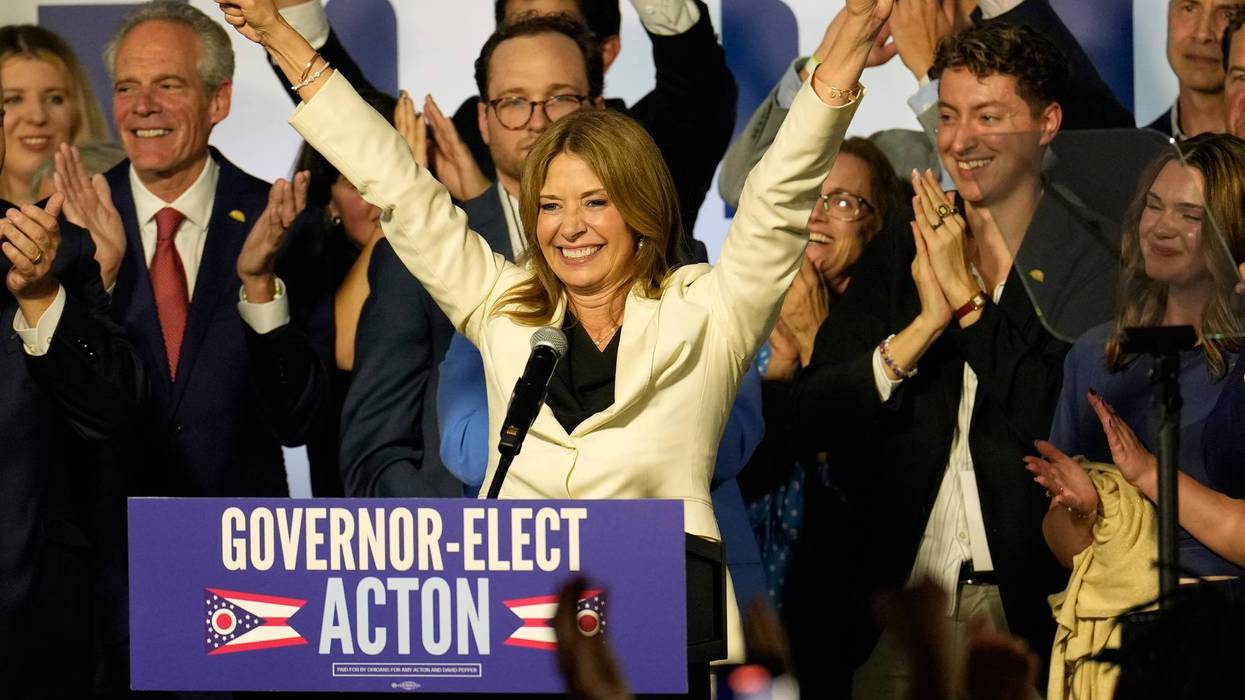
The biggest prize went to Amy Acton, who defeated Republican Vivek Ramaswamy by a 52 to 44 margin to become Ohio’s next governor. Her victory ends a two-decade Republican hold on the state’s top office, marking the first time a Democrat has won since Ted Strickland in 2006. Acton will replace outgoing Governor Mike DeWine, who completed his second four-year term and was ineligible to run again due to term limits. She also makes history as the first woman elected to the office and the first Jewish governor of Ohio.
Acton Promises Unity in Victory Speech
In a statement released Tuesday night, Acton framed her win as a mandate for bridge-building rather than partisan warfare.
“Tonight, Ohio has chosen unity and decency over division and hate,” Acton said. “Ohio is ready for a Governor who will fight to lower costs, take on corruption, and build a state where everyone gets a fair shot. Regardless of who you voted for, I will be a governor for all Ohioans.”
The governor-elect’s message of bipartisanship comes as Republicans grapple with losses across the statewide ticket, though the party did manage to hold onto the auditor’s office.
Brown Returns to the Senate After Four Years Away
In Washington, Sherrod Brown reclaimed his U.S. Senate seat, defeating appointed incumbent Republican Jon Husted 50 to 45. Brown, who previously served as senator from 2007 to 2025, had vacated the seat when JD Vance won it in 2022; Vance resigned in 2025 to become Vice President, leaving Husted to serve as the appointed replacement.
“Thank you, Ohio,” Brown said simply. “Let’s get to work.”
The race drew national attention not only for its competitiveness but also for the presence of Greg Levy, a Socialist candidate running as an independent who received financial backing from Republican PACs and managed to capture two percent of the vote.
Central Ohio Congressional Races Flip and Columbus Remakes Its Council
Incumbent Democrat Joyce Beatty crushed Republican challenger Cleophus Dulaney 77 to 23 to retain Ohio’s District 3, which covers the north and east sides of Franklin County. Meanwhile, in the 15th District, Democrat Don Leonard unseated incumbent Republican Mike Carey 52 to 45, flipping a gerrymandered district that stretches from south and western Franklin County into rural areas around Springfield and Dayton.
🚨🔵🎉 BREAKING NEWS: OHIO DELIVERS A DOUBLE DEMOCRATIC VICTORY! 🎉🔵🚨 🔥 TWO RACES! TWO BIG WINS! ONE HISTORIC ELECTION NIGHT! 🔥 OHIO HAS SPOKEN! 🗳️👏🏾 Congratulations to Dr. Amy Acton and Sherrod Brown on their victories in the November 3, 2026 midterm elections! 🏛️ DR.… pic.twitter.com/KTlMpQR22v
“We didn’t win this race by playing it safe,” Leonard said. “We didn’t hide from tough issues, water down our beliefs or let polling tell us what to stand for.”
Columbus voters also approved Issues 8 and 9, fundamentally restructuring how the city elects its council. The measures convert the nine existing district seats from citywide at-large voting to district-only voting, while adding four new at-large seats to bring the total council membership to 13. The expansion will phase in gradually, with two seats added in 2028 and two more in 2030, each serving four-year terms.
Will Petrik of the Our City Our Say coalition, which placed Issue 8 on the ballot, celebrated the result: “We’re excited for a new era of democracy in Columbus, with robust conversations about our city’s future in each district, and a more level playing field for new candidates to offer their vision.”
Allison Russo defeated Robert Sprague 50 to 47 for Secretary of State, while John Kulewicz edged Keith Faber 50.3 to 49.7 for Attorney General.
Allison Russo stated, “I am deeply honored and profoundly humbled to be elected as your next Ohio Secretary of State,” adding that “From Cincinnati to Cleveland, Defiance to Ironton, and everywhere in between, I’ve heard your message: Ohioans want an election system that is secure, efficient, accessible, and transparent for every eligible voter.”
Kulewicz noted that Faber had called to concede, adding that the campaign proved “only the impossible is worth the effort.” In a rare Republican hold, incumbent Frank LaRose defeated Annette Blackwell 51 to 49 for State Auditor, though he acknowledged the bittersweet nature of the victory.
“I’m honored and humbled by the opportunity to serve as your next Auditor of State, but it’s certainly a victory that’s bittersweet,” LaRose said. “We, as Republicans, have a lot of work to do.”
Seth Walsh completed the Democratic trifecta by winning the Treasurer’s race 51 to 49 over Jay Edwards. Meanwhile, voters approved State Issue 3 by a wide 65 to 35 margin, amending the state constitution to require valid photo ID when casting ballots—a requirement that current Ohio law already mandates.
As county boards continue counting provisional ballots, the full shape of Ohio’s new government remains preliminary, and the first test of this new political alignment will come when Columbus phases in its expanded city council seats beginning in 2028.
More on Amy Acton

Democrats Flip Wisconsin Senate for First Time Since 2010
Democrats flipped the Wisconsin State Senate on election night, The Daily Cardinal reported, ending more than a decade...

Nelson County Man Arrested for Internet Crimes Against Children
The Alleghany County Sheriff’s Office has arrested a Nelson County man in connection with internet crimes against children,...
Melinda Ann Haney Obituary: Remembering a Life of Service in East Prairie
Early Wednesday morning, November 4, 2026, the household on a quiet street in East Prairie, Missouri, fell silent....
Port of Seattle Wins IAP2 Program of the Year for Community Equity
In October, at the International Association for Public Participation's North American Conference in Vancouver, B.C., the Port of...