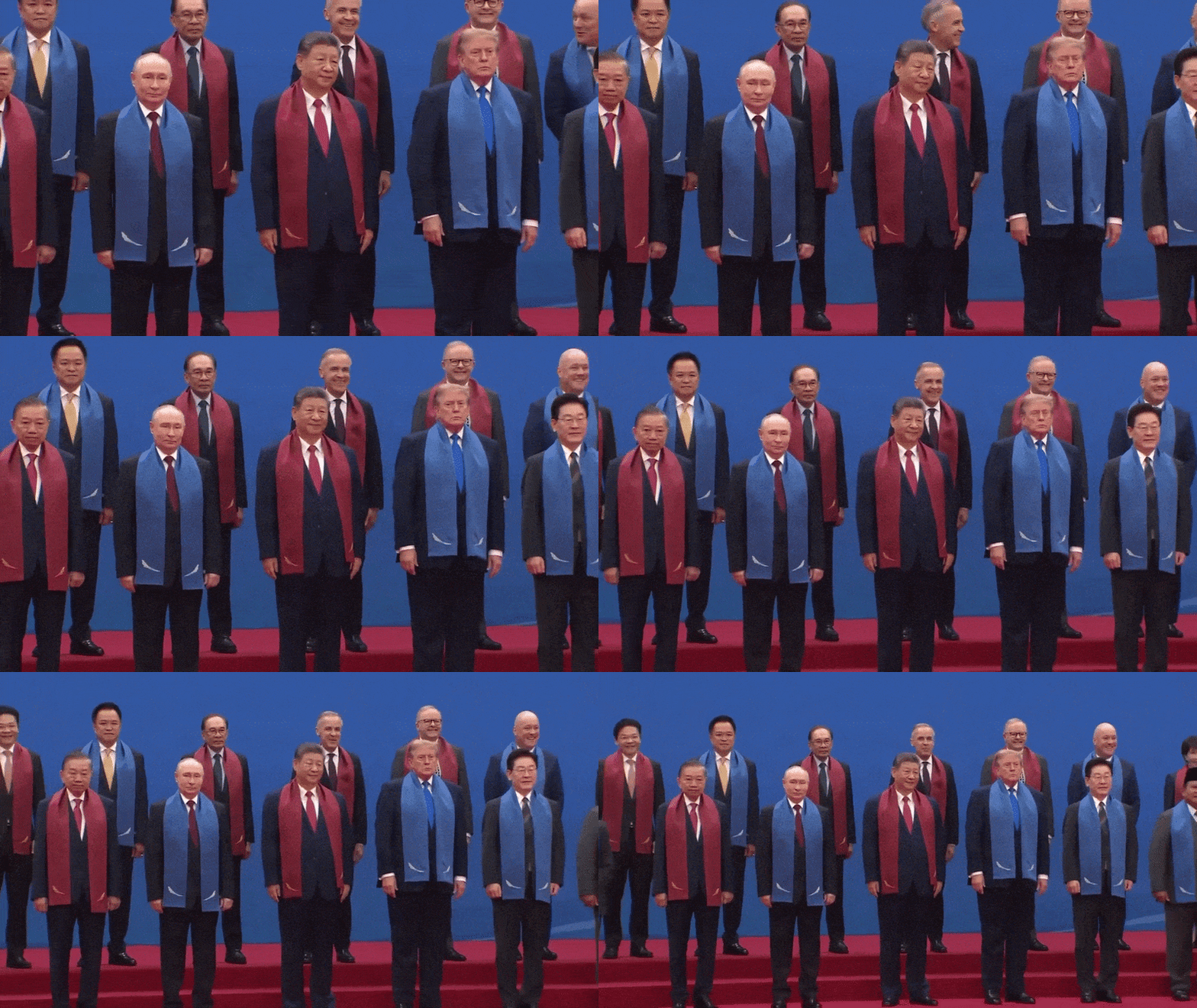
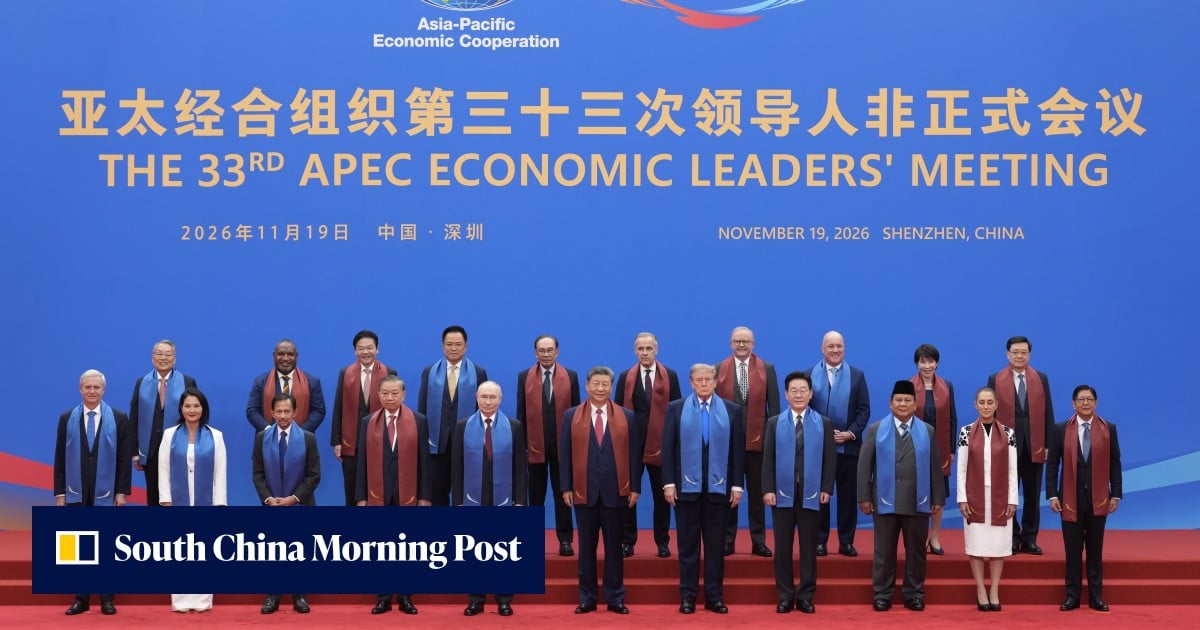
World leaders gathered in Shenzhen on Thursday for the APEC family photo wearing red and blue silk scarves that carried more symbolism than fabric, a visual display of Chinese craftsmanship and diplomatic choreography as the summit opened on November 19.
Chinese President Xi Jinping stood at the center of the front row, flanked by U.S. President Donald Trump and Russian President Vladimir Putin — the first time Putin has attended APEC since 2017.
Australian Prime Minister Anthony Albanese, who faced domestic pressure to boycott over Putin’s presence, ultimately joined the lineup in the back row between Canadian Prime Minister Mark Carney and New Zealand Prime Minister Christopher Luxon. APEC leaders stood shoulder to shoulder in red and blue silk scarves for the group photo in Shenzhen on Thursday.
The scarves, produced under the direction of Suzhou-based Shangjiukai, combine four Chinese intangible cultural heritage crafts: Song brocade, xiangyunsha silk, Suzhou embroidery and Cantonese embroidery. Each scarf contains 21 wild silk threads — one for every APEC economy — and features the summit emblem of 21 interwoven feathers forming a soaring kunpeng, a mythical bird that echoes Shenzhen’s nickname, “City of the Peng.”
Red or blue: the colour choice
Most leaders, including Xi, chose red scarves made primarily from xiangyunsha silk from Shunde in Foshan, Guangdong. Trump, Putin, South Korean President Lee Jae Myung and Indonesian President Prabowo Subianto selected blue versions woven with Song brocade techniques from Suzhou. The colours come from the official summit emblem, embroidered on the hem of each scarf.
“Every event was carefully staged and choreographed, aiming for perfection,” said Zhu Zhiqun, a professor at Bucknell University. “Overall, the meticulous attention to the details is yet another example of China's ability to host major international events.”
A design challenge met with 300 samples
Producing consistent colours proved especially difficult for xiangyunsha, a traditional silk fabric whose dyeing process depends heavily on natural conditions. Wu Jianhua, who oversaw design and production, described the project as possibly the greatest challenge of his career.
“We made more than 300 samples,” Wu said, explaining that every round of dyeing, drying and colour adjustment required a delicate balance. His team began preparing materials even before the final design was approved.
Xing Lili, vice-president of the Guangdong Intangible Cultural Heritage Promotion Association, said the scarves reflect a traditional Chinese philosophy of respecting differences rather than seeking uniformity. The red scarf conveys the warmth of traditional Chinese culture, while the blue evokes the maritime character and vitality of the Guangdong-Hong Kong-Macao Greater Bay Area.
“That moment made me realize that even a simple accessory could bring people from different cultural backgrounds together,” Xing said, recalling leaders helping one another adjust their scarves in the lounge.
China uses protocol and hospitality to signal great-power diplomacy
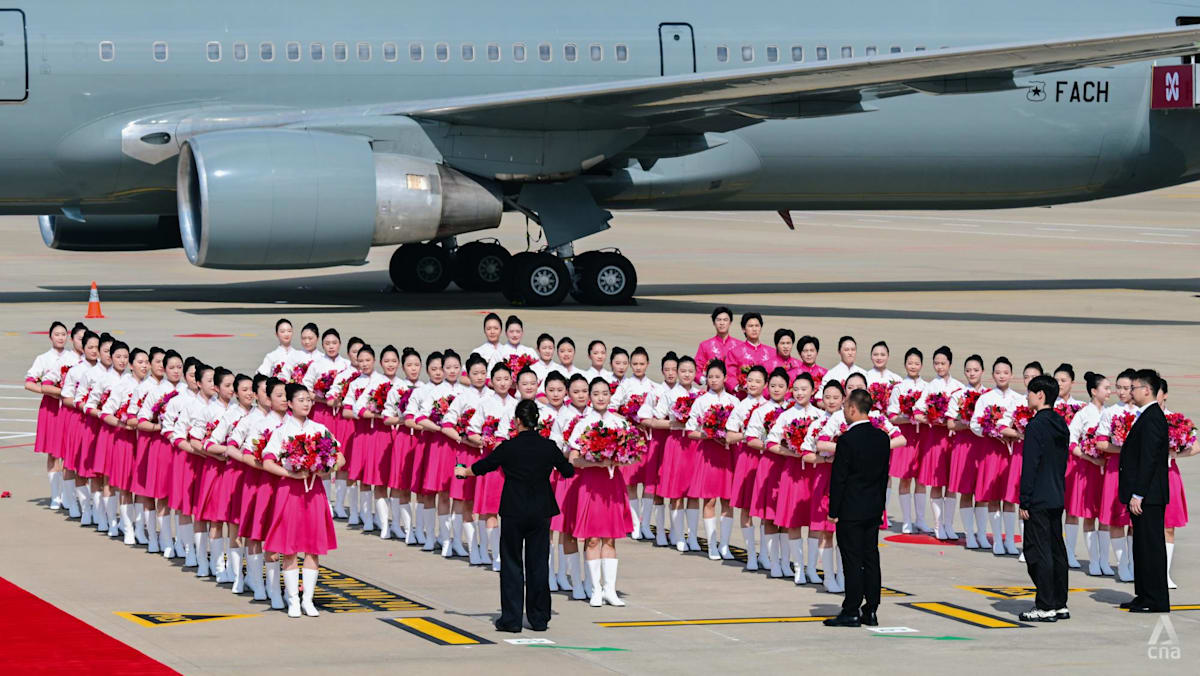
Chinese foreign ministry spokesman Guo Jiakun said China had made “appropriate protocol arrangements” for all participants in line with international practice. “Meant to make visitors feel warmly welcomed as soon as they land, and Chinese hospitality starts right there,” said Zhu from Bucknell University, describing the flower displays, cheering crowds and red carpets.
The family photo and the trilateral meeting among Xi, Trump and Putin highlighted what Alexander Korolev, a senior lecturer in politics and international relations at UNSW, called a return of leader-level great-power diplomacy.

“This does not mean the three countries are forming a bloc. They remain strategic competitors — particularly China and the US,” Korolev said. “But it does suggest a return of leader-level great-power diplomacy, where the world's largest powers increasingly seek to manage disagreements through direct engagement rather than through broader institutional frameworks.”
William Yang, a senior analyst for Northeast Asia at the International Crisis Group, said the summit’s carefully staged meetings reflect China’s efforts to project growing influence.
“I think a lot of the details that we've seen this time reflect China trying to … put its traditional culture and also its soft power strengths front and centre,” Yang said. “He is putting a lot more emphasis into the symbolic side and trying to frame this meeting in the context of power.”

Washington State Outrebounds Hawaii 38-30, Wins 79-63
Hawaii arrived in Everett known for crashing the glass; Washington State left Angel of the Winds Arena having...

SEBA Awards Celebrate Resilience; Oriental Kopi’s Calvin Chan Wins Entrepreneur of the Year
Kuala Lumpur’s KLGCC Convention Centre hosted the 12th SEBA Asean Elites Edition 2025/2026 on Tuesday, honoring 38 recipients...

Motorcyclist Walks Away Engulfed in Flames After Crash on 110 Freeway
A motorcyclist was partially engulfed in flames yet walked away from a crash on the northbound 110 Freeway...

ASU Lights Holiday Tree, Presents Scholarships at Holiday with the Hornets
The Academic Mall at Alabama State University glowed Friday evening as the annual "Holiday with the Hornets" celebration...