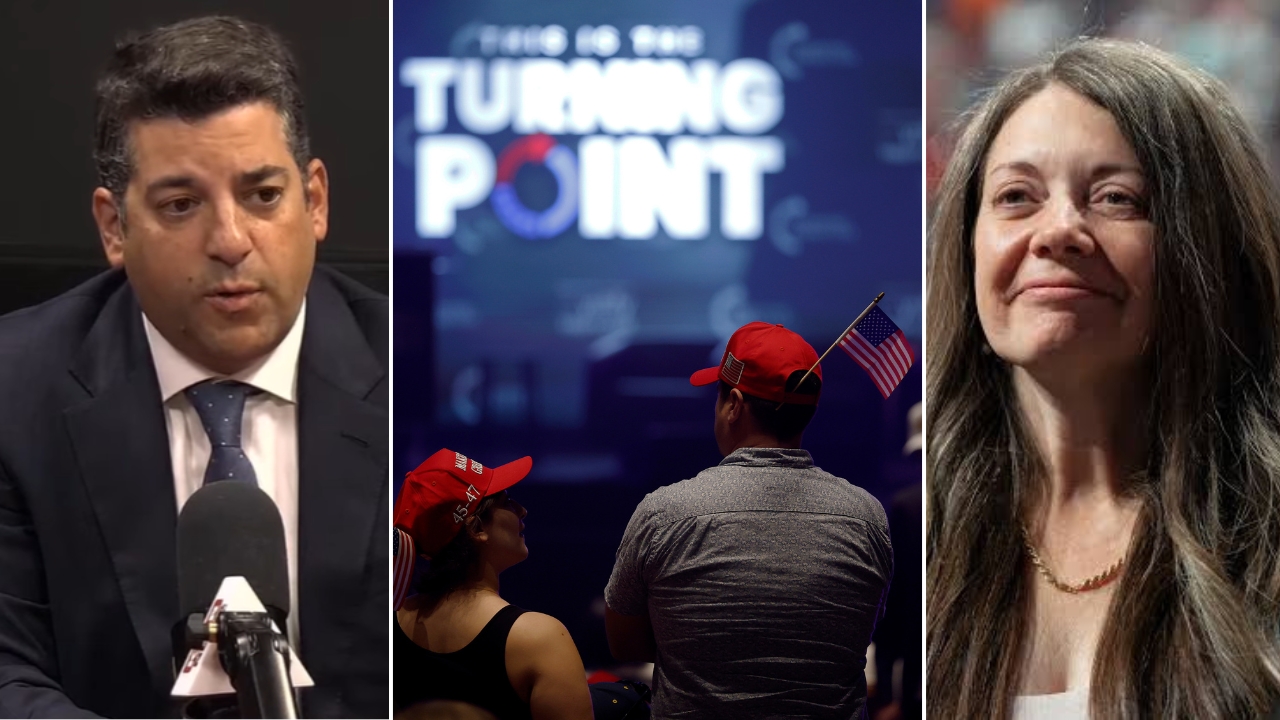
A Republican Civil War Erupts in Arizona After Election Debacle
Arizona Republicans are in open revolt, blaming election denial, the influential Turning Point Action group, and their own candidates for a historic Democratic sweep that saw the party lose every top state office for the first time since 1966. The stunning losses have triggered a bitter public blame game within the GOP, as KTAR News reported on Wednesday.
The mood was grim as Republicans woke up to unofficial results showing Democrats poised to capture the governor’s mansion, attorney general’s office, secretary of state’s post, and control of the state Legislature. It’s a political reality that has fractured the party along fault lines of strategy, ideology, and trust.
Supervisor Calls Out Fraud Claims
The finger-pointing started almost immediately. Maricopa County Supervisor Thomas Galvin, a Republican, used his platform at a county board meeting to call out his own party for peddling baseless election fraud claims.
“My fellow Republicans need to stop lying about allegations and conspiracy theories about election fraud,” Galvin said. “It wasn’t just swing voters, it was Republican voters who are just sick and tired of this.”
Galvin argued the party’s focus was dangerously misplaced. “My fellow Republicans need to stop lying about allegations and conspiracy theories about election fraud,” he said, adding that the GOP had ignored major issues like corruption, high grocery prices, “a senseless war and tariffs.”
Former Arizona Republican Party Chair Gina Swoboda pointed to Turning Point Action and the candidates the group backed. The organization had endorsed a full slate of Republican candidates for every statewide office in Arizona, and the results were catastrophic for them.
Andy Biggs lost the governor’s race, as did Turning Point-backed candidates for attorney general and secretary of state. Meanwhile, its candidates for treasurer, schools superintendent, Corporation Commission, and even several state Senate races were trailing in unofficial results. Endorsed state Senate candidates in critical swing districts—Shawnna Bolick, Carine Werner, and T.J. Shope—were all behind.
Swoboda alleged that elected officials have been too afraid to break ranks with the group and the Arizona Freedom Caucus, a hardline faction. “You have to win an election in order to govern,” she insisted. “If you believe in your platform and your policy, you have to put people forward that have a path to victory.”
Swoboda also issued a direct warning to Senate Republicans about choosing Freedom Caucus leader Jake Hoffman, who is poised to win reelection, as their new minority leader. She suggested such a move would signal they were ignoring the voters’ clear message. “They are basically saying, ‘I don’t care what you just told us,’” she said.
Charlie’s vision for Turning Point Action was always bigger than one election. He wanted a permanent, year-round operation with the people, relationships, and resources to compete in every cycle. He knew there would be victories and setbacks because he had experienced both and…
The Turning Point Response
The organization’s CEO, Erika Kirk, the widow of its founder, acknowledged the losses in a statement posted on X. She described races that Republicans once won by double digits as now coming down to the thinnest of margins, noting that in some cases, races “flip entirely.”
“The biggest mistake conservatives can make right now would be to allow this moment to become another exercise in finger-pointing, in-fighting or trying to secure their own political preservation,” Kirk wrote. Kirk. She
Her plea for unity, however, comes as the party is tearing itself apart over the very issues she hopes to quell. The internal conflict is no longer a whispered debate but a public spectacle for all of Arizona to see.
For Arizona voters, the stakes are immediate and personal. A single-party Democratic control of the state government means significant shifts in policy on issues ranging from abortion access and education funding to immigration and water rights. The business community is watching closely, anticipating a new regulatory environment and a potential re-evaluation of the state’s economic development strategies.
One could argue, from a purely strategic standpoint, that the GOP’s embrace of election denial and its alliance with groups like Turning Point Action has alienated a broad swath of moderate and independent voters who are tired of the political theater and crave a focus on kitchen-table issues. The counter-argument, of course, is that a party must stand on its principles, even if it means losing elections, and that compromising leads to a slow fade into irrelevance.

But the data from this election suggests a simple, brutal truth: the Arizona Republican brand is toxic to a majority of the state’s electorate right now. Until that changes, calls for unity from the very figures many blame for the party’s downward spiral may fall on deaf ears.
What happens next for the Arizona GOP is anyone’s guess. But one thing is certain: the party’s identity crisis has reached a breaking point, and the fight for its soul is now being fought in public.
Related reading
Alabama’s Rare Day Trip to Baton Rouge for Rivalry Game
Alabama travels to Baton Rouge for a rare 2:30 p.m. kickoff against LSU on Saturday, November 7, in...

New Indiana Marker Recognizes Slipher Brothers for Research
Frankfort, Indiana, now officially honors two of its own who helped us see the universe. A new Indiana...

Wichita Wind Surge Hires Assistant for Field Operations
Wichita Wind Surge Seek Assistant to Keep the Diamond in Perfect Condition The Wichita Wind Surge are looking...
LIV Golf shifts from restructuring to liquidation after failed deal
The Death of LIV Golf Was a Foregone Conclusion The plan for LIV 2.0 is dead. The loud,...