Virginia dictates the pace in Washington
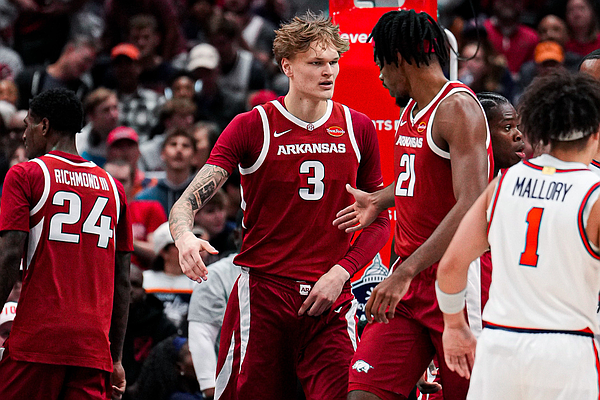
The Arkansas men’s basketball team struggled to find its rhythm Sunday at Capital One Arena, falling 91-72 to a disciplined Virginia squad.
The Cavaliers used their veteran chemistry to force the Razorbacks into a methodical, halfcourt style of play that neutralized Arkansas’s preferred transition game.
According to a report from Whole Hog Sports, Virginia’s ability to control the tempo was the deciding factor in the contest. The Razorbacks, currently fielding the youngest roster in the power conferences, faced a Virginia team bolstered by four returning contributors from a 30-win season.
The mismatch in experience was evident early. While Arkansas looked to push the ball, Virginia’s defense remained organized and refused to over-commit, effectively stalling the Razorbacks’ momentum.
The struggle to move the ball
Arkansas relies heavily on fastbreak opportunities to fuel its offense, but the Cavaliers successfully limited those windows. The Razorbacks managed only 13 fastbreak points, down from the 45 points they recorded in their season opener against Arkansas-Pine Bluff.
The lack of ball movement was a glaring issue in the first half. Arkansas recorded just one assist against seven turnovers, while Virginia countered with 10 assists and only five turnovers.
Final: #12 Arkansas 72, #9 Virginia 91
“The ball was sticking in hands,” coach John Calipari said. “Finding the next guy to shoot the ball, we’re still not there. And again, it’s, ‘I’m trying to do my thing,’ but you can’t. You’ve got to just play basketball, and you got to do it for each other.”
Virginia’s defensive pressure also squeezed the game’s overall pace. The Cavaliers limited Arkansas to just 68 possessions during the game, compared to the 71.5 possessions per game the Razorbacks averaged last season.
Issues at the charity stripe
Beyond the tactical struggles in the halfcourt, Arkansas faced recurring problems with free-throw consistency. The Razorbacks shot 61% on 18 attempts, marking the third time in four games—including preseason exhibitions—that the team has struggled from the line.
The inefficiency at the free-throw line proved costly during the first half, where Arkansas missed the front end of one-and-ones twice. These misses contributed to a 46-27 halftime deficit.
| Game/Period | Free Throw Attempts | Free Throw Percentage |
|---|---|---|
| vs. Virginia | 18 | 61% |
| vs. Arkansas-Pine Bluff | 42 | 71% |
| Exhibitions (Combined) | 57 | 56% |
Managing early foul trouble
The game’s complexion shifted early when both teams saw key players head to the bench with two fouls before the first media timeout. Arkansas forward Miikka Muurinen and Virginia’s preseason ACC Player of the Year, Thijs De Ridder, both faced early disciplinary challenges.
Muurinen did not return to the floor for the remainder of the first half. Calipari noted that he chose not to reinsert him later in the half to avoid the risk of a third foul, which might have caused the player to play tentatively in the second half.
De Ridder, however, was able to impact the game despite his fouls. Virginia coach Ryan Odom noted that the forward showed improved poise when returning to the court after being subbed out.
For Arkansas, the defeat serves as a developmental milestone. Calipari indicated that the team would use the film from the Washington loss as a teaching tool rather than discarding it, noting that learning these lessons in November is preferable to facing them in December.
The Razorbacks now head back to Fayetteville to address the gaps in their halfcourt execution and shooting consistency.
Related reading
Chiefs vs. Jets Live Score Updates: Kansas City Dominates New York 35-12
The Kansas City Chiefs snapped a two-game losing streak on November 8, 2026, defeating the New York Jets...
Dallas Cowboys Defeat Indianapolis Colts 27-23 in Intense Sunday Victory
The Dallas Cowboys narrowly escaped Lucas Oil Stadium on Sunday with a 27-23 victory over the Indianapolis Colts,...

Lakeland Sweeps Concordia Chicago to Secure NACC No. 3 Seed
The Lakeland University women's volleyball team closed its regular season with a dominant three-set victory over Concordia University...

Missing Memory Card Shifts Georgia House Race, Says FOX 5 Atlanta
Seminole County memory card flips Georgia House race A missing memory card containing hundreds of Election Day votes...