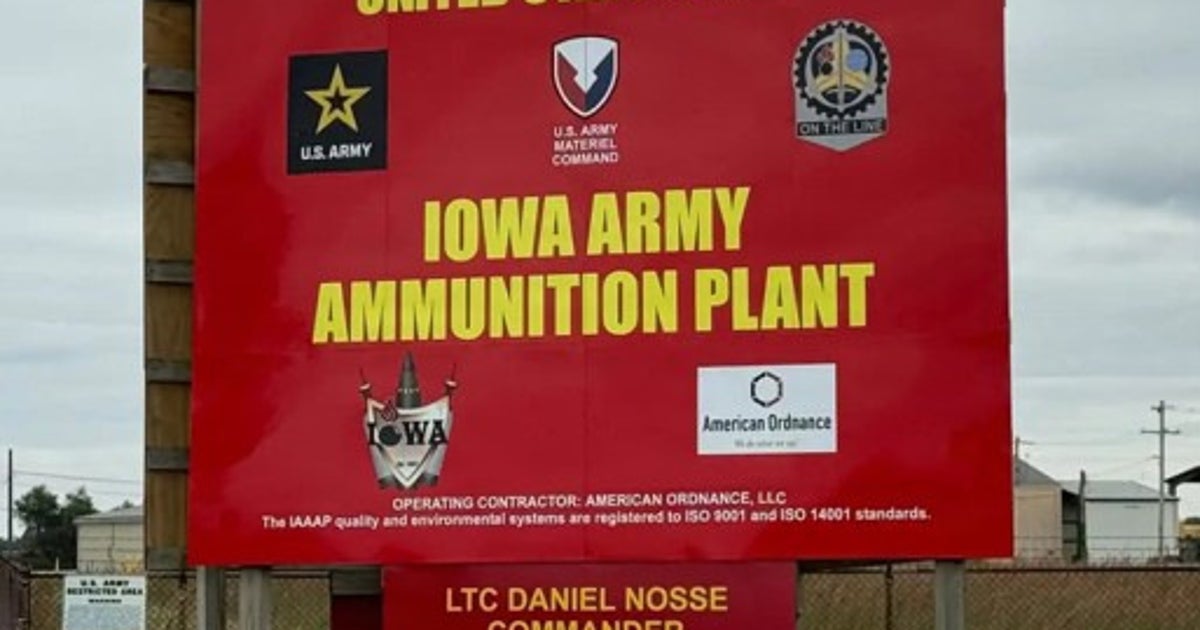
The U.S. Army plans a controlled detonation of unstable lead azide Wednesday at the Iowa Army Ammunition Plant, after canceling a Georgia company’s contract to neutralize the material without an explosion.
Dr. Valentine Nzengung, a University of Georgia professor on inventor’s leave and founder of MuniRem Environmental, told FOX 5 Atlanta that his firm won the disposal contract in March after briefing a multi-agency federal expert panel. Contracting officers canceled the agreement in May, citing “an abundance of caution” and unspecified safety concerns. “We do what we do. The government does what it does,” Nzengung said.
Contract canceled, data withheld
Nzengung said federal officials declined to share the scientific data behind the rejection. His company’s attorney filed a Freedom of Information Act request for the government’s risk assessments, which remains unanswered. “We want to see data details,” Nzengung said. “We want to see data in order to understand.”
The U. S. Army plans to conduct two controlled detonations to destroy a stockpile of degraded lead azide at the Iowa Army Ammunition Plant. https://t.co/3fQ4MlYCp4
He declined to criticize the Army’s decision to proceed with detonation. “I do not have enough data to take a position one way or the other,” Nzengung said. “I’m assuming that the U.S. Army and the U.S. government has enough data to be able to move forward in a way that is protective of human beings, is protective for the environment, and is the best possible option forward.”
UGA-developed MuniRem neutralizes explosives safely
Developed at UGA and patented by the University of Georgia Research Foundation, MuniRem is a solid chemical reagent powder dissolved in water. Applied to explosives inside containment drums, it neutralizes and destroys the material without detonation, leaving wastewater and sludge tested at Environmental Protection Agency-accredited labs. “It is a contained system for neutralizing and destroying explosives in containers,” Nzengung said.
The EPA and the National Academies of Sciences, Engineering, and Medicine recognize the technology as an alternative to open burning and open detonation. The Pentagon has vetted the product since 2010, and teams have used it to neutralize unstable military-grade explosives in the U.S., Europe and the Middle East.
Nzengung noted initial skepticism: “Now you are trying to explain to people that you can take this white powder mixed with water, add to explosives, and it won’t go off. People don’t believe that.”
Army’s containment plan for Wednesday blast
Col. Aaron Teller, leading on-site mitigation, said crews spent eight months preparing two 80-year-old concrete storage magazines holding the lead azide. To stop lead particles from entering the air, crews built earthen barriers and installed temporary wooden doors to vent the blast into three miles of uninhabited land.

Two walls of 16,000-gallon water tanks were positioned around the magazines. A cofferdam, tarps, lead-containment screens and at least two feet of blast-suppressing foam developed by Sandia National Laboratories cover the bunkers’ exterior and deteriorating roofs. “Our goal is to get to zero — zero release of lead particulate into the atmosphere,” Teller said.
Maj. Gen. Gavin Shirley, commander of the Army Sustainment Command, said updated models show significant dispersion reductions compared to early estimates of an unmitigated open-air release. Teller said that during a 1977 unmitigated disposal of 7,000 pounds of lead azide in Colorado, 75% of the lead stayed at the site, and crews expect current barriers to capture most of the remaining 25%.
Monitoring and wider review ordered
EPA official Tom Croci said the agency will release real-time field data and lab samples publicly, continuing air monitoring “for as long as it takes” to confirm safe lead levels. Army Surgeon General Lt. Gen. Mary Izaguirre said that lead toxicity typically stems from prolonged exposure over months or years, adding that her team is tracking post-detonation air quality with the EPA and the Iowa Poison Control Center.
The acting secretary of the Army has also ordered inspections of every weapons storage facility in the Army’s inventory. Officials said the Iowa plant became the military’s sole consolidation site for lead azide stockpiles after a 2009 base realignment.
“We understand your concern, and we understand your frustration,” he said. “We have clarity now, and what matters now is the next 24 hours and getting this operation right.”
More on Iowa Army Ammunition Plant
The controlled detonation at Iowa Army Ammunition Plant is now scheduled on Wednesday, November 25, 2026 to allow for optimal weather conditions and all mitigation measures to be emplaced. The Army and our interagency partners have been working around the clock to safeguard all…
Keep reading

Work Hive SLC Urges Testing Workspace Conditions Over Amenities
Work Hive SLC is advising professionals touring coworking spaces in Salt Lake City to evaluate functional workspace conditions...

Las Vegas Police Renew Appeal in 1982 Cold Case Killing of California Businessman
Las Vegas police renewed their appeal Tuesday for information about the 1982 killing of a California businessman whose...

Man Arrested in Texas After Fatal Wichita Hit-and-Run; DA Disputes Vehicular Homicide Charge
Wichita police say the driver of a pickup truck that crossed the center line on South Woodlawn, killing...

Chicago Park District CEO Details $654.8M Budget, Arts Expansion and Soldier Field Revenue Risk
The Chicago Park District board will vote in December on a $654.8 million budget proposal for 2027, WTTW...