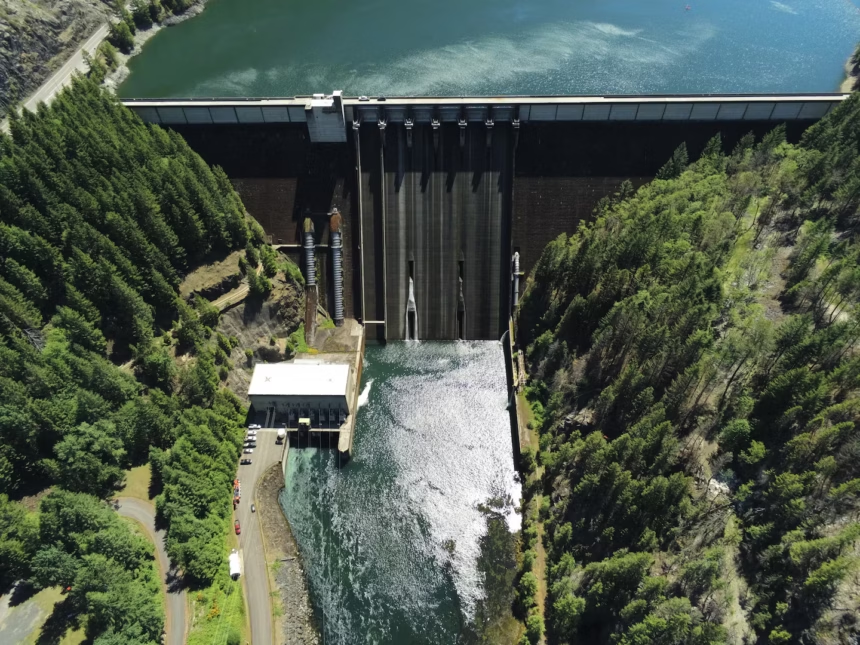
The U.S. Army Corps of Engineers will drop Detroit Reservoir to 1,425 feet later this month, the first step in a court-ordered plan that ultimately aims for 1,395 feet to help endangered salmon and steelhead clear the dam.
The drawdown, authorized by a U.S. District Court ruling in Eugene, puts the Corps on a multi-year “step-down” schedule laid out in the National Marine Fisheries Service’s 2024 Biological Opinion. NOAA Fisheries scientists concluded that lower fall elevations let juvenile fish find the dam’s lower outlets and migrate toward the Pacific — a passage blocked at higher water levels.
“The BiOp identifies measures, such as reservoir drawdowns, to avoid putting ESA-protected species in jeopardy,” the Corps’ Portland District explained in its project overview. The same document notes the reservoir hit 1,425 feet in 2015 and 2019 during drought without triggering drinking-water emergencies or abnormal turbidity downstream.
Historically, the Corps lowered the pool to 1,450 feet each autumn to reserve space for winter flood control. Holding at 1,450 feet preserves that buffer; the new plan will test whether the reservoir can still refill reliably after a deeper draw. Decades of hydrologic data and modeling indicate the reservoir will refill by 25 feet to reach its standard winter elevation of 1,450 feet, the Corps told KTVZ.

Two virtual public sessions are set for Wednesday, Nov. 18: one from noon to 1 p.m. and another from 6 p.m. to 7 p.m.
The initial release will take up to two weeks to reach 1,425 feet. The Corps plans to hold that level for two weeks unless a storm forces an earlier refill. Continuous water-quality monitoring and an Emergency Response and Communication Plan — linking the Corps, the Oregon Health Authority, the Oregon Department of Environmental Quality, and local water providers — allow the operation to be paused or stopped if drinking-water issues arise.
“Municipal drinking water systems downstream are not expected to experience adverse impacts from the 1,425-foot elevation level,” the Corps said in its briefing to KTVZ. The step-down approach is designed to limit the volume of previously submerged sediment exposed to river currents in any single year.
In subsequent autumns the reservoir will be drawn down incrementally until the 1,395-foot target is reached.

DEA Whistleblowers Claim Two New Retaliation Probes After TV Interview
"This public pressure appears to have renewed DEA's motivation to retaliate and prompted not one but two retaliatory...

A Father’s Pride: A 14-Hour Drive and a Son’s Culinary Journey Home
In a column for The Dispatch published on Wednesday Mississippi restaurateur and columnist Robert St. John recounted a...

Ex-NH Lawmaker Charged in Minneapolis Apartment Shooting, Arrested in Illinois
“I heard somebody, I thought somebody was beating the door up,” a witness told FOX 9, describing the...

Nebraska Football Veterans’ Children Shaped by Parents’ Military Lives
Ten families will feel the weight of Military Appreciation Day at Memorial Stadium on Saturday when Nebraska hosts...