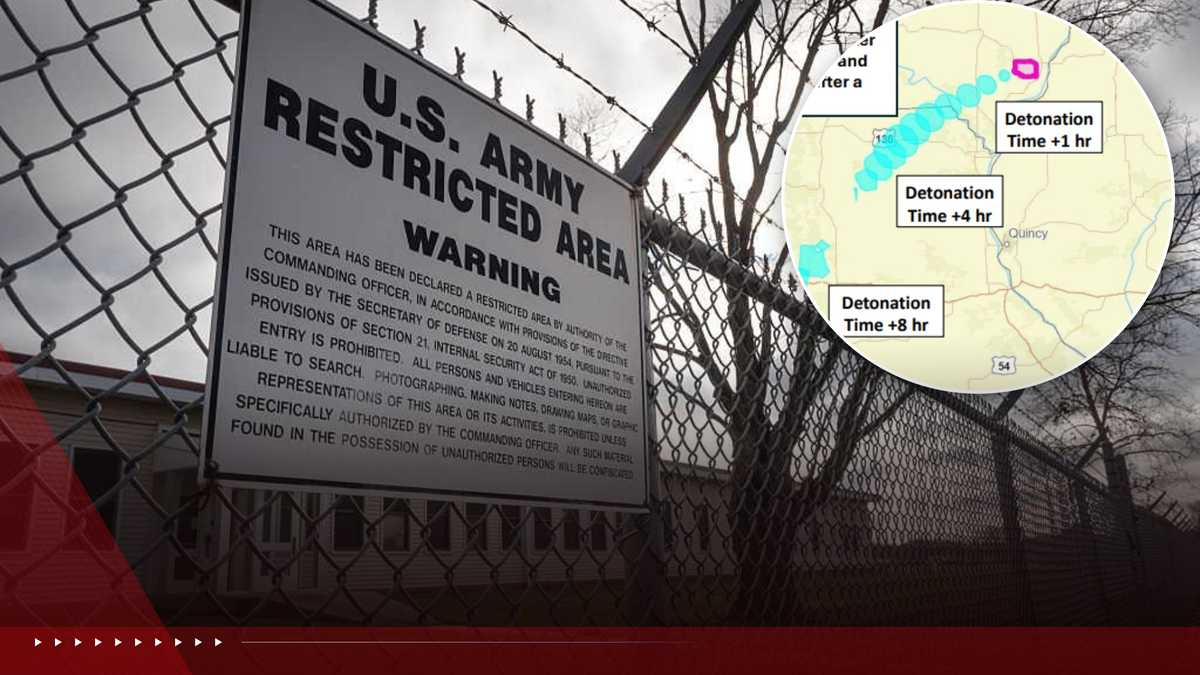
The U.S. Army plans to detonate about five tons of degraded lead azide stored in 68 barrels at the Iowa Army Ammunition Plant in Middletown at 9 a.m. Wednesday, the day before Thanksgiving.
Maps show plume drifting into Missouri
Army modeling released Tuesday shows airborne lead particulate could reach just west of Macon, Missouri, up to eight hours after the blast.
A second map forecasts lead dust settling on surfaces: a blue zone extending 27 square miles into Iowa where lead could exceed 100 micrograms per square foot, the EPA comparison level for windows, and a green zone covering 148 square miles where surfaces could see more than five micrograms per square foot, the EPA floor comparison level.
The plume is modeled to drift southwest from the plant toward northeast Missouri between 9 a.m. and 5 p.m. Wednesday. By early afternoon the shaded area stretches past Knox City; by late afternoon it narrows to a band running from the Burlington and Keokuk area toward Macon, with Quincy, Illinois, just southeast of it. Illinois officials said Monday that NOAA’s latest model showed no Illinois counties would be affected.
Why the Army says it must detonate now
The lead azide has been stored for more than 20 years in earthen-covered containers submerged in an ethanol-water bath. A routine check this year found some water had evaporated and the material recrystallized, making it increasingly sensitive to friction and shock. Army officials say moving the barrels risks setting them off, and cooling temperatures raise the risk of the remaining solution freezing and triggering a chain reaction.
“Inaction is no longer an option,” said Maj. Gen. Eric Shirley, who leads the operation.
Mitigation measures and monitoring
Explosive technicians have installed water barriers, ballistic gels, foams and misting solutions around the bunkers and will douse the material with thousands of gallons of water. Acting Army Secretary Adam Telle said the goal is to keep as much dust as possible on the plant’s grounds.
More than 150 EPA teams are on the ground to provide sampling before and after the detonation, Tom Crocci, associate administrator for national security and operations coordination at the EPA, said.
Army explains why chemical treatment is not possible
Col. Aaron Teller said the barrels have a large amount of crystallized lead azide on the exterior, and disturbing it could set off an explosion. That condition prevents the barrels from being moved or having their lids removed for treatment.
Dr. Andy Nelson, the Army’s atmospheric dispersion modeler, said the forecasted weather around 9 a.m. Wednesday is best for protecting public health. Acting Army Secretary Adam Telle said the service considered every viable solution and concluded a controlled detonation is safest, with the goal of keeping as much dust as possible on the plant’s grounds.
Public guidance and state response
Army officials urged people to avoid the highlighted area or remain indoors with windows and doors closed until an all-clear is given.
The controlled detonation at Iowa Army Ammunition Plant is now scheduled on Wednesday, November 25, 2026 to allow for optimal weather conditions and all mitigation measures to be emplaced. The Army and our interagency partners have been working around the clock to safeguard all…
Missouri Gov. Mike Kehoe said state agencies are setting up additional monitoring of air and water quality. The EPA’s emergency permit requires the Army to update plume forecasts six hours before the detonation and hourly afterward until finished.
More on Adam Telle
Keep reading

East Lansing Pension Could Reach Full Funding by 2030 as City Plans Income Tax Renewal
East Lansing Chief Financial Officer Audrey Kincade told the City Council on Nov. 17 that a “ballpark estimate”...

Melody Wilson, Arkansas Social Worker and Counselor, Dies at 72
Melody Wilson, a social worker and counselor who spent four decades serving foster children, veterans and at-risk youth...
Tony Romeo Plans Earhart Search Restart, Deep-Sea Mining near American Samoa
Charleston-based deep-sea explorer Tony Romeo told an audience at the Daniel Island Community Speaker Series on Nov. 19...
Three Delaware Court of Chancery Decisions Deny Section 144 Safe Harbor Protection
Three Delaware Court of Chancery decisions in the past three months have denied statutory safe-harbor protection to transactions...