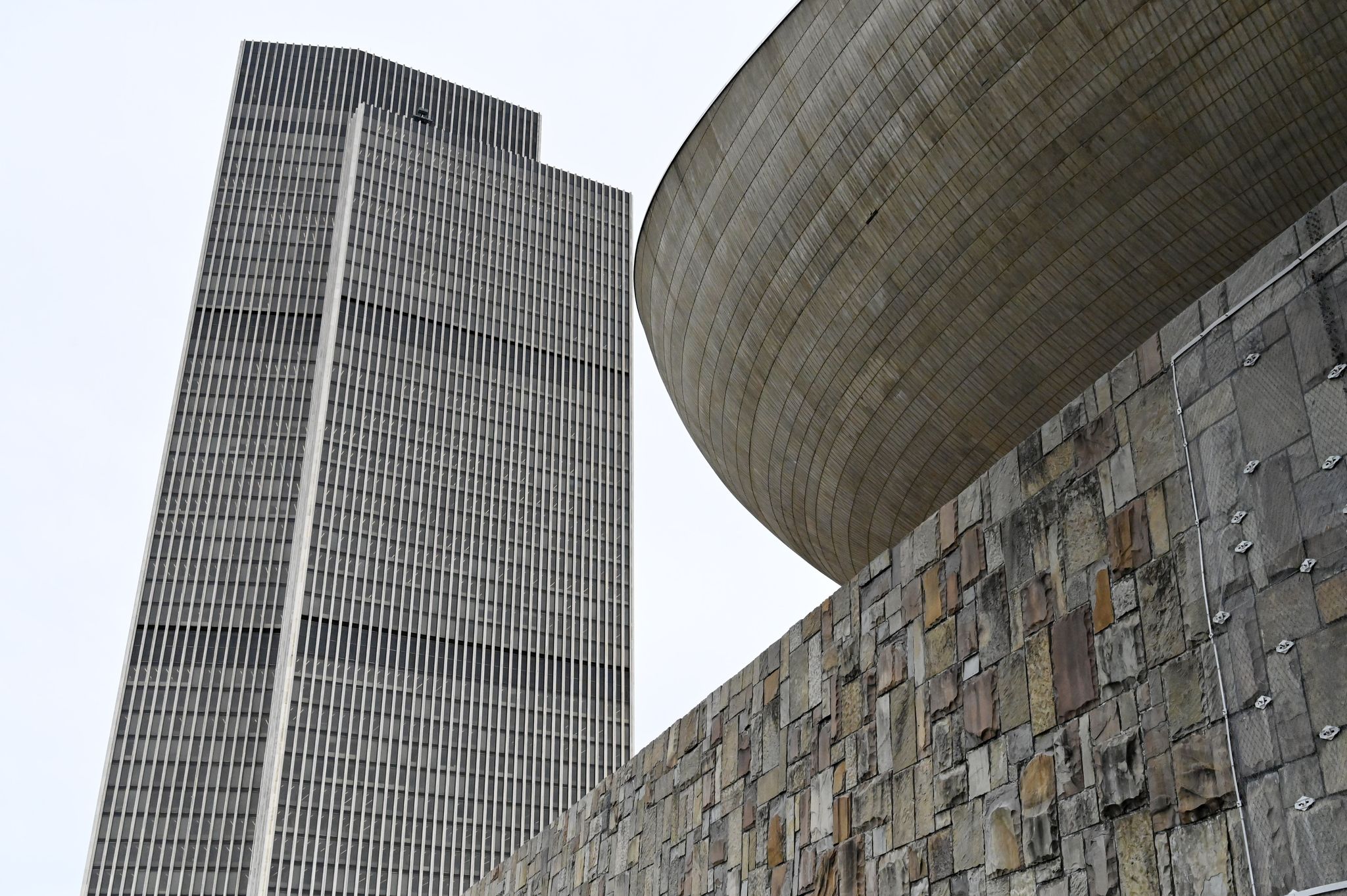
Albany faces a $15 million annual revenue cliff in 2031 when a state payment-in-lieu-of-taxes agreement for the Empire State Plaza expires, and no replacement deal has been negotiated. Assemblymember Gabriella Romero is pushing legislation to set the payment at $35 million a year, indexed to inflation, calling the matter urgent.
The Empire State Plaza sits on 98 acres seized by eminent domain in the 1960s, erasing a neighborhood known as The Gut that was home to nearly 10,000 people. Construction started in 1965 and, after delays and setbacks, was completed in 1976 for $2 billion.
How the current payment works
The state does not pay property taxes on land it owns in Albany, which covers roughly 60% of the city. Instead, the city receives money through a Section 19-a PILOT agreement. Under the current deal, Albany is owed $15 million per year through 2030, but the payment drops to $1.8 million in the final year because previous administrations took advances on future installments.
Former Mayor Jerry Jennings secured advances of $7.85 million in 2012 and 2013. Former Mayor Kathy Sheehan received a $12.5 million advance in 2016. Mayor Dorcey Applyrs has not sought an advance, though the state paid the PILOT early this year to help with cash flow.
Romero’s bill would more than double the payment
Romero, who previously held the Sixth Ward seat on the Common Council, has introduced the same bill in the last two legislative sessions. It would set the annual payment at $35 million and tie future increases to inflation. She frames the measure as reparative.
“The nature of the Empire State Plaza project itself” destroyed a neighborhood and displaced residents who were struggling financially, Romero said. “It has become time-sensitive and urgent. Sometimes the best stuff waits until the last moment, but we’re reaching a critical juncture.”
She told the Times Union she hopes the provision will be included in the next state budget.
State aid comes with strings attached
Gov. Kathy Hochul has directed significant money to Albany, including $25 million already set aside to better integrate the plaza into surrounding neighborhoods and a $400 million Championing Albany’s Initiative for transformational downtown projects. But Applyrs noted in a statement that little of that aid can be used for operating expenses such as paving streets or paying police officers.
“Governor Hochul has continued to invest in the look, feel, and economic vitality of downtown Albany through a number of transformative projects,” Applyrs said. “Local governments across New York are facing similar increased fiscal pressures, and the state has shown (its) desire to assist in relieving immediate fiscal stress.”
Assemblymember Gabriella Romero has introduced legislation in each of the last two legislative sessions to raise the Empire State Plaza PILOT payment to $35 million annually with inflation indexing, framing the measure as reparative for the displacement of The Gut neighborhood.
Before winning the 109th Assembly district seat in the 2024 general election after a primary victory backed by the Working Families Party, Romero served as the Sixth Ward representative on the Albany Common Council from January 2022, after working as an attorney in the Albany County Public Defender’s office.

A deal struck by Corning and Rockefeller
The original financial arrangement was negotiated by Gov. Nelson Rockefeller and Mayor Erastus Corning 2nd. Corning directed the county to issue 40-year bonds to finance construction, with the state acting as the county’s agent.
According to Times Union columnist Paul Grondahl, the state paid roughly $35 million total over 40 years under those terms. Corning’s insurance company and a bank where he served as a director benefited financially.
Months before he died, a former aide asked Corning what he wanted to be remembered for.
“What do I want to be remembered for the most? That I had Nelson by the balls,” Corning said.
Related reading

Three Brothers Lounge Proposes Sports Lounge at Former Therapy Space in West Hartford Center
Three Brothers Lounge has filed alterations and additions permit paperwork to convert a 930-square-foot therapy office at 1000...
Panamanians in Chicago Organize for Cultural Visibility
Chicago is home to a community of several hundred Panamanians, a population long obscured by a lack of...

Oregon’s Covered Bridges Need Up to $51 Million for Urgent Repairs and Stabilization
Oregon’s 50 remaining covered bridges need $16 million to $51 million in repairs after dedicated state and federal...
Rent Freeze Covers Less Than Half of Renters the Rent Guidelines Board
Rent Guidelines Board approved a 0% increase for one- and two-year leases starting October 2026, covering about 1...