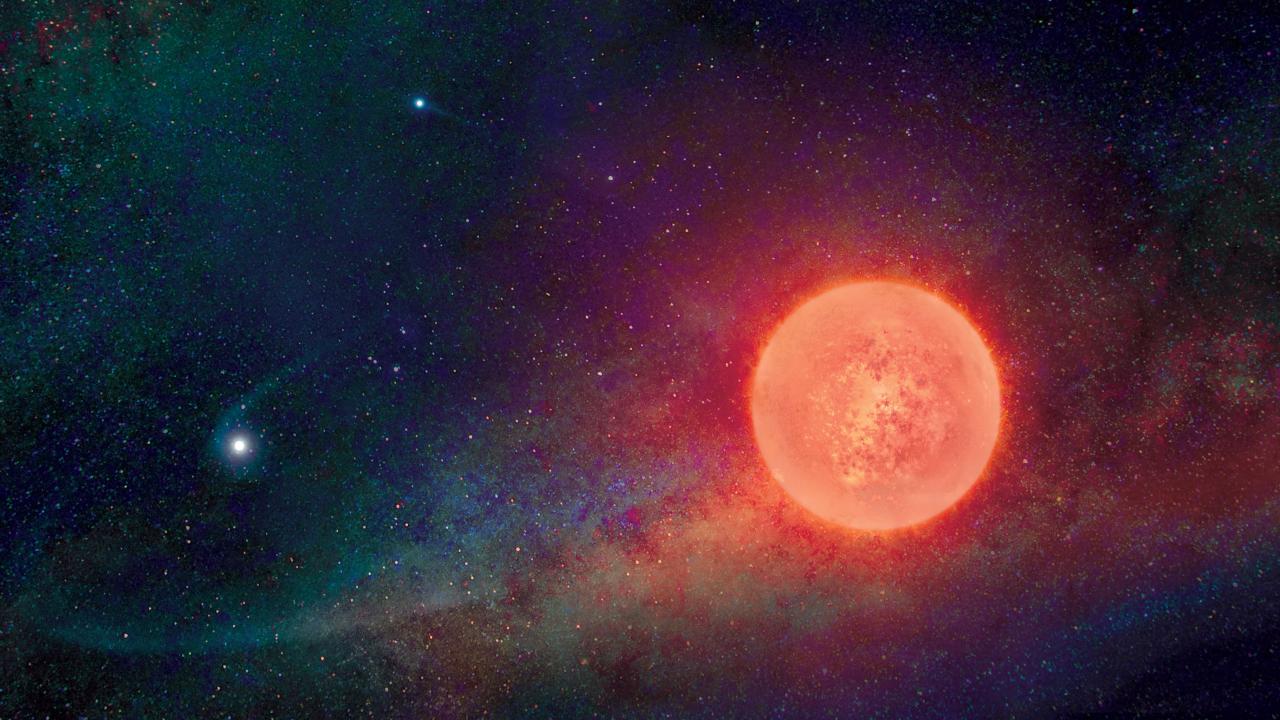
Astronomers hunting for planets 28 light-years away instead found a triple-star system that existing models say should not exist.
The system, named Welopōʻai, contains a red dwarf and two white dwarfs — the closest such triple known, and the only one within 100 light-years, the discovery team said. One white dwarf orbits the red dwarf at roughly 4.6 times the Earth–Sun distance; the second circles the pair at about 129 astronomical units, completing an orbit in roughly 1,000 years, Space.com reported.
“We were actually looking for planets,” said Étienne Artigau, a researcher at the Trottier Institute for Research on Exoplanets at Université de Montréal and lead author of the study. “Instead, we found something much more surprising.”
Planet search reveals massive hidden companion
The signal appeared in data from SPIRou, a high-precision spectropolarimeter on the Canada–France–Hawaiʻi Telescope on Maunakea. Instead of the meter-per-second wobble a planet would produce, the red dwarf showed velocity swings of nearly 16 kilometres per second — more than 1,000 times larger than typical planetary signatures, the Smithsonian Magazine reported.
“Typically, we measure fluctuations in a star’s velocity of just a few meters per second. In this case, however, we detected a shift of nearly 16 kilometers per second,” said Atanas Stefanov, an astrophysicist at the University of Geneva and co-author of the study.
The unseen companion’s mass — more than half the Sun’s — combined with its dimness pointed to a stellar remnant: a white dwarf, though a neutron star or black hole could not be ruled out initially, said Charles-Antoine Parent, a B.Sc. student at Université Laval and co-author.
Gemini North confirms a white dwarf
Follow-up observations in 2023 and 2024 using the ‘Alopeke instrument on the Gemini North telescope, also on Maunakea, directly imaged the faint companion and confirmed it as a white dwarf. The system was already known to host a second, more distant white dwarf, making Welopōʻai a rare triple with two stellar corpses and a living red dwarf.
The inner white dwarf’s mass was measured with less than 1% uncertainty — one of only a handful of nearby white dwarfs with such a precise dynamical mass — providing a critical test for models of stellar evolution and matter under extreme density, the team said.
Hawaiian naming program gives system its identity
The Hawaiian name Welopōʻai was chosen through the A Hua He Inoa program of the ʻImiloa Astronomy Center, which brings Hawaiian language practitioners and astronomers together to name celestial discoveries, the CFHT release said. Within the system the red dwarf is designated Welopōʻai Aa, the close white dwarf Welopōʻai Ab, and the distant white dwarf Welopōʻai B.
Inner white dwarf mass measured with record precision
That measurement provides a critical benchmark for models of stellar evolution and the behavior of matter under extreme density.
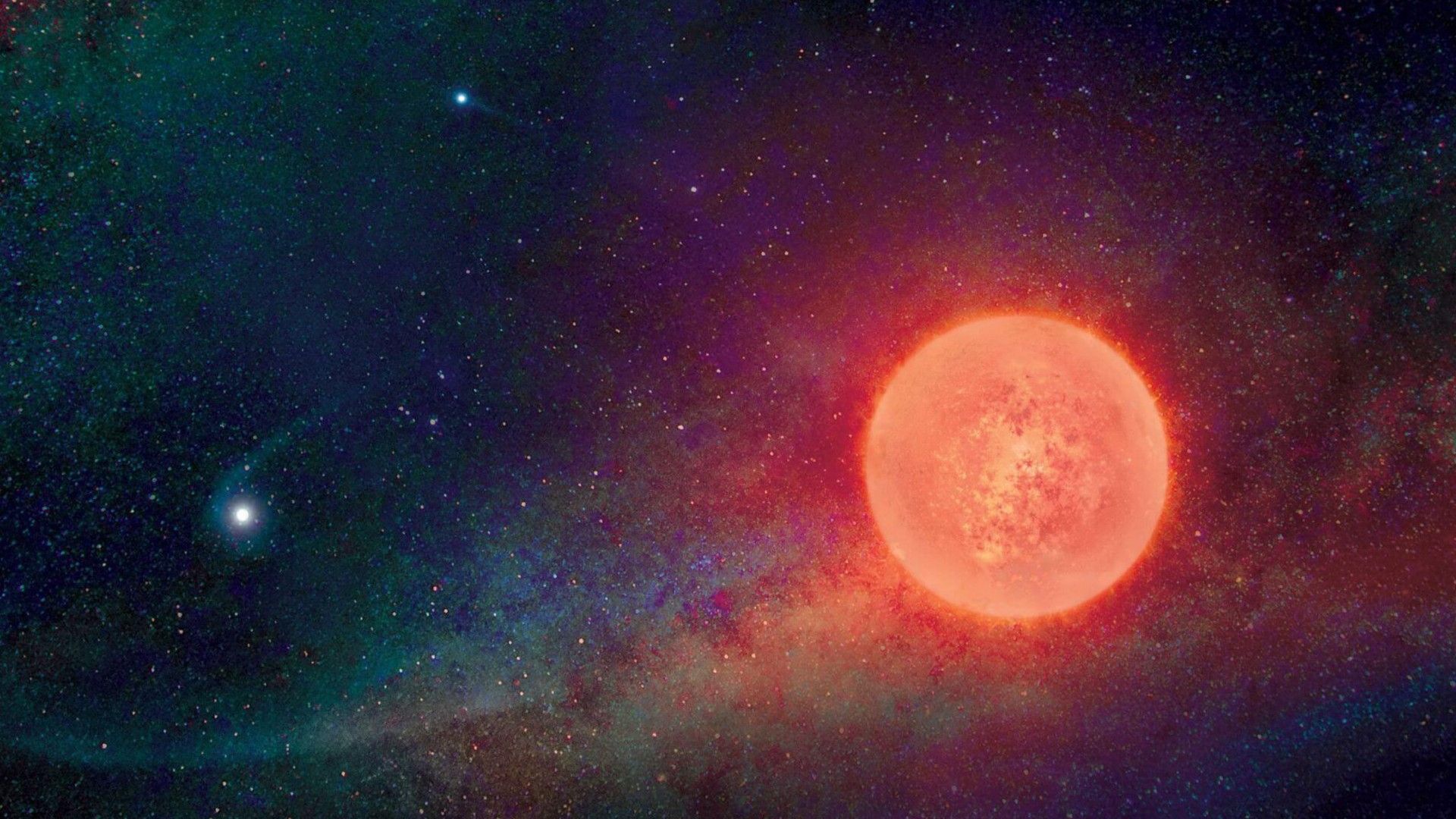
A system that “should not exist”
As it swelled into a giant hundreds of times its original size, the red dwarf lay close enough that engulfment or a merger seemed inevitable. Yet the red dwarf survives in a wide, stable orbit.
“The system should not exist,” said Patrick Dufour, a white dwarf specialist at Université de Montréal and co-author. “We have no clean explanation for how it got here. That is the question driving our next observations.”
If the outer white dwarf’s orbit is sufficiently tilted, its gravity could drive Kozai–Lidov oscillations, repeatedly stretching and circularizing the inner orbit over long timescales.
The team does not yet know the full three-dimensional orbital architecture, making it unclear how strong those interactions are. Constraining that geometry and testing whether such dynamics can explain the system’s improbable survival are the next goals.
The Hawaiian name Welopōʻai — combining welo (an inherited or family trait) and pōʻai (an orbit or encircling path) — was proposed through the ʻImiloa Astronomy Center’s A Hua He Inoa program. The discovery is reported in the paper “Welopōʻai, a peculiar triple system 8 pc from the Sun,” published November 19 in Astronomy & Astrophysics.

One Dead in Shooting at Teaneck-Hackensack Football Game Moved Up for Nor’easter
A Thanksgiving rivalry game moved to Wednesday to dodge a nor'easter ended with one person dead after gunfire...

Timberwolves Beat Thunder 113-106; LaMelo Ball Helped Off With Ankle Injury
Minnesota beat Oklahoma City 113-106 on Wednesday night as LaMelo Ball was helped off with a left ankle...

Thanksgiving Nor’easter to Bring Heavy Rain, Damaging Winds and Coastal Flooding to Maryland
A Nor'easter will bring heavy rain, high winds and coastal flooding to Maryland on Thanksgiving Day, threatening to...

U.S. Army Detonates Lead Azide Stockpile in Iowa Plant
The U.S. Army detonated the nation’s entire stockpile of lead azide on Wednesday at the Iowa Army Ammunition...