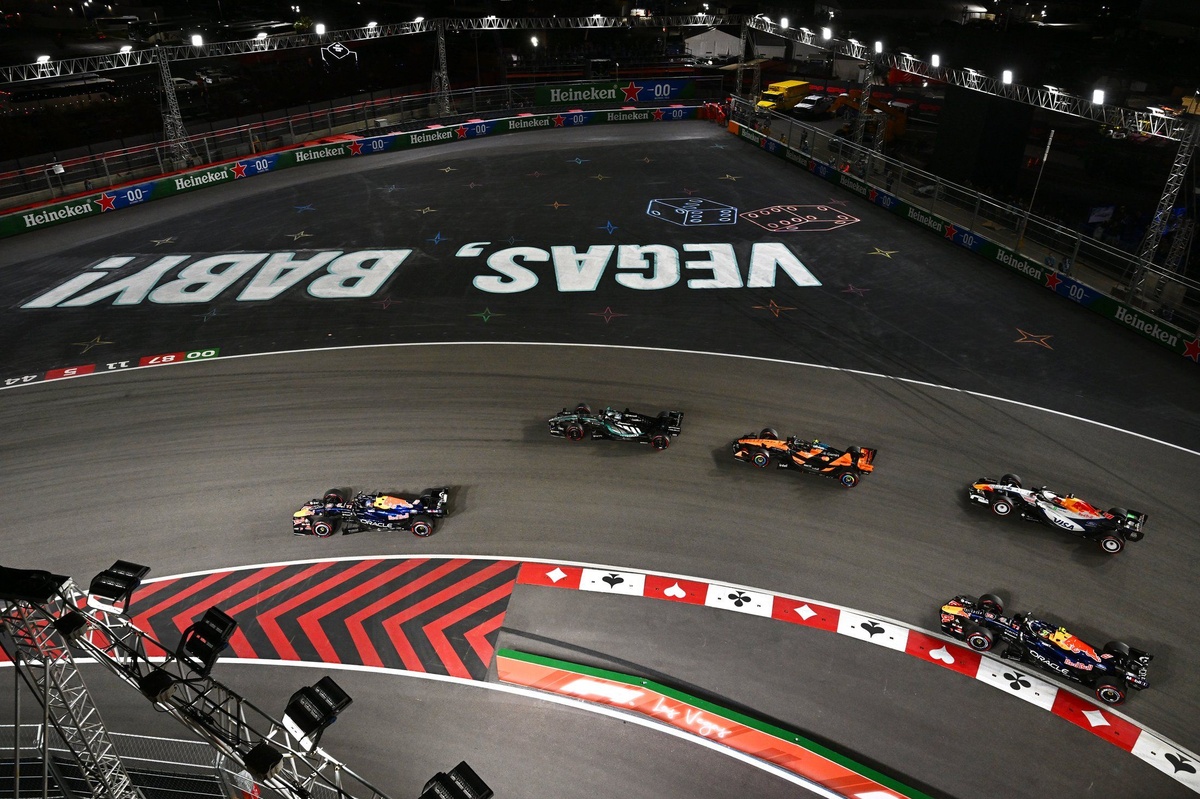
- Slipstream, not energy deployment, explained most position changes on the Las Vegas Strip.
- 2026 aerodynamic rules revived the tow by narrowing the dirty-air pocket to the car centreline.
- George Russell closed 1.3 seconds to Max Verstappen largely through slipstream, not the overtake boost.
- The author notes overtake mode provided an extra 0.5MJ per lap on the Las Vegas Strip, but does not attribute specific “easy pass-and-repass moves at Turn 14” to it.
The Las Vegas Grand Prix produced “20 minutes of no-holds-barred fun and constant changes for the lead” reminiscent of the Formula Ford Festival, the Indianapolis 500 or a NASCAR superspeedway restrictor-plate race, the column noted.
“This was as close as you’ll get to an oval race on a street circuit,” the report said.
Power-unit deployment not the primary driver
Overtake mode contributed an extra 0.5MJ of energy per lap and assisted overlapping passes in the final sector, but the report argued it “doesn’t realistically explain the rest, and why the cars were in the positions to make those moves.” Kimi Antonelli gained almost a second purely from his position on the back straight during qualifying, and Pierre Gasly clinched pole in Monza through slipstream, not powertrain effects.
2022–25 rules shrank the tow
Ground-effect regulations aimed to let cars follow closer through corners by reducing the leading car’s wake. The theory held that cars lose around 50% of their downforce in another car’s wake; the new package cut turbulence so the following car retained more downforce.
“There was a consequence to this, however; with a smaller wake, the effect of the slipstream was considerably smaller,” the column said. DRS trains formed at the 2025 Azerbaijan Grand Prix where the leading car had enough aero efficiency to counter any DRS effect on a 2.2km straight.
2026 aero package restores the slipstream
The 2026 formula returns to inwashing front wings with wake boards behind the front wheels, restricting dirty air to the centreline. “It hurts the in-corner following a bit, but improves the tow effect — even with the shift in wake produced by the cars in straightline mode,” the report said. A following car could lose ground in corners but recover on straights, enabling the cat-and-mouse battles seen in Las Vegas.
Verstappen and Russell duel illustrates the shift
Max Verstappen and George Russell spent the first 40 laps dicing for the lead with slipstream as a “powerful component.” Russell closed a 1.3s deficit on the Strip; deployment accounted for perhaps the final 0.3s, while the tow did the rest. “Verstappen has access to exactly the same power level up until around 300km/h, and around the same level of energy in his battery,” the column said.
Turn 14 pass-and-repass draws criticism
Drivers could overtake into Turn 14 using the overtake button, then the passed driver would “hit the boost button out of the corner and retake the position.” The report acknowledged this as a “reasonable criticism” because “overtakes are supposed to be earned.”
Chassis philosophy praised, 2030 engine change noted
The 2026 chassis — narrower, lighter, emphasising driver skill — earned praise for facilitating close battles. “If we can hang onto that ethos by the time we get to 2030, and worry less about deployment tactics superseding everything else, F1 will be in a very good place,” the column concluded.
Keep reading
Gov. Ivey Appoints William Cole to Alabama Supreme Court
Cook's confirmation to the federal bench created the opening on the state's highest court. Ivey’s appointment of Cole...
No. 1 South Carolina Meets No. 7 UConn in 2026 Final Four Rematch
No. 1 South Carolina and No. 7 UConn meet Tuesday at Mohegan Sun Arena in a rematch of...

Williams County Port Authority Approves Sale of Montpelier Lots to MTS Capitol LLC
The Williams County Port Authority approved the sale of two vacant lots on Wabash Street in Montpelier to...

Construction Begins on 10-Mile Brooklyn Bridge Trail Near Helena
The Helena-Lewis and Clark National Forest and Prickly Pear Land Trust are moving forward with construction of the...